
10 Crazy Concepts by Lamborghini

From a V12-powered minivan and a military off-roader to experimental electric supercars, these 10 Lamborghini concepts show just how far the Italian manufacturer has been willing to push automotive design.

Lamborghini has never been particularly interested in playing it safe. Since its founding in 1963, the Italian manufacturer has built some of the most recognizable and unconventional cars in automotive history. But its production models only tell part of the story.
Over the decades, Lamborghini and its design partners have experimented with glass-bodied grand tourers, military vehicles, family minivans, and single-seat supercars. Some concepts influenced future production models, while others remained one-off experiments.
Here are 10 of Lamborghini's craziest concepts, from 1967 to 2025.
1
1967 Lamborghini Marzal Concept

The 1967 Lamborghini Marzal was Bertone's attempt to create a practical four-seat Lamborghini without sacrificing the dramatic styling of the Miura. Designed by Marcello Gandini, the Marzal featured enormous glass gullwing doors, a glass roof, silver leather seats, and a remarkably open passenger compartment. Its angular body contrasted sharply with the curved styling of Lamborghini's existing models.
Power came from a 2.0-liter inline-six producing approximately 175 horsepower. The engine was essentially one half of Lamborghini's 4.0-liter V12 and was mounted transversely behind the rear seats. The Marzal remained a one-off, but its proportions and four-seat layout helped shape the production Lamborghini Espada, introduced in 1968.
2
1977 Lamborghini Cheetah Concept
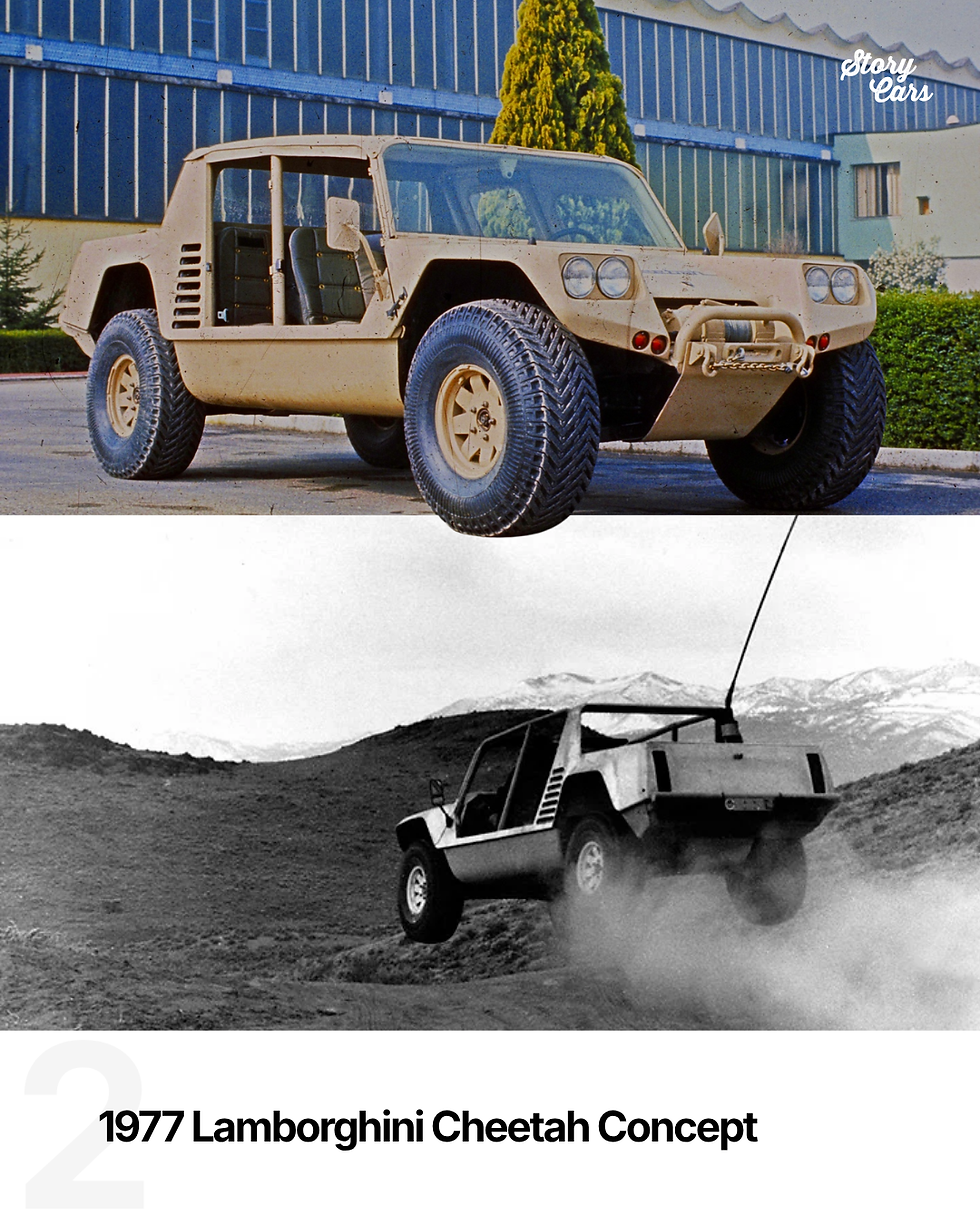
Long before the Urus, Lamborghini experimented with a military off-road vehicle. Developed with the American company Mobility Technology International, the 1977 Cheetah was designed as a potential military transport vehicle. Its fiberglass body, four-wheel-drive system, large off-road tires, and open cabin were a complete departure from Lamborghini's sports cars.
The Cheetah used a rear-mounted 5.9-liter Chrysler V8 producing approximately 180 horsepower, connected to a three-speed automatic transmission. Unfortunately, that was not enough power for a vehicle weighing roughly 4,500 pounds. The rear-heavy weight distribution also created handling problems. The military project failed, but Lamborghini continued experimenting with off-road vehicles, eventually introducing the V12-powered LM002 in 1986.
3
1980 Lamborghini Athon Concept

Unveiled at the 1980 Turin Motor Show, the Lamborghini Athon was a wedge-shaped, open-top sports car designed by Marc Deschamps at Bertone. Built using Lamborghini Silhouette mechanical components, the Athon had a sharply pointed nose, concealed headlights, an unusually low windshield, and a completely open cockpit. The interior featured digital instrumentation and a minimalist dashboard that looked years ahead of its time.
Behind the seats was a naturally aspirated 3.0-liter V8 producing approximately 260 horsepower, paired with a five-speed manual transmission. Unlike many static design studies, the Athon was a fully functional vehicle. It arrived during a period of serious financial difficulty for Lamborghini, so production was never realistic. Only one example was built, and it later sold at auction in 2011.
4
1988 Lamborghini Genesis Concept

A Lamborghini minivan sounds like a joke, but Bertone actually built one in 1988. The Genesis was a five-seat concept with front gullwing doors, sliding rear doors, and a spacious cabin designed around the mechanical components of a supercar. Bertone spent approximately 30,000 hours developing the prototype before unveiling it at the Turin Motor Show.
Under its long hood sat the Countach Quattrovalvole's 5.2-liter V12, producing approximately 455 horsepower. Unlike the Countach, the Genesis used a front-engine, rear-wheel-drive layout and a Chrysler three-speed automatic transmission. Its roughly 4,000-pound weight limited performance, but the engineering was real. The Genesis demonstrated that Lamborghini power could work in a completely different vehicle category, even if the concept was never intended for mass production.
5
1996 Lamborghini Zagato Raptor Concept

The 1996 Zagato Raptor combined the mechanical components of the Diablo VT with a radically different carbon-fiber body. Designed by Norihiko Harada at Zagato, the Raptor made its debut at the Geneva Motor Show with a streamlined shape, rounded headlights, and an unusual canopy system. Instead of conventional doors, the windshield, roof, and side sections tilted forward together to reveal the cabin.
Beneath the lightweight body was Lamborghini's 5.7-liter V12, connected to a manual transmission and all-wheel-drive system derived from the Diablo VT. The removable roof section also allowed the Raptor to function as an open-top sports car. Unlike a static show model, the Raptor was fully operational. Despite interest in the design, it remained a single prototype as Lamborghini continued developing its existing Diablo range.
6
1998 Lamborghini Pregunta Concept

Developed by French coachbuilder Heuliez, the 1998 Lamborghini Pregunta was one of the final experimental designs based on the Diablo platform. Inspired by military aviation, particularly the Dassault Rafale fighter jet, the Pregunta featured a wide, rounded windshield, removable roof panels, enormous side air intakes, and a cockpit filled with advanced electronics.
The car retained a 5.7-liter Lamborghini V12 producing approximately 530 horsepower, paired with a five-speed manual transmission and rear-wheel drive. Its technology was particularly ambitious for 1998, including rearview cameras instead of conventional mirrors, GPS navigation, fiber-optic interior lighting, and a Formula One-inspired digital instrument cluster. Heuliez built one functioning example, which debuted at the Paris Motor Show but never entered production.
7
2005 Lamborghini Concept S
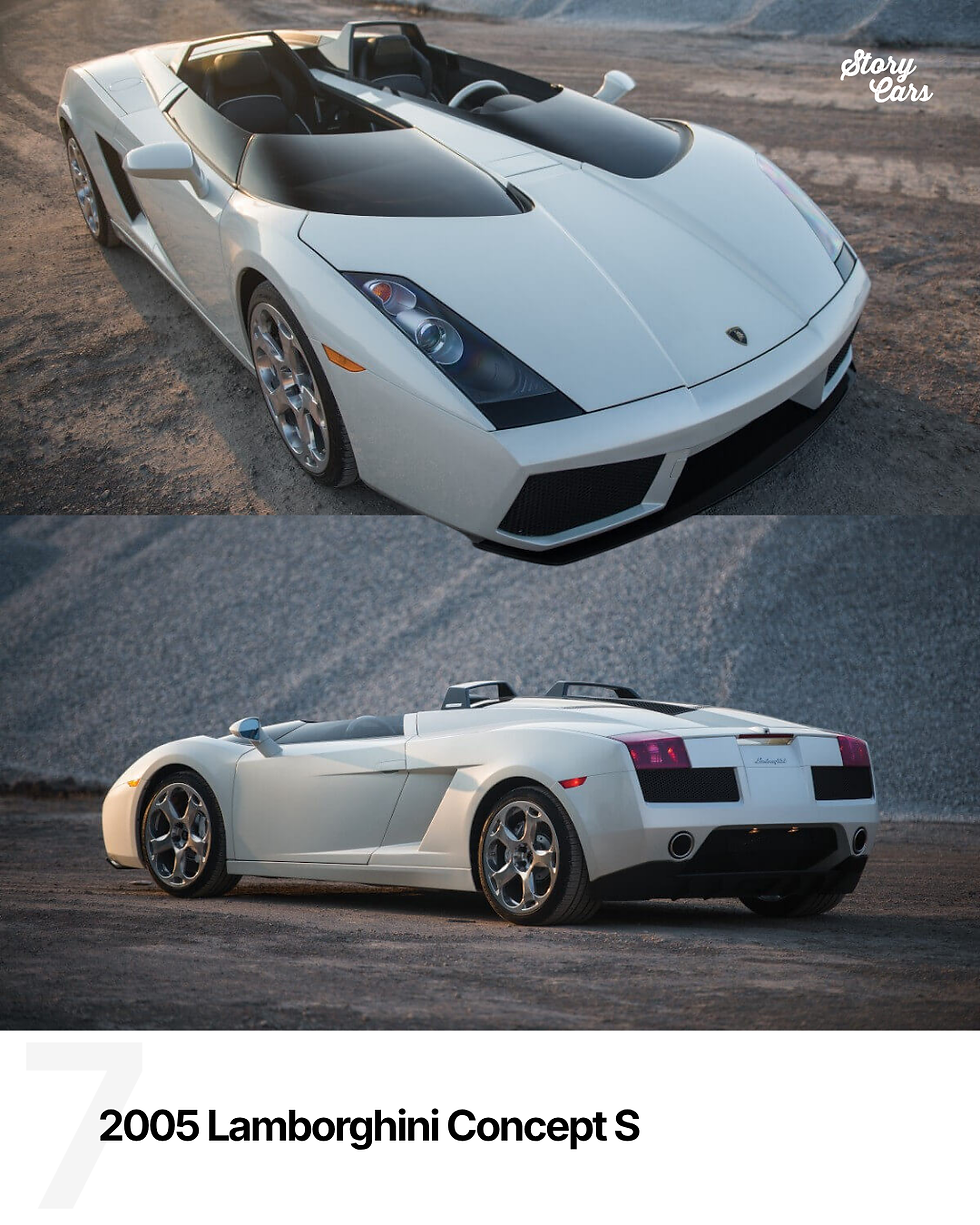
The 2005 Lamborghini Concept S started with a straightforward idea: what if the Gallardo had no roof, no conventional windshield, and two completely separate cockpits? Designed under Luc Donckerwolke, the Concept S divided the driver and passenger with a raised central body section. Each occupant had a small individual wind deflector, creating one of Lamborghini's most distinctive open-top designs.
The original 2005 Geneva Motor Show concept was a non-running design study, but Lamborghini subsequently built a functioning prototype using Gallardo mechanical components. That car featured a 5.0-liter V10 producing approximately 520 horsepower, all-wheel drive, and an E-Gear automated manual transmission. Lamborghini initially planned to build 100 examples, but high production costs ultimately ended those plans. Only one fully operational Concept S was completed.
8
2013 Lamborghini Egoista Concept

Created to celebrate Lamborghini's 50th anniversary, the 2013 Egoista took the company's reputation for outrageous design to another level. Designed under Walter de Silva, the Egoista was a single-seat supercar inspired by the Boeing AH-64 Apache helicopter. Its angular body surrounded an enclosed central cockpit, with dramatic lighting elements and separate aerodynamic structures along either side.
The Egoista used a 5.2-liter V10 derived from the Gallardo, producing approximately 600 horsepower. Its cockpit combined carbon fiber and aluminum construction with a racing seat, four-point harness, and aircraft-inspired head-up display. Entering or exiting required the driver to remove the steering wheel and open the powered canopy. The name Egoista means selfish in Italian, reflecting the car's single-occupant design. It was built as a one-off celebration rather than a production proposal.
9
2017 Lamborghini Terzo Millennio

The 2017 Lamborghini Terzo Millennio explored what a future electric supercar could look like if engineers were not restricted by conventional battery packaging. Developed in collaboration with the Massachusetts Institute of Technology (MIT), the concept investigated advanced energy storage, electric propulsion, and new carbon-fiber materials. Its extremely low body, open aerodynamic channels, and covered wheels reflected an entirely different approach to vehicle construction.
One of its most ambitious ideas involved using supercapacitors and carbon-fiber structural components to store electrical energy. Researchers also explored materials capable of detecting damage and potentially initiating self-repair. The proposed propulsion system placed electric motors at the wheels, freeing space within the body for aerodynamic development. The Terzo Millennio was primarily a research and design project, not a production-ready electric vehicle.
10
2025 Lamborghini Manifesto Concept

Unveiled in 2025 to celebrate 20 years of Lamborghini's Centro Stile design department, the Manifesto offered a preview of the company's future styling direction. The bright yellow design study featured an extremely low nose, sharply defined wheel arches, a compact central cockpit, and large aerodynamic openings. Its continuous black canopy and dramatic rear diffuser created a shape that looked far removed from Lamborghini's current production vehicles.
Unlike traditional concepts built around a proposed engine or drivetrain, the Manifesto focused almost entirely on exterior design. Lamborghini described it as a sculpture on four wheels, emphasizing clean surfaces, Y-shaped lighting, hexagonal details, and recognizable brand proportions. No production powertrain or performance specifications were announced. Instead, the Manifesto was created to influence the appearance of future Lamborghinis, much as earlier experimental designs helped establish the company's modern styling language.
Why Lamborghini's strangest concepts matter
Not every Lamborghini concept was designed to reach production. Some were engineering experiments, others were commissioned by independent coachbuilders, and a few existed primarily to explore styling ideas without the restrictions of manufacturing costs or regulations.
The Marzal helped establish the design direction of the Espada, while the Cheetah contributed to Lamborghini's eventual move into high-performance off-road vehicles. Later concepts, including the Terzo Millennio and Manifesto, explored future technologies and design approaches rather than immediate production plans.
What connects these cars is Lamborghini's willingness to explore ideas outside the conventional supercar formula. Whether the result was a V12 minivan, a military prototype, or an electric research vehicle, each demonstrated a different possibility for the brand.
Which of these 10 Lamborghini concepts deserved a production version?


Comments