
Every Concept Car of 2022

A technical A-Z reference to 163 concept vehicles, prototype programs, show builds and experimental designs from 2022.

The year 2022 delivered an unusually varied group of design studies, running prototypes and factory show builds. Hyundai experimented with hydrogen-electric performance, Alpine tested alternative sports-car powertrains, Porsche pursued battery-electric circuit racing and smaller manufacturers developed everything from V12 speedsters to compact urban EVs. This guide covers global reveals, including less widely reported work from Asia and independent European builders.
Entries explain what was actually built or proposed: engine displacement and cylinder layout, motor output, battery capacity, charging architecture, driveline arrangement, chassis, suspension, aerodynamics, materials and intended use wherever those details were disclosed. Manufacturer targets are described as targets, not certified results. One-off conversions, virtual concepts and revisions of earlier vehicles appear in separate sections.
83 NEW STUDIES / 58 ONE-OFFS / SHOW BUILDS / 17 DIGITAL / MOBILITY / 5 UPDATED / CONTINUED
New concepts, prototypes and design studies
Original concepts, design proposals and experimental prototypes introduced or first exhibited during 2022, arranged by manufacturer. The category includes early product previews as well as work that was never proposed for series production.
2022 Acura Precision EV Concept
Acura introduced the Precision EV at Monterey Car Week as a styling study for its first electric SUV. The low nose, long hood and sculpted sides were meant to give a battery-powered crossover a recognizable Acura identity rather than copy a gasoline SUV. A wide digital cockpit demonstrated the company's ideas for future interfaces and automated driving. The design used Acura's new illuminated Diamond Pentagon face, very thin LED lighting, large wheels and a cab-forward seating package despite the deliberately long-looking hood. The cockpit proposed two modes: an interactive driving configuration and a calmer automated-travel layout. This was a surface-and-interface exercise; Acura did not identify battery chemistry, cooling, suspension type or a working motor configuration for the show vehicle. Its engineering context was the coming GM-based Ultium electric SUV program, not a confirmed specification shared with the concept. The concept did not announce a production battery, motor output or certified driving range; its main purpose was to establish a new design direction.
2022 AEHRA SUV Concept
Italian startup AEHRA unveiled its first electric SUV design in Milan in November. Its large upward-opening doors were intended to ease access to the cabin, which featured a screen spanning most of the dashboard. The nearly 3.0-meter wheelbase and very short overhangs were possible because there was no bulky front engine or transmission tunnel. Four upward-opening doors exposed the front and rear seating areas, while a retractable instrument panel freed sightlines when the car was parked. The body was pitched as an aerodynamic, low-drag premium SUV, and the cabin was wider than many conventional crossovers. Battery chemistry, motor winding details, curb weight and independently measured consumption were not released at this stage. AEHRA proposed lightweight construction and a dedicated battery-electric platform, although verified production specifications and manufacturing plans were still preliminary.
2022 Alpine A4810 by IED Concept
Students at Turin's Istituto Europeo di Design developed the A4810 with Alpine as an advanced styling exercise. The two-seat sports car used a very low roof, open side channels, large rear diffuser and sculpted fenders to suggest high aerodynamic performance. Its proposed powertrain was hydrogen-based, but the project was principally a full-size design model rather than a running vehicle with documented output. Its enclosed front wheel forms, deeply recessed sides and rear venturi treatment were designed as one continuous aerodynamic shape rather than separate styling add-ons. The body presented a mid-engine-style cabin location, but there was no packaged production engine or transmission to inspect. The hydrogen theme was a design brief, not evidence of a working fuel-cell stack, pressure vessel or combustion engine. Its value for enthusiasts is as a full-scale exploration of airflow, weight distribution and a potential alternative-fuel Alpine sports-car layout. The A4810 explored how a lightweight Alpine berlinetta might look with an alternative-energy drivetrain.
2022 Alpine Alpenglow Concept
Alpine's Alpenglow was a very low, single-seat sports prototype shown ahead of the Paris Motor Show. It used a long central cockpit, enclosed wheels and a stretched rear body to explore the visual language of future Alpine road and race cars. The show vehicle proposed hydrogen-fueled combustion rather than a conventional battery-only drivetrain. The nose incorporated large air passages, with thin lighting and long aerodynamic surfaces running back to a tall rear fin and diffuser region. Hydrogen combustion was important because it could retain piston-engine sound and throttle character without gasoline as the fuel. However, the 2022 model had no publicly verified cylinder count, displacement, injection pressure or dyno output. Alpine subsequently built running Alpenglow variants, but their later mechanical details should not be applied retroactively to this original single-seat design model. Alpine presented it as a design and technology direction, not a fully specified engine or a homologated racing car ready to compete.
2022 Aston Martin DBR22 Concept
Aston Martin showed the DBR22 at Pebble Beach as a two-seat open-cockpit speedster created by its Q personalization division. A unique carbon-fiber body, broad rear haunches and a small horseshoe-shaped cockpit screen gave it the proportions of a classic racing roadster. Aston Martin specified 715 metric horsepower and 753 Nm from the 5.2-liter twin-turbo V12, paired with an eight-speed automatic. The stated targets were 0-60 mph in 3.4 seconds and 198 mph flat out. One notable engineering detail was a 3D-printed aluminum rear subframe, produced as parts subsequently bonded into a structural assembly. Dedicated shear panels and adaptive dampers were also developed for the speedster, whose carbon-fiber body was not simply a roofless version of a regular DB11. It was built as an exclusive design and engineering demonstration rather than a regular production model.
2022 Audi A6 Avant e-tron Concept
Audi's A6 Avant e-tron translated its earlier electric sedan study into a five-door wagon. The concept used a dedicated PPE electric platform with batteries mounted under the floor, a long roof and a relatively low drag body. Narrow lighting units and a full-width rear light bar previewed the brand's future electric design. Audi quoted 350 kW (about 469 hp) and 800 Nm for the dual-motor concept, with a 100-kWh-class pack mounted low in the floor. The 800-volt system was intended to accept up to 270-kW DC charging, while the wagon body achieved a claimed drag coefficient of 0.24. It measured roughly 4.96 meters long. Air suspension and multilink wheel control were considered for the PPE platform, and the packaging created a flat passenger floor without surrendering a full-length cargo area. The published figures were engineering targets, not finalized production certification results.
2022 Audi Urbansphere Concept
Audi designed the Urbansphere around rear-seat comfort in dense Chinese cities. At about 5.5 meters long, it was unusually large for a concept aimed at urban mobility, but the electric skateboard architecture opened up a spacious cabin. Sliding-style rear access, reclining seats and a broad digital interface made the interior the focus. The car measured approximately 5.51 meters long and rode on a 3.40-meter wheelbase, closer in footprint to an executive limousine than a normal city SUV. Audi described a 120-kWh battery, dual-motor all-wheel drive, 295 kW and 690 Nm, with 800-volt charging planned. Lounge-like second-row chairs could swivel or recline, and the doors opened in opposite directions around a pillar-free aperture. The autonomous features were part of a forward-looking cabin brief rather than a road-approved hands-off system. Audi proposed a 120-kWh battery and two electric motors, while autonomous driving was presented as a future capability rather than something customers could immediately use.
2022 BeyonCa GT Opus 1 Concept
BeyonCa revealed the GT Opus 1 in October as the first design study for its planned premium electric sedan range. The long, low four-door combined a smooth roofline with a broad cabin and restrained exterior surfaces. Its main technical idea was integrating health monitoring and a connected in-car service platform into the driving experience. BeyonCa's cabin program proposed sensors for vital signs, onboard health assessments and links to remote medical services; it was more ambitious than ordinary connected-car infotainment. The long-wheelbase body favored a spacious rear compartment, low-drag glazing and electrically powered comfort equipment. Those systems would require medical-grade validation, privacy controls and reliable sensor operation in a moving car. There was no established high-voltage architecture, battery capacity, motor torque curve or instrumented range test accompanying the initial reveal. The startup discussed artificial intelligence and personalized services but did not supply independent performance tests, so its drivetrain and production promises remained preliminary.
2022 BMW iX Flow Concept
BMW used a modified iX to demonstrate body panels that could change from white to dark gray through electronic ink technology. A surface coating containing millions of microcapsules changed appearance when an electrical signal altered the pigments' positions. Unlike a conventional color-changing wrap, the demonstration could change large body areas on command. The iX Flow was not a new electric platform or production trim. The electrophoretic surface contained electrically controlled black and white pigment particles in millions of tiny capsules supplied through electronic-paper technology. Changing their orientation altered the car's visible color; unlike a powered LED display, the surface needed little energy to hold a selected shade. BMW segmented the wrap to switch separate areas and explored how a pale finish might reflect more sunlight while a dark finish could absorb more. The standard iX electric drive system was not the experimental component. It was a working materials and interface experiment with possible future applications for vehicle personalization and thermal management.
2022 Buick Electra-X Concept
The Buick Electra-X was an electric crossover concept designed specifically around the expectations of Chinese buyers. Its sharp hood, slim lighting, long wheelbase and sweeping roofline established the look of Buick's upcoming Electra family. The interior used a broad continuous display and a minimal center console made possible by the EV floor layout. Electra-X combined a relatively short front structure with a long passenger compartment, a floor-mounted traction battery concept and Buick's newest tri-shield badge. Its cabin used a wide curved display, streamlined front seats and an uncluttered console that a transmission tunnel would normally interrupt. The aerodynamic roof and closed front fascia anticipated the packaging of production Ultium-based Buicks. It was not accompanied by verified charging voltage, electric motor design, suspension geometry or crash-test data. Buick linked the study to GM's Ultium technology but did not publish a final battery size, confirmed driving range or production motor specification for this exact vehicle.
2022 Buick Wildcat EV Concept
Buick revived the Wildcat name for a low electric coupe intended to show the brand's future styling, not to announce a new two-door model. The concept introduced a forward-leaning nose, thin lamps, strong wheel arches and a new Buick badge. Its long doors and unusual seating arrangement emphasized an open interior. There were no confirmed battery-capacity or horsepower numbers. The Wildcat's front fascia used a broad aerodynamic aperture, nearly flush lighting and a sharply tapering roof over a four-seat cabin. Its rear-quarter treatment recalled classic American fastbacks without replicating a 1960s Buick chassis. The concept also proposed biometric entry and systems that could adjust lighting and cabin conditions according to driver state. It was a non-running design direction rather than a homologated sports coupe: no axle configuration, reduction gears, motor output or charging rate were confirmed. Most of the vehicle's influence was expected to appear in production crossovers, sedans and interior systems rather than a Wildcat coupe.
2022 Cadillac Celestiq Show Car Concept
Cadillac's Celestiq show car previewed a hand-built electric flagship sedan with a long fastback roof, unusually short front overhang and extensive use of glass. The concept used GM's Ultium battery architecture and introduced adjustable interior zones for the panoramic glass roof. High-resolution displays and bespoke materials were central to the cabin design. The show car combined Ultium underfloor packaging with a dramatic fastback body, four individually controllable zones of electrochromic roof glass and a dashboard display roughly 55 inches wide. Its architecture was intended for low-volume hand assembly and unusually extensive bespoke trim, with additive manufacturing used for selected complex parts. Unlike a mass-market EV, its engineering package prioritized rear-seat comfort, sound isolation and visual continuity across the cabin. The production car's later 111-kWh battery and drive figures should not be confused with the first display's specifications. Although the Celestiq later reached limited production, the 2022 vehicle was a show-car preview; final power and range figures belonged to subsequent production specifications.
2022 Cadillac InnerSpace Concept
Cadillac unveiled the InnerSpace at CES as a two-seat autonomous electric luxury concept. Its low, wide body opened with a canopy-like roof and broad doors, allowing passengers to enter without stepping around a conventional steering wheel. The proposal centered on reclining seating, panoramic displays and a travel experience designed around passengers rather than the driver. The huge forward glass area and canopy doors removed the need for conventional ingress around a fixed steering column. The interior was arranged for two reclining occupants with a wraparound digital display in the area normally used by an instrument panel and windshield base. Cadillac discussed an autonomous vehicle without ordinary driver-control priorities, but did not demonstrate a certified Level 4/5 control system. Without a commercial sensor suite, redundancy architecture or homologated battery, the InnerSpace was mainly an autonomy-and-packaging proposal. Cadillac discussed wireless battery technology and future autonomy but did not present the InnerSpace as a road-certified self-driving production vehicle.
2022 Changan CD701 Concept
Changan presented the CD701 during its August technology event as a new type of software-focused electric vehicle. The body combined a tall crossover cabin with a sloping rear and the utility suggested by a small pickup. Its SDA electronic architecture was intended to connect driving systems, cabin interfaces and software services. The show car used a simple dashboard without a traditional instrument cluster. The unusual rear compartment was designed to move between crossover-like storage and pickup-style utility through changes to the upper body arrangement. Changan paired that idea with its software-defined architecture, which separated digital services and connected functions from the familiar engine-centric vehicle layout. The exhibition interior relied heavily on screens, voice interaction and flexible seating rather than traditional switchgear. Changan did not make a settled claim for towing mass, bed payload, rear axle construction or battery pack size. Changan treated it as a platform and lifestyle study rather than a fixed specification for an immediately available model.
2022 Chery GENE Concept
Chery's GENE concept proposed a large electric SUV with an especially square cabin, short front overhang and a distinctive full-width lighting system. The vehicle emphasized connected functions and an interior arranged for future driving modes, with a broad display and simplified controls. Its roof and rear body were deliberately upright to preserve passenger and luggage space. The front lighting graphic and broad, upright tail created a strong visual contrast with the short-hood EV package. Chery treated the interior as a reconfigurable space for passengers, screens and assisted-driving demonstrations; conventional mechanical controls were visually minimized. Some exterior panels appeared designed for simple stamping and large flat glazing, although production body structure was not specified. The concept's real limitations were the missing hard points: platform wheelbase, suspension travel, cooling system and charging performance were not disclosed. The GENE was presented as a forward-looking design study, so no production-ready battery, drivetrain or charging information should be assumed from its appearance.
2022 Chery Exeed AtlantiX Concept
Exeed presented the AtlantiX as a preview of its next generation of premium SUVs. The concept featured a low, continuous front lighting strip, a broad grille treatment and a long side profile that made the crossover look larger and more expensive. The interior displayed future connected-cabin ideas, while Exeed talked about electrified powertrains and advanced driver assistance. Large-diameter wheels and a long shoulder line gave the AtlantiX the stance of a flagship crossover; the very narrow light bar and large grille surface masked the normal radiator-opening proportions. Its driver-assistance and connectivity ideas were shown alongside a premium-seat interior, but the company offered no single confirmed 2022 drivetrain specification for the display. The production SUV influenced by the study must be treated separately when discussing actual engines, gearboxes, all-wheel-drive hardware and crash structure. The study influenced later production models, but its reveal did not establish a single finalized engine, battery or market launch configuration.
2022 Chevrolet FNR-XE Concept
Chevrolet revealed the FNR-XE in China as a low battery-electric sedan based on the company's Ultium technology. The sharply creased body used a long, smooth roofline, slim front lighting and an illuminated grille area, with camera-style mirrors and hidden door handles. Unlike earlier futuristic FNR studies, this car pointed toward attainable electric sedan design. Chevrolet connected the show car to the Ultium modular battery program, with the pack implied beneath a long, low passenger floor and the nose shortened by the absence of a large combustion engine. Rear lighting, flush exterior handles and camera mirrors helped reduce exposed airflow disturbances. The FNR-XE name also linked it to Chevrolet's earlier Chinese design experiments, but this design was much closer to a conventional sedan. No validated battery capacity, system voltage or measured aerodynamic drag figure was disclosed. Its battery capacity, drive configuration and acceleration had not been finalized publicly, so it remained a design preview rather than a production specification sheet.
2022 Chrysler Airflow Concept
Chrysler unveiled the Airflow at CES as a fully electric crossover design intended to guide a future battery-powered lineup. It featured a low roof, relatively long wheelbase and a connected cabin with individual screens across the dashboard and rear seating areas. Chrysler discussed an electric architecture with dual motors and Level 3-capable driver assistance as development goals. Chrysler showed the concept with two electric motors rated at 150 kW each and discussed an approximately 118-kWh battery and a 350-400-mile range target. The wide-screen interior was tied to the STLA Brain/SmartCockpit software approach, with over-the-air updates and a Level 3-oriented driver-assistance roadmap. A low floor and relatively long wheelbase improved passenger packaging compared with Chrysler's traditional minivan architecture. These were development targets for a future electric portfolio, not independent consumption-test results for the Airflow. The name recalled the original aerodynamic Chrysler of the 1930s, but the concept was not a revival of its original body or mechanical layout.
2022 CID Babieca Concept
French craftsman José Cabrerizo unveiled the hand-built Babieca speedster at Le Mans Classic before showing it in Paris. The front-engined two-seater used a modified Mercedes-derived 6.0-liter V12, a tubular chassis and a mixture of carbon-fiber, composite and aluminum body panels. A traditional manual gearbox and long hood gave it the character of an old racing roadster. The long V12 sat behind the front axle area beneath a hand-formed hood, and the low seating position placed the driver close to the rear axle line. Cabrerizo combined a tubular spaceframe with lightweight body materials and a manually shifted transmission rather than using a mass-produced supercar monocoque. Exhaust routing, cooling openings and the narrow cockpit were shaped for a hand-built racing-roadster character. Because it was an independent craft project, certified emissions, crashworthiness and standardized performance testing were not available. The car was a personal low-volume engineering project with no established mass-production program or conventional dealer network.
2022 Citroën Oli Concept
Citroën developed the Oli as a lightweight electric family-vehicle study built around reducing material use. Flat body panels, a vertical windshield and several recycled materials were chosen to make the car simpler to produce and repair. Citroën targeted a 40-kWh battery, low vehicle weight and modest consumption rather than high power. Citroen's target was around 1,000 kg, a 40-kWh battery, roughly 400 km of range and consumption near 10 kWh/100 km, with maximum speed deliberately limited to 110 km/h. Reinforced recycled-cardboard sandwich panels formed the hood, roof and pickup-style bed, each designed to support an adult's weight. Flat glazing, interchangeable body parts and simplified seating reduced the complexity of repairs. The concept also explored vehicle-to-load power delivery and a rapid 20-80 percent charge target of about 23 minutes. The show car explored affordable efficiency, not a confirmed production program.
2022 Cupra Terramar Preview Concept
Cupra displayed a near-future Terramar design at its June Unstoppable Impulse event alongside the UrbanRebel and Tavascan programs. The SUV preview used a broad nose, sharply cut lighting and muscular rear haunches to define a more mature performance-oriented crossover. Cupra said the eventual model would support electrified drivetrains, including plug-in hybrid technology, but the 2022 presentation was not a final retail specification. At the time of the preview, Cupra positioned the Terramar above its smaller crossovers and discussed both conventional electrified engines and a plug-in hybrid intended to offer meaningful electric-only travel. The elongated hood, pronounced rear haunches and conventional five-door opening were closer to production constraints than the radical UrbanRebel race study. The show model was a styling preview rather than an engineering prototype with public curb weight, transmission ratios or battery thermal-management data. It represented the original public styling direction for a later production vehicle.
2022 Dacia Manifesto Concept
Dacia's Manifesto is a small open off-road study with no doors, no windshield and very little bodywork beyond the pieces needed to carry passengers and equipment. The design explored removable batteries, practical cabin surfaces and the idea of using a smartphone instead of a complex infotainment system. Oversized all-terrain tires and a washable interior suited it to outdoor use. Its single front lamp was removable for use as a handheld light, while the seat surfaces and floor were designed for wet, muddy equipment. Dacia proposed airless tires to resist punctures and a deliberately simple four-wheel-drive adventure package, plus fittings that could hold modular travel gear. Recycled plastic surfaces were intended to survive impacts without painted decorative covers. Since Manifesto was not a production proposal, there were no genuine axle-ratio, tire-speed-rating, powertrain or curb-weight figures to compare with a Duster. Dacia said the Manifesto was not destined for production; it was a collection of ideas that could influence simpler future cars.
2022 Daihatsu Ayla BEV Concept
Daihatsu presented an electric Ayla study in Indonesia, examining how a small low-cost hatchback could accommodate battery-electric drive. The compact body retained the recognizable tall cabin and short overhangs of the familiar Ayla while replacing the combustion powertrain with an electric system. The project demonstrated packaging feasibility in an affordable segment, not a finished production electric Ayla with finalized range. Ayla was an inexpensive front-engine, front-drive city car, so converting its small platform into an EV required finding space for batteries, power electronics and adequate crash protection without removing the rear seats. The study kept the donor car's short wheelbase and narrow track, making packaging more important than acceleration. No independently published battery capacity, charge speed or detailed motor specification was tied to the 2022 prototype. Its main technical challenge was bringing EV costs and serviceability into the entry-level Indonesian market. Its main value was proving that Daihatsu's inexpensive urban-car architecture could serve as a development base.
2022 DeLorean Alpha5 Concept
DeLorean Motors Reimagined showed the Alpha5 at Pebble Beach as a battery-electric 2+2 grand tourer designed with Italdesign. Huge gullwing doors recalled the original DMC-12, but the new car had a much longer wheelbase, smooth aero surfaces and a contemporary digital cabin. The company published performance and range ambitions rather than demonstrated certification results. DeLorean quoted a drag coefficient of 0.23, a battery capacity above 100 kWh, at least 300 miles of range and a projected 0-60 mph time of 2.99 seconds, with a planned 155-mph top speed. The huge single-piece gullwing apertures gave access to both seating rows; that solution would bring substantial hinge, seal and body-rigidity challenges in a production car. Italdesign worked on the dramatic exterior package, but motor placement, pack chemistry and charging characteristics were not independently verified. The concept was a relaunch statement, with an early prototype and design proposal rather than a proven production sports car available to buyers.
2022 DEUS Vayanne Concept
Austrian startup DEUS announced the Vayanne with design assistance from Italdesign and technology input from Williams Advanced Engineering. The electric hypercar proposal used a low cockpit, broad rear tires and an aerodynamic body with prominent vents and a sculpted rear. DEUS discussed an output target above 2,000 horsepower, but the 2022 display was a development-stage vehicle, not a verified production performance test. The Vayanne's published goals included more than 2,200 horsepower and a sub-two-second 0-60 mph run, numbers that remained targets rather than achieved homologated data. Williams Advanced Engineering's involvement centered on EV technology expertise, while Italdesign contributed styling and prototype development. The low center section, large rear aero channels and wide stance suggested the need for serious battery cooling and tire loads. Actual motor geometry, battery energy, inverter rating and repeat-lap endurance were not established at the reveal. Its main significance was combining ambitious electric drivetrain planning with Italian exterior design.
2022 Dodge Charger Daytona SRT Concept
Dodge used the Charger Daytona SRT concept to show how its muscle-car identity could survive the move to electric power. The two-door hatchback-like coupe had broad rear shoulders, a long hood and a front R-Wing aerodynamic opening that maintained a familiar Charger silhouette. The 800-volt Banshee drivetrain was a proposed top-tier electrical architecture; Dodge also presented an eRupt multi-speed gearbox concept, a PowerShot temporary acceleration function and its Fratzonic Chambered Exhaust sound generator. The front R-Wing routed air through a raised hood passage to reduce lift while retaining a blunt muscle-car face. Daytona graphics and full-width lighting tied it to historic Chargers. No final battery, motor torque, gearbox count or EPA range belonged to this 2022 study. Exact production output was not established by the concept, which remained a technology and styling demonstration.
2022 DS E-Tense Performance Concept
DS Automobiles developed the E-Tense Performance as a running electric sports-car test bed for Formula E technology. The low two-seat body used a carbon-fiber monocoque, wide tracks and complex aero surfaces. Its two motors were drawn from racing development, with a quoted combined peak output of roughly 815 horsepower. DS also explored energy recovery and braking strategies. DS specified two motors: 250 kW at the front and 350 kW at the rear, for 600 kW total and all-wheel drive. It also claimed up to 600 kW of regenerative braking, challenging engineers to manage massive power flow back into the compact pack. The battery used advanced cell cooling developed with Saft, and the carbon-aluminum containment structure sat behind the occupants. Formula E-inspired suspension and brake-by-wire research were central to the prototype, not just its unusual exterior styling. Despite the race-derived engineering, it was an experimental prototype for future electric technology rather than a production supercar launch.
2022 Eon Motors Weez City-4 Concept
French company Eon Motors introduced its Weez City-4 at the Paris Motor Show as a four-seat version of its compact electric city vehicle. The approximately three-meter-long body used narrow proportions and small rear-hinged doors to improve access to the second row. Unlike many cheap quadricycles, the Weez layout employed electric motors in the wheels and a four-wheel-drive arrangement. The package used four compact wheel-mounted traction motors instead of one large central drive unit and differential, eliminating much of the usual transmission hardware. That helps free cabin and floor space in a vehicle only about three meters long, but adds engineering challenges in unsprung mass, sealing and cooling. City-4 put two more occupants into the small Weez footprint with compact rear doors. The design was not intended to sustain motorway speeds, heavy payloads or full-size passenger-car crash requirements. The study focused on shared urban transport and practical short journeys, not highway performance or a premium infotainment package.
2022 Foxtron Model B Concept
Foxconn's Foxtron division unveiled the Model B crossover hatchback in Taiwan, with exterior design by Pininfarina. The EV had smooth body sides, a sloping roof and an aerodynamically shaped rear, with Foxconn quoting a 0.26 drag coefficient. The concept demonstrated how the company's modular electric-vehicle development services could support different manufacturers. Published dimensions and range targets were developmental, not certified retail figures. Its 0.26 claimed drag coefficient was achieved through a rounded nose, smoothly managed wheel openings and a fastback tail, rather than fitting large external spoilers. The interior showed how Foxconn's open vehicle architecture could host the electronics, screens and connected services supplied by a customer brand. The dimensions placed Model B between a hatchback and a crossover. Traction motor layout, cooling, cell chemistry and real-world energy consumption remained development matters, despite the published range ambitions. It was a new platform demonstration rather than a confirmed mass-market vehicle under Foxtron's own sales network.
2022 Foxtron Model V Concept
The Model V was Foxconn's first electric pickup concept, introduced alongside the Model B at Hon Hai Tech Day. Its upright cab, short hood and useful rear bed were shaped around a purpose-built electric chassis. Foxconn emphasized modular production, connected electronics and the ability to supply engineering and manufacturing services to other brands. The pickup was presented as a prototype rather than a vehicle with confirmed towing, battery and payload ratings. The Model V used a pickup-specific cabin and short front section instead of stretching a passenger hatchback body. Its underfloor electric package opened possibilities for front storage and simplified 4x4 drive, but the design team gave fewer engineering hard points than a production work truck would require. For pickup enthusiasts the missing data were significant: payload, continuous towing torque, axle ratio equivalents, brake cooling, underbody protection and thermal performance while hauling all remained unvalidated. It added a commercial and outdoor-use body type to Foxconn's EV lineup.
2022 GAC Barchetta Concept
GAC's Barchetta concept explored a minimalist electric roadster with an extremely low driving position and an open cockpit. The design reduced the body to broad flat surfaces, open wheel arches and sharply defined aerodynamic channels. With no conventional roof or large grille, the show vehicle placed more importance on proportion and driving experience than on a familiar production silhouette. GAC's Italian design team used the body as an exercise in reducing unnecessary mass and exposed surfaces, with very little visible overhang ahead of the front wheels. The open cabin and low seating implied a sports-car chassis carrying its battery mass below the occupants, although that layout was not formally specified. The concept did not have a published production suspension layout, axle loads, chassis stiffness or tire specification. It should be judged as a proportion and aerodynamic sculpture, not a validated track EV. GAC did not release certified horsepower, weight or range figures for a running production prototype, so the Barchetta should be understood primarily as a design study.
2022 GAC Space Concept
GAC unveiled the Space as a large hydrogen-powered mobility study blending SUV proportions with a lounge-like interior. Its tall, smoothly rounded front end and squared rear created a generous passenger compartment, while the cabin drew on Chinese architectural ideas. The proposal explored hydrogen technology, automated travel and a living-space approach to seats and cabin controls. It was not a production-ready fuel-cell SUV. The hydrogen theme relied on a fuel-cell electric drive concept: stored hydrogen would generate electricity, while a battery would buffer changing load and regenerative braking. The expansive cabin proposed swiveling or lounge-style seats with screens and controls distributed around passengers. Large wheel arches and high ground clearance suggested SUV capability, but there was no published off-road geometry, hydrogen tank pressure or measured efficiency. GAC was mainly demonstrating packaging and a different passenger-space philosophy. Specific range and performance claims were early targets tied to a longer-term technology concept.
2022 Genesis X Convertible Concept
Genesis revealed the X Convertible in California as the third design in its X family of luxury electric grand tourers. It kept a long hood, short front overhang, broad shoulders and a clean rear deck, adding a folding roof above a four-seat cabin. The Twin Lines lighting theme connected it visually to other Genesis vehicles. The show car adopted the X family's very long dash-to-axle proportion even though an electric drivetrain does not demand a large engine bay. A retractable hardtop was designed to preserve the coupe-like roof when closed, and a four-seat layout distinguished it from two-seat sports-roadsters. The light signature was split into two parallel strips at each end, with the rear lamps extending into the deck. It offered no disclosed motor count, mass distribution, battery capacity or chassis layout. The car served as a design argument for an elegant electric convertible rather than a sales announcement.

2022 Genesis X Speedium Coupe Concept
The X Speedium Coupe reinterpreted the earlier Genesis X as a longer, more flowing electric grand tourer. A full-width illuminated grille shape extended the Genesis twin-lamp treatment across the nose. Genesis later presented a detailed interior study, but did not specify certified drivetrain output. Speedium's long rear glass and roof shape made it a grand-tourer design exercise, with packaging more like a practical shooting brake than a two-seat coupe. Its nose omitted a conventional grille opening; the twin light bars crossed the front in a virtual crest shape. The unusually long shoulder line and short overhangs were possible without front-engine packaging. Genesis never supplied a production floorpan, wheelbase, independent suspension design or range figure for the 2022 design study. The concept was primarily about proportions and future styling rather than imminent production.
2022 Honda e:N2 Concept
Honda introduced the e:N2 in China as a sharp-edged electric design study for the local market. It sat between a sedan and crossover, with a long roof, angular rear pillars and hidden lighting details. The cabin used a simplified dashboard and connected interface arranged around the possibilities of electric propulsion. Honda developed it as part of the China-focused e:N program, not as a global production model. The e:N2 belonged to Honda's China-market battery-electric program and drew on the company's intended e:N Architecture F front-drive packaging philosophy. A dark cabin, flat display surfaces and a low cowl were meant to reduce conventional switchgear clutter. Its steep rear pillars and sculpted tail pushed hatchback aerodynamics toward crossover utility. Honda gave no verified battery chemistry, pack size, fast-charge curve or final drive-motor rating, so numerical specifications from later production e:N vehicles do not automatically apply. The show car did not announce final drive motors, battery capacity or certified range.

2022 Hopium Machina Vision Concept
French startup Hopium showed the Machina Vision as a four-door luxury hydrogen sedan concept. A long, low body and full-width glazing made it look closer to an executive fastback than a conventional fuel-cell demonstration vehicle. The interior concept emphasized clean surfaces and screens that could appear when needed. Hopium publicly discussed an output goal around 500 horsepower and an ambitious claimed four-figure-kilometer range, with quick hydrogen refueling central to its pitch. Fuel-cell propulsion would still use electric traction motors and a smaller buffering battery; the engineering problems include pressurized hydrogen storage, cooling, stack performance and system cost. The streamlined four-door shape targeted high-speed efficiency. None of the headline targets amounted to certified EU range, independent durability testing or a proven retail build plan. The car was a prototype from a startup, not a verified production hydrogen sedan.
2022 Hyundai N Vision 74 Concept
Hyundai's N Vision 74 combined design cues from the 1974 Pony Coupe with a sophisticated electric test platform. Hyundai quoted about 670 horsepower for the concept and used individual rear motors to experiment with torque distribution. The wide body, louvered rear deck and large wing were designed around high-performance cooling and aero demands. Hyundai listed more than 500 kW and 900 Nm driving the rear axle through two independently controlled motors. The power sources were a 62.4-kWh battery plus an 85-kW net hydrogen fuel-cell stack fed by 4.2 kg of hydrogen; the fuel cell served as an onboard generator rather than mechanically driving the wheels. Claimed range exceeded 600 km and refueling took roughly five minutes. The split rear drive allowed aggressive torque vectoring, while large intake and outlet ducts addressed heat from sustained high-load operation. It was a running research vehicle, not a showroom specification.
2022 Hyundai RN22e Concept
The RN22e used the basic body outline of Hyundai's Ioniq 6 to test performance hardware on the E-GMP electric platform. Two motors supplied all-wheel drive, while upgraded cooling, brakes and electronic torque management were developed for repeated track use. Hyundai described a peak output around 577 horsepower, similar to the later Ioniq 5 N, although the exact test-car setup was experimental. The E-GMP-based RN22e had a 77.4-kWh pack, dual electric motors making a stated 430 kW and 740 Nm, and 800-volt-capable charging from 10 to 80 percent in under 18 minutes under suitable conditions. Hyundai quoted a speed above 250 km/h. Torque-vectoring software, brake cooling and suspension tuning were used to study how a heavy EV could repeatedly brake and corner on a circuit. It was a development laboratory and its tune did not transfer unchanged into every future N model. Unlike a pure styling model, RN22e was a rolling laboratory focused on handling, thermal behavior and driver feedback.
2022 Jeep Avenger 4x4 Concept
Jeep displayed the Avenger 4x4 study at the Paris Motor Show as an off-road version of its small European electric SUV. Its raised suspension, tow hooks, larger tires and wider body were intended to strengthen the vehicle's ability on poor tracks. The study also explored combining compact electric propulsion with the Jeep brand's traditional trail-focused appearance. The 4x4 study raised ground clearance and placed protective panels under the low front and rear overhangs. Tow hooks, larger tread blocks and wider track styling addressed the limitations of a small front-drive electric crossover on loose surfaces. In an EV, adding a second driven axle also raises packaging questions about rear motor space and the weight of additional hardware. Jeep did not provide a measured approach angle, crawl ratio equivalent, battery protection test or certified 4x4 system for this concept. The 2022 display did not provide confirmed specifications for the later production Avenger 4xe, which used a different electrified drivetrain arrangement.

2022 Jeep Recon Concept
The Recon was Jeep's early design preview for a fully electric off-road SUV positioned as a purpose-built alternative to a conventional Wrangler. It combined upright glass, removable door and roof sections and a boxy body with space for electric drive hardware. Jeep emphasized trail equipment and future off-road capability but provided limited finalized powertrain figures. Jeep promised Trail Rated-oriented equipment including electronic axle locking, off-road tires and underbody protection, while keeping the Wrangler-like removable-door experience. A dedicated electric 4x4 platform made room for battery modules between axles and motors that can meter wheel torque precisely at low speed. The boxy windshield and roof were deliberately less aero-optimized than the road-focused Wagoneer S. Powertrain layout, water-fording results and final vehicle dimensions were not given for the early Recon styling proposal. The 2022 reveal established the model's styling and intent; later prototypes and production development should be distinguished from this initial concept phase.
2022 Jeep Wagoneer S Concept
Jeep introduced the Wagoneer S design preview as a low-roof premium electric SUV within a broader battery-electric product plan. The smooth, aerodynamic body was very different from the boxier Grand Wagoneer, with an illuminated grille and a long roofline. Jeep discussed rapid acceleration and substantial driving range as development goals, but the figures were not certified specifications for the 2022 study. At the 2022 preview, Jeep discussed roughly 600 horsepower, 0-60 mph in about 3.5 seconds and up to 400 miles of range as ambitions for the eventual model. Its sleek roof, closed grille and rear spoiler were aimed at lowering drag rather than emphasizing extreme articulation. A long underfloor battery and electric all-wheel-drive layout were expected. Those development goals should not be presented as independent 2022 road-test results or final production EPA figures. The concept showed how a road-focused electric flagship could fit beside the brand's more traditional 4x4 vehicles.
2022 Jidu ROBO-01 Concept
Baidu-backed Jidu introduced the ROBO-01 in June as a concept for a highly automated electric crossover. It featured retractable lidar units, a yoke-style steering control able to fold away and a wide dashboard screen. The vehicle's electronics were designed around Baidu autonomous-driving systems and NVIDIA processing hardware. Its Level 4 ambitions depended on future software and operating conditions, not unrestricted self-driving capability available in 2022. The demonstrator combined retractable roof-mounted lidar sensors with cameras, radar and a large, uninterrupted display spanning the dashboard. Jidu envisaged controls that could retract when automated driving took over, placing heavy demands on redundant steering, braking and fault detection. The software ecosystem was tied to Baidu's Apollo work and advanced onboard processors. In practice, fully driverless operation depends on validated sensing, maps, operating domains and legal permission; the ROBO-01 reveal did not establish that level of capability for consumers. The concept later helped establish the production Ji Yue 01.
2022 KGM Technology ERC140 Concept
KGM Technology displayed the ERC140 at the Paris Motor Show as a lightweight battery-electric track car for competition and driver training. KGM claimed acceleration from zero to 100 km/h in approximately 3.8 seconds and a top speed around 240 km/h. The 140-kW motor and 400-Nm torque target had relatively little vehicle mass to accelerate: KGM stated about 890 kg. Its claimed 0-100 km/h time of 3.8 seconds and 240-km/h speed put it in lightweight track-day territory despite modest absolute motor power. The small closed cockpit and composite-style body favored downforce and low drag over visibility or luggage storage. Battery capacity, charging system and repeatable circuit-range data were not well documented for the prototype. The low, closed two-seat body was designed around circuit work rather than luggage space, refinement or road-car crash certification.
2022 Lincoln Model L100 Concept
Lincoln celebrated its centennial with the Model L100, a long electric luxury-car study unveiled at Pebble Beach. The vehicle used a very low body with an extensive glass canopy and unusually large, opening body panels. Inside, a lounge arrangement replaced conventional sedan seating and focused on future automated travel. Lincoln proposed the use of connected interfaces and intelligent materials but did not build a production-ready drivetrain around the show car. A sweeping glass canopy and front-and-rear body panels hinged upward to open the interior almost like an aircraft cabin. Lincoln used a floor-mounted digital display and movable seating elements in place of a conventional driver-oriented dashboard. The wheel covers and extremely low roof reinforced its long-wheelbase, streamlined profile. Nothing at Pebble Beach established a structural battery pack, practical entry mechanism, steering redundancy or homologated self-driving electronics, making it a design model rather than a road-test prototype. It was a futuristic tribute to the 1922 Lincoln Model L.
2022 Lincoln Star Concept
Lincoln's Star concept introduced a new look for its planned electric SUVs, with a smooth nose, slim lamps and a long, open passenger compartment. The interior included adaptable seating and display areas intended to create a relaxing cabin while traveling. A front storage compartment and an unusually open rear access arrangement illustrated the packaging advantages of electric propulsion. Lincoln did not provide finalized range or motor specifications for the study. The Star featured an illuminated front face, floating-roof look and rear cargo opening that could extend the interior seating space when parked. Lincoln designed multiple lighting, audio and scent modes to turn the cabin into an adaptable environment. It also explored electronic driver assistance and a long-range EV floor structure, but offered no cell chemistry, charge rate or measured drag number. The interesting engineering brief was how to package luxury amenities and a usable luggage compartment around a dedicated EV skateboard. Its purpose was to preview the design language and experience of future vehicles.
2022 Lynk & Co The Next Day Concept
Lynk & Co revealed The Next Day in 2022 as a dramatic four-door grand tourer design proposal. A low nose, large wheels, sharply cut lighting and doors opening upward helped define the exterior. The car explored advanced plug-in hybrid powertrains and connected-cabin services, although detailed retail specifications were not established for the show model. The Next Day explored a plug-in hybrid grand tourer rather than being presented as a confirmed pure EV. Its full-width front lighting, upward-opening door arrangement and sharply angled rear glazing combined exotic-car access with a four-seat layout. A PHEV package requires room for an engine, exhaust, traction battery and electrical drive hardware; the sculpture disguised those normal packaging constraints. There were no firm 2022 numbers for combined output, electric-only range, engine displacement or gearbox type for the exhibited design. Its design was more luxurious than the brand's earlier crossovers, suggesting how the company might expand its identity beyond compact utility vehicles.
2022 Mahindra BE.05 Concept
Mahindra's BE.05 was one of five electric SUV proposals revealed during its August design event. The compact coupe-SUV used a short hood, rising window line and heavily sculpted body, with packaging based on the company's proposed INGLO electric architecture. The cabin concept emphasized an immersive digital driving interface and a sportier seating position than a conventional crossover. The compact BE.05 placed its occupants in a relatively low sports-crossover cabin over Mahindra's intended skateboard architecture. INGLO was described with modular battery packs, rear-wheel-drive or all-wheel-drive configurations and high-power DC charging as platform possibilities. A wraparound driver display and prominent center console made the car look more performance-focused than its related XUV concepts. Those architecture capabilities were family-level engineering targets, not a confirmed 2022 BE.05 torque curve or cell specification. At its debut, Mahindra gave platform targets rather than final battery and motor choices for the vehicle that would later reach production.
2022 Mahindra BE.07 Concept
The BE.07 was Mahindra's larger, family-oriented electric SUV concept built around the same planned INGLO architecture as the BE.05. Its taller roof, longer body and broader rear opening emphasized seating and luggage capacity rather than coupe styling. The design preview included a highly digitized dashboard and a relatively open cabin made possible by the electric floor layout. The taller roof and more upright tail allowed the BE.07 to trade some of the BE.05's sleek profile for passenger headroom and usable boot volume. Mahindra's electric floor module was designed to accommodate different wheelbases and battery capacities without a new conventional transmission tunnel. Large screens occupied most of the dash surface and the rear cabin prioritized family use. Detailed crash structure, curb mass, 10-80 percent charge time and final axle configuration had not been frozen for the public preview. Mahindra announced it as a future portfolio direction, not a fixed model with confirmed battery capacity, charging curve or production output.
2022 Mahindra BE.09 Concept
Mahindra's BE.09 studied a larger electric grand-touring SUV with a sloping roof, sharply folded body panels and seating arranged around an upmarket interior. It was intended to sit above the smaller BE concepts while sharing broad principles of the INGLO battery-electric platform. The design favored a low roof and dramatic rear rather than maximum cargo space. BE.09 was the most design-led of the Born Electric SUVs, using an elongated roof sweep, large rear haunches and short forward overhang to suggest a fast electric GT. Mahindra positioned the model within the same INGLO electrical family as the other BE and XUV.e studies, so shared motors and battery modules were plausible. However, it did not publish an individual pack size, rear-seat dimensions, charging curve or final production date, and its proportions were much closer to a styling manifesto. Mahindra described it as a statement about its future range, with performance and range figures still projected rather than certified.
2022 Mahindra XUV.e8 Concept
Mahindra's XUV.e8 previewed an electric SUV with conventional family-vehicle proportions and a cabin built around digital displays. Compared with the BE-series coupes, the XUV.e8 kept a more upright roof and a long rear cargo area. It formed part of Mahindra's August 2022 Born Electric reveal and was planned around the INGLO architecture. XUV.e8 was deliberately closer to a conventional large SUV, allowing three-row-friendly body proportions and familiar ingress around a dedicated electric underfloor arrangement. The preview used a near-full-width digital dashboard and a taller roof than the coupe-shaped BE family. At platform level Mahindra discussed configurable battery and drive modules; at vehicle level its 2022 presentation did not prove continuous motor power, towing rating or final wheelbase. It served as a bridge between existing XUV buyers and future electric hardware. The show car was an early preview of a future production-oriented model, so its published platform goals were not yet finalized retail performance or battery details.
2022 Mahindra XUV.e9 Concept
The XUV.e9 was the fastback member of Mahindra's early electric XUV proposals. It mixed a crossover's ride height with a sharply descending rear roof, broad rear shoulders and smooth aerodynamic panels. Mahindra designed it around the INGLO battery-electric architecture and proposed a wide digital dashboard within the cabin. Unlike the more traditional XUV.e8, its focus was a coupe-like body shape. Its long roofline and rear glass lowered the apparent rear deck while keeping four side doors and the wheelbase needed for an SUV cabin. The proposed INGLO floorpan was designed to package the high-voltage pack within the wheelbase rather than consume the trunk as an aftermarket conversion might. In enthusiast terms it was a design for aero and positioning, with much less disclosure about steering ratio, suspension bushings, tire sizes or battery mass than an engineering prototype would provide. The concept was introduced before final retail specifications for batteries, range, motors and equipment were established.
2022 Mazda Vision Study Concept
Mazda briefly revealed the Vision Study as an unusually low, compact electric sports-car design study in late 2022. The rounded nose, short overhangs, butterfly-style door arrangement and small cabin recalled the proportions of a lightweight roadster rather than a heavy grand tourer. Mazda connected it to its long-term design direction and the possibility of future electrified sports cars. The study was visibly smaller and narrower than Mazda's large RX-Vision, with the compact cabin pushed toward the center of the wheelbase and muscular rear fenders implying rear-drive sports-car proportions. No actual chassis, axle layout or final powertrain appeared in the brief video. A rotary range extender was a wider Mazda development topic but was not established as the Vision Study's specific engine. The idea was to preserve lightweight sports-car packaging under electrification, not to present a finished successor to the MX-5. The company did not publish a complete powertrain or production commitment, making it chiefly a styling proposal.
2022 Mercedes-Benz Vision AMG Concept
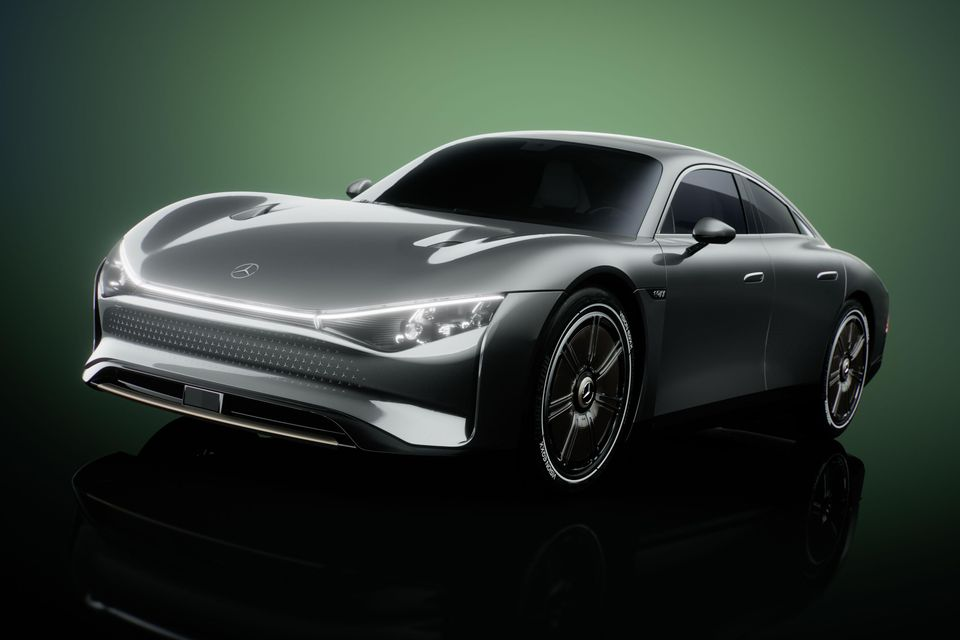
Mercedes-AMG presented the Vision AMG as a low four-door electric performance-car study. Its long wheelbase, narrow greenhouse and sculpted rear looked more like a sports coupe than a family sedan. The illuminated grille and three-point-star headlights deliberately connected the concept to AMG's combustion-era sports cars. Vision AMG previewed a purpose-built AMG.EA electric architecture, intended for high-performance motors and rapid power delivery rather than adapting a standard Mercedes passenger-car platform. Mercedes highlighted its investment in YASA axial-flux motor technology, whose compact shape can provide high power density. The long, almost closed nose, large wheels and trailing cabin were aerodynamic design statements. Output, battery capacity, curb weight, cooling circuit and the actual configuration of the 2022 show model were not published. The concept was primarily a design preview, with no certified range or output figure.
2022 Mercedes-Benz Vision EQXX Concept
The Vision EQXX was Mercedes-Benz's running efficiency prototype, developed to travel more than 1,000 kilometers on a charge. Its long-tail body, narrow frontal area and careful aerodynamic detailing produced a quoted drag coefficient of about 0.17. The battery stored just under 100 kWh, while the vehicle was designed around low mass and unusually efficient energy use. Mercedes completed extended real-world demonstration drives in 2022. Mercedes quoted a drag coefficient of 0.17, a 180-kW electric drive unit, a battery below 100 kWh and a prototype curb weight near 1,755 kg. The system operated above 900 volts, while narrow tires, a small frontal area, a rear diffuser and a long tapering tail minimized wasted energy. A 2022 road drive covered 1,008 km at an average 8.7 kWh/100 km; a later 2022 run exceeded 1,200 km on one charge. Those are actual demonstrator results, not a theoretical marketing range. It was a working engineering project, not an announced production sedan.
2022 MINI Aceman Concept
The Aceman explored a new compact electric crossover positioned between MINI's hatchback and its larger SUVs. It used short overhangs, a boxier nose and strongly defined wheel arches, keeping the brand's small-car character without copying its older chrome-heavy styling. Inside, a circular center display and simple dashboard reflected a more software-focused interface. The Aceman measured around 4.05 meters long and used large wheels with a compact wheel-at-each-corner stance. A circular central screen previewed MINI's later OLED interface, while the cabin did away with many leather and chrome conventions in favor of knitted and recycled materials. Its crossover ride height had to coexist with a flat EV floor and useful back-seat space. The show car omitted final electric motor ratings, wheelbase and charge limits; those came with later production development. MINI used the concept to preview a future production EV but had not confirmed a complete retail drivetrain, battery or range specification when it debuted.

2022 Mitsubishi K-EV X Style Concept
Mitsubishi's K-EV X Style previewed a small electric kei hatchback ahead of its production Minicab-sized EV program. The tall body, short hood and upright seats made practical use of Japan's strict small-car dimensions. The show car had SUV-inspired trim, a contrasting roof and copper-colored accents suggesting electric components. Mitsubishi discussed quiet running, connected functions and driver assistance, but did not publish a final battery or range figure for the prototype. The body fit within Japanese kei-car packaging, where length and width are tightly controlled and interior height is a major selling point. Mitsubishi's decision to style the little EV as a crossover left very little space for added crash structures or large wheel assemblies. The eventual eK X EV gave context for the market need, but its published production battery and power figures should not simply be copied onto the earlier display. The X Style was particularly useful as a study in packaging batteries beneath a tall urban body. It was a close-to-production styling preview.
2022 Mitsubishi Vision Ralliart Concept
The Vision Ralliart was a widened, performance-focused SUV study shown at Tokyo Auto Salon. It used large fender extensions, substantial brake hardware, 22-inch wheels and a more aggressive stance than Mitsubishi's regular road vehicles. A dark paint finish that showed blue highlights reinforced the motorsport theme. Mitsubishi talked about stronger electric-motor response and four-wheel control, but did not disclose a final road-ready powertrain specification. The visual hardware included greatly flared arches, a front grille shutter and an unusually broad rear diffuser, with 22-inch wheels and performance-oriented brake presentation. Mitsubishi framed it as a way to explore Ralliart handling, traction and electrified response. The show car did not confirm a bespoke turbo engine, inverter type or suspension kinematics, and it was not a homologated rally vehicle. More than outright horsepower, its theme was controlled torque delivery and stable cornering in mixed conditions. The vehicle tested how the returning Ralliart name might be applied to performance-oriented SUVs.
2022 Mitsubishi XFC Concept
Mitsubishi unveiled the XFC in Vietnam as a compact SUV concept tailored to Southeast Asian markets. Its squared wheel openings, broad shoulders and high-mounted lighting gave it a stronger visual stance than a conventional small crossover. The interior emphasized clear sightlines and a simple connected dashboard, with vehicle modes designed for varied regional road conditions. The XFC's elevated driving position, squared arches and relatively straight roof created more usable interior volume than a heavily coupe-shaped crossover would offer. Mitsubishi proposed several selectable drive settings, including a Wet mode intended to suit tropical roads with heavy rain. Screen placement and outward visibility were designed around everyday ASEAN conditions, while short overhangs improved urban maneuverability. As a near-market study, it established packaging and design direction before the production Xforce received firm engine and transmission specifications. The XFC previewed a later production SUV, but the initial 2022 concept was a styling and packaging proposal rather than a finalized engine or transmission specification.
2022 NamX HUV Concept
NamX introduced its Hydrogen Utility Vehicle concept with design work from Pininfarina. Its bold front end and long roof aimed to position hydrogen technology in the premium SUV market. The capsule network and driving-range claims depended on infrastructure that had not been established. NamX proposed a permanent 5-kg hydrogen tank plus six rear-mounted removable capsules holding a further 3 kg combined, for a conceptual 8-kg storage total. The advertised 800-km range and 300-550-horsepower variants were targets, not independent test results. A fuel cell would convert hydrogen into electrical power for the traction system, while the capsules were meant to address the lack of regular filling stations. The difficult unresolved engineering lay in pressure-vessel handling, crash safety, infrastructure and repeated refills. The HUV was an early proposal rather than a tested, commercially available hydrogen vehicle.
2022 Pantore Vakog Concept
Pantore showed the Vakog in Paris as a low two-seat sports-car proposal designed to accommodate different powertrains on one chassis. The electric Vakog-E was quoted at about 290 horsepower with a claimed 350-kilometer driving range, while a separate proposal used a 2.0-liter turbocharged engine producing around 420 horsepower. These were manufacturer targets for different intended versions, not results from one production-certified car. Pantore discussed two different propulsion routes: an electric version around 290 hp and a 2.0-liter turbo combustion version around 420 hp. The low cockpit, broad rear body and short wheelbase gave both proposed versions similar weight-distribution challenges, even though battery mass and liquid-fuel tanks would need different locations. The project was small-scale enough that chassis material, cooling duct sizes, gearbox selection and track durability were not fully standardized in public documentation. Its appeal was lightweight performance rather than luxury-car equipment. The independent project emphasized compact packaging, light weight and two-seat sports-car proportions.
2022 Polestar O2 Concept
Polestar's O2 was a compact electric roadster proposal derived from the brand's Precept design language. It used a folding hard roof, a low cabin and an aluminum-based platform concept intended to balance weight and stiffness. The interior featured recycled materials and the company even proposed a small autonomous camera drone operating from behind the rear seats. Polestar proposed a bonded-aluminum body structure to improve torsional rigidity without the weight penalty of a heavy open convertible shell. The interior used recyclable thermoplastic single-material components to ease later material recovery. A deployable autonomous camera drone could launch from behind the seats to record the car in motion, an unusual piece of lifestyle tech rather than a driving aid. Polestar did not confirm a production motor layout or battery pack for O2, so later Polestar 6 claims must be kept separate. Although the design later informed a planned sports car, the O2 itself had no final homologated motor, battery or range specification.

2022 Porsche 718 GT4 e-Performance Concept
Porsche developed the 718 GT4 e-Performance as a running electric race-car test bed based on elements of the earlier Mission R program. The prototype used one motor at each axle, an advanced oil-cooled battery system and very high charging power for track testing. Porsche discussed peak qualifying output approaching 1,000 horsepower, lower sustained race output and the thermal requirements of repeated laps. The GT4 e-Performance drew its chassis from the 718 GT4 Clubsport, widened by roughly 14 cm, with new body parts including natural-fiber composites. Porsche's 900-volt system delivered up to 800 kW in qualifying mode and approximately 450 kW continuously for a 30-minute race simulation. Direct oil cooling of both battery and motors was engineered to resist thermal power reduction; charging from 5 to 80 percent was quoted at about 15 minutes. This was a genuine running race laboratory with repeat-lap goals, not an art-only EV shell. The car's extensive bodywork and wide track were functional racing equipment, not a street-legal Cayman specification.
2022 Raffer TB-02 Concept
French specialist Raffer exhibited the TB-02 at the 2022 Paris Motor Show as a lightweight competition barchetta. The mid-mounted engine was a roughly 1.0-liter Kawasaki motorcycle four-cylinder producing around 200 horsepower, driving a very small chassis rather than a road-car drivetrain. Its unusual front safety hoop and low rear roll structure were shaped to send airflow toward the rear wing. Its transverse motorcycle-engine installation kept the mass low and central, with a sequential-style high-revving power delivery that suited a very light chassis. The roll structures were integrated into the aero profile so that safety tubes did not simply stick into the airstream. A narrow front end, broad rear wing and open cockpit made it a car for controlled track environments rather than public roads. Detailed certified curb mass, tire loads and series-production gearbox options were not widely published. The modular chassis also allowed possible open-wheel variations for other racing disciplines, not family-road-car production.
2022 Renault 4Ever Trophy Concept
The 4Ever Trophy was Renault's off-road-flavored concept for a future electric Renault 4. Its tall, simple cabin, substantial bumpers and raised suspension made it look like a small rally-support vehicle. Renault used the concept to preview practical packaging and a retro-inspired body without simply reproducing the original 1960s car. The wheels, body panels and recovery equipment were more extreme than a production model would need. The raised wheel arches accommodated chunky off-road tires, while the bumpers incorporated recovery details and the ride height suggested rough-trail use. Renault used the small EV package to keep the bonnet short and cabin upright, essential to the original Renault 4's practicality. The extreme roof gear and exposed accessories were not intended to pass into production unchanged. It was an early design and chassis-positioning study, so later Renault 4 E-Tech motor and battery specifications should be labeled as later production data. Motor output, battery capacity and consumer range were still conceptual at its reveal.
2022 Renault Hippie Caviar Motel Concept
Renault showed the Hippie Caviar Motel as a compact electric camping concept based on the Kangoo E-Tech. It turned an ordinary small van into a weekend vehicle with a folding sleeping platform, removable storage and equipment intended for outdoor trips. The concept was more practical than Renault's earlier luxury camping proposal, relying on a standard electric van layout and simple accessories. The Kangoo E-Tech donor gave Renault a boxy body, sliding side access and useful cargo volume with no need for a bespoke camper platform. The production electric van family used a roughly 45-kWh battery and a 90-kW-class motor; the show conversion concentrated on interior modularity rather than a new traction drive. Its roof storage, pull-out equipment and compact sleeping surface demonstrated the tradeoff between usable bed length and remaining luggage space. No separate off-grid battery system or all-wheel drive was announced for the Motel. It explored how an electric utility vehicle might double as an affordable recreational base rather than creating an entirely new drivetrain.
2022 Renault R5 Turbo 3E Concept
The R5 Turbo 3E was an electric drift-car concept inspired by Renault's mid-engine 1980s rally specials. Two electric motors drove the rear wheels, with a quoted combined output around 375 horsepower and a chassis built for wide-angle slides. The car used a tubular safety structure, very broad fenders, a tall rear wing and modern digital displays. Renault gave the Turbo 3E two rear motors producing 280 kW and 700 Nm, with a 42-kWh battery mounted centrally in its tubular safety chassis. The car carried a carbon-fiber body, FIA-style roll structure and more than 50 degrees of steering lock for sustained drifting. Published targets included 0-100 km/h in 3.5 seconds and 200 km/h maximum speed. Overall mass was roughly 1,500 kg, including a battery pack of about 520 kg, making its drift-focused suspension and cooling just as important as peak torque. Unlike a showroom hot hatch, the design deliberately sacrificed rear seating and practicality to explore high-performance electric driving and show-car drama.

2022 Renault Scénic Vision Concept
Renault's Scénic Vision previewed a family crossover using a battery-electric drivetrain supported by a hydrogen fuel-cell range-extender concept. It had a long wheelbase, low nose and broad rear doors that emphasized passenger space. Renault also used recycled materials and proposed a cleaner approach to interior components. The combined energy system was presented as a possible future solution rather than a confirmed mass-production design. The experimental system combined a 160-kW electric motor with a 40-kWh battery and a 15-kW hydrogen fuel cell intended to recharge the pack on longer trips. Renault placed the hydrogen tank at the front and the fuel cell behind the battery, showing how component location would dictate cabin packaging. The proposed 800-km future range required hydrogen infrastructure that did not yet exist at scale. The study also claimed more than 70 percent recycled materials and broad end-of-life recyclability. The later electric Scénic followed the styling direction but not the same hydrogen-assisted setup.
2022 Sony Vision-S 02 Concept
Sony introduced the Vision-S 02 at CES as a seven-seat electric SUV prototype built on the technology base of its earlier Vision-S sedan. The car used cameras, radar and lidar to study driver assistance, cabin monitoring and connected entertainment. Its wide dashboard displays and extensive sound system were as important to the project as the powertrain. Sony did not announce a finalized production battery or certified range. The Vision-S 02 used a multi-sensor package to test how a production-size SUV might perceive its surroundings and monitor passengers. Its electrical system was arranged around connected services, cloud software and entertainment displays; Sony also demonstrated high-quality audio throughout the cabin. The seven-seat body imposed real packaging demands for third-row legroom and traction battery location. The company did not present independently verified crash ratings, braking distance, cell capacity or continuous motor-output data for a customer vehicle. The study explored how electronics, sensing and software could shape a future vehicle.
2022 Subaru STI E-RA Concept
Subaru's STI E-RA was a dedicated electric racing study developed for high-speed circuit work. Four electric motors, one for each wheel, provided a proposed combined output of more than 1,000 horsepower and allowed direct control of wheel torque. The low body, large wing and wide tires prioritized aerodynamic grip and cooling over normal passenger-car practicality. Subaru planned to use the prototype for engineering tests and possible record attempts. STI specified four Yamaha-developed motor units delivering a combined maximum 800 kW, fed by a 60-kWh lithium-ion battery. The one-motor-per-wheel architecture gave engineers direct left-right and front-rear torque control without conventional mechanical differentials. STI aimed for a 6-minute-40-second Nürburgring lap, a development goal rather than an achieved 2022 record. Control software would process steering, yaw, wheel loads and brake inputs to maximize grip at each tire, with the large rear wing and diffuser managing high-speed aero load. It was a motorsport research program, not an electric BRZ replacement.
2022 Tata Avinya Concept
Tata's Avinya concept was built around a new purpose-designed electric platform, rather than an adapted gasoline-car structure. The long wheelbase, flat floor and very short overhangs created a cabin closer to a small lounge than a regular compact SUV. Butterfly-style doors and a simplified, largely screen-free interior supported that idea. Avinya used a dedicated Gen 3 EV concept package, separating its battery floor and passenger cell from the compromises of an adapted gasoline platform. Tata talked about recovering more than 500 km of projected range after under 30 minutes of suitable fast charging, though no final pack size was given. The long wheelbase, swivel-style seat presentation and expansive doors highlighted how a skateboard floor could support lounge proportions. Structural crash paths, steering hardware and cooling-system detail were not published for this design model. Tata discussed fast charging and an ambition for more than 500 kilometers of range but did not provide a complete homologated production specification in 2022.
2022 Tata Curvv Concept
Tata's Curvv previewed an electric coupe-SUV with a comparatively upright front end and a long roof tapering sharply toward the rear. It introduced a new design direction with slim lights, strong wheel arches and a wide, clean dashboard. The initial study used Tata's planned second-generation EV-compatible architecture rather than the later Avinya's dedicated Gen 3 platform. Curvv used an EV-compatible second-generation architecture that could also support combustion-engine derivatives, unlike the clean-sheet Avinya floor. That compromise left more familiar wheelbase, steering and crash-structure hard points under the dramatic roofline. A narrow lamp strip and coupe-style rear improved its appearance but introduced rear-headroom and rear-window compromises. The initial design had no finalized production battery, gearbox or towing rating and should not be confused with the later roadgoing Curvv's specific trim and engine options. Tata intended to develop both electric and combustion versions, but the 2022 car was a design prototype with provisional drivetrain information.
2022 Toyota bZ Compact SUV Concept
Toyota showed the bZ Compact SUV in Los Angeles as a small electric crossover proposal with a low nose, short overhangs and a sharply cut rear. Its dedicated battery-electric packaging aimed to maximize cabin space while keeping the body compact. Toyota emphasized connected functions and a simplified interior, but did not disclose a complete motor, battery or charging specification. Toyota kept the EV's wheels close to its corners to create a roomy passenger compartment within a small crossover footprint. A low bonnet and short front overhang distinguished it from Toyota's larger bZ4X, while the sharply sloped rear reduced practical hatch volume in exchange for design impact. The interior proposed a voice-interactive digital assistant and clean central display. Toyota supplied no battery energy, charge curve, torque output or certified driving range for this one-off proposal. The vehicle's styling was more aggressive than the production bZ4X and served as an early study for a smaller electric SUV.
2022 Toyota C-HR Prologue Concept
Toyota's C-HR Prologue was a close-to-production styling study for the second generation of the compact crossover. Its short hood, pointed nose, large wheel arches and sharply divided rear panels developed the first C-HR's unusual shape. A two-tone or three-tone finish emphasized the sculpted surfaces. The ED2-designed Prologue retained a compact body with deliberately exaggerated front and rear haunches, plus a two-tone rear color treatment. Toyota said the next C-HR family would include hybrid and plug-in hybrid propulsion, so engineers had to accommodate both a combustion engine and traction battery rather than design for an entirely flat EV skateboard. Hidden rear door handles helped maintain the coupe-like side view. Its specific electric-only range and drivetrain outputs were disclosed with later production vehicles, not the original design display. Toyota presented the car as a design preview rather than a fully engineered production derivative, and it did not attach finalized hybrid power outputs or market-specific equipment details to the concept.
2022 Toyota Crown Estate Preview Concept
Toyota's Crown Estate design preview presented a longer, more practical member of the new Crown family. It used an upright rear hatch, extended roof and higher ride height to combine crossover packaging with wagon-like cargo space. The body was intended to carry luggage more easily than the Crown sedan or Sport while retaining the line's upmarket appearance. The Estate body favored a nearly level cargo-loading floor, long rear roof and wide tailgate opening. As part of the new Crown architecture, the tall wagon/SUV format was aimed at combining long-distance ride quality with useful passenger and luggage capacity. Toyota had not yet fixed public market-by-market engine and hybrid variants, so the 2022 styling model should not be assigned an individual displacement, fuel-economy rating or tow capacity. The practical roofline was its central differentiator from Crown Sport. Toyota displayed it as a future model in 2022, before publishing the final powertrain lineup and detailed production specifications.
2022 Toyota Crown Sedan Preview Concept
When Toyota introduced its expanded Crown family in 2022, it showed a sedan design with a long hood, formal roofline and distinct rear deck. Compared with the higher-riding Crown crossover, this version emphasized a traditional chauffeur-style interior and a more luxurious stance. The public display previewed a later production car, but the 2022 exhibit was part of a future-model announcement rather than a finished market specification. The Sedan preview had a separate trunk, long wheelbase look and a more traditional rear-seat environment than the higher Crown crossover. Its large glass area and length emphasized chauffeur comfort, while the platform strategy offered scope for different powertrain configurations depending on market. Toyota deliberately withheld detailed 2022 specifications for engine, transmission, driven axle and hybrid system. In 2022, the mechanical significance lay primarily in the move from a single Crown sedan to a family of different chassis and body configurations. It established the sedan's design role within the new Crown range.
2022 Toyota Crown Sport Preview Concept
The Crown Sport was shown as a broad-shouldered, low-roof crossover design within Toyota's 2022 four-body Crown reveal. Its sharply pointed nose, sloping roof and unusually prominent rear wheel arches suggested a more driver-oriented model than the regular Crown crossover. Toyota used the preview to explain how the Crown family would cover different driving styles and cabin needs. The Sport's wide rear tracks, strongly tapered upper body and lower driving stance suggested more responsive on-road handling than the Estate's practicality-led body. Toyota used large wheels and short rear glass to pull it visually toward a hot hatch, though its overall ride height remained SUV-like. Its 2022 appearance previewed a later model rather than demonstrating an independently tested performance suspension or one particular hybrid system. Curb weight, tire selection and gearbox details still depended on later production specification. The show version did not yet establish the final-market hybrid powertrains, options and equipment later offered to customers.
2022 Toyota GR GT3 Concept
Toyota Gazoo Racing unveiled the GR GT3 as a clean-sheet racing concept at Tokyo Auto Salon. Its long hood, very low cockpit and wide rear fenders were developed around GT3 customer-racing priorities rather than adapting a current road car. The concept included a large rear wing, side-exit exhaust layout and a low aerodynamic nose. Toyota did not fully disclose the mechanical package at the show. Unlike most GT3 builds, Toyota did not begin with a roadgoing GR Supra body shell; the long front-engine proportions and rearward cockpit were designed to accommodate customer-racing service needs. The low front splitter, vented fenders and large rear wing addressed downforce, cooling and stability under long-stint track conditions. The 2022 show car gave no complete engine or homologation data. Later GR GT3 engineering announcements, including its V8 plans, should not be treated as specifications already confirmed at Tokyo Auto Salon in 2022. It was intended to develop a future competition car with road-car technology spin-offs.
2022 Viritech Apricale Concept
British company Viritech introduced the hydrogen-powered Apricale hypercar concept with exterior design assistance from Pininfarina. The low two-seat body was built around a carbon-fiber structure, with hydrogen storage and fuel-cell systems intended to provide long-distance electric driving without a large battery. The project discussed very high output and low weight, but those targets were still part of development. Viritech positioned hydrogen pressure vessels and a fuel-cell system within a lightweight carbon structure, using a traction battery to absorb regeneration and help with transient power demand. That arrangement allows much smaller battery capacity than a comparable long-range battery-only hypercar, but the extra plumbing, tanks and heat exchangers complicate the package. The startup discussed four-figure horsepower and low vehicle-mass goals without independent testing. Tank pressure, repeatable track output and fuel availability remained critical feasibility questions. The car showed a potential alternative route for performance vehicles, not a finished, verified production hypercar.
2022 Volkswagen GEN.TRAVEL Concept
Volkswagen's GEN.TRAVEL was an autonomous travel-pod concept combining a glass-heavy passenger compartment with an unusually tall lower body. Inside, the seats could be arranged for work, conversation or reclining during long journeys. The proposal emphasized self-driving mobility services and adaptive air suspension intended to smooth the ride. Volkswagen proposed fully automated long-distance travel with individual seats that could be turned into a meeting room or flat sleeping arrangement. The active suspension concept would anticipate changes in road conditions to reduce motion and improve passenger comfort, a particularly important issue when occupants face one another rather than the road. The very large glass areas and high body create real aerodynamic and energy-demand tradeoffs. No production-ready safety redundancy, approved autonomy system or certified consumption figure was tied to GEN.TRAVEL. Volkswagen presented a future transport experience, not a conventional owner-driven sedan with a finalized electric powertrain, certified range or regulatory approval for fully autonomous operation.

2022 Volkswagen ID. Aero Concept
The ID. Aero was Volkswagen's concept for a long-range electric sedan using the MEB platform. Its smooth nose, fastback roof, low drag body and long wheelbase were intended to improve aerodynamic efficiency and passenger space. The concept carried an approximately 77-kWh battery and claimed up to 620 km of WLTP range as a development goal. Its MEB skateboard gave the sedan a long wheelbase and short overhangs, with rear-drive-oriented packaging typical of Volkswagen's electric platform. Flush exterior details, a low hood and sloping roof helped reduce drag at motorway speeds. The ID. Aero was a shape and efficiency precursor to ID.7, but its range figure was a projection rather than a final production-car test. The study established the shape of the eventual ID.7 but was not identical to the final production vehicle.
2022 Volkswagen ID. Xtreme Concept
Volkswagen transformed an ID.4 GTX-based test vehicle into the ID. Xtreme electric off-road concept. The higher suspension, underbody protection, roof lighting and chunkier tires were designed for rough-terrain use. Volkswagen increased combined motor output to around 382 horsepower and used an acoustic sound generator to change the experience of the otherwise quiet drivetrain. The experimental build investigated a more adventurous application for the MEB platform rather than announcing an ID. Volkswagen fitted a used 77-kWh development battery, increased combined output to 285 kW through the rear drive unit and software, and quoted 0-100 km/h in 5.3 seconds. Rally-derived suspension raised the body about 30 mm; 20-mm track spacers and 18-inch off-road tires sat under 3D-printed arch extensions. Aluminum underbody protection and auxiliary lighting addressed trail durability and visibility. This was a reuse-and-modification engineering exercise based on ID.4 GTX hardware, not a purpose-built electric rock crawler. Xtreme production model.
2022 Zeekr M-Vision Concept
Zeekr unveiled the M-Vision in November as a purpose-built electric vehicle intended for autonomous ride services. The cabin could be arranged around passengers instead of traditional driver controls, while the architecture supported wheelbases between 2.7 and 3.3 meters. The project also formed the basis of a separate Waymo robotaxi design. The SEA-M platform was developed with a low, open floor and a B-pillar-free opening large enough for easy boarding, especially in shuttle service. Zeekr described flexible wheelbases from roughly 2.7 to 3.3 meters, making the architecture adaptable to different cabin lengths and seating arrangements. Electric steering, braking and vehicle-control interfaces would have to work with an outside autonomous-driving stack. The M-Vision was a mobility-platform prototype, and range, motor output and operation without a human safety driver were not confirmed. Autonomous operation still depended on external self-driving systems.
2022 Škoda Vision 7S Concept
The Vision 7S was a large electric seven-seat SUV study that introduced Škoda's Modern Solid design language. Its upright front end, smooth doors and narrow lighting traded delicate styling details for robust forms and practical packaging. Skoda outlined an approximately 89-kWh battery, more than 600 km of targeted WLTP range and DC charging capability up to 200 kW. The broad seven-seat cabin included a central child-seat location, with the interior able to switch between driving and relaxation configurations. Thick lower-body protection, high ground clearance and the new Tech-Deck front face emphasized practical toughness. Its published numbers were concept targets for a future large EV family rather than final customer-ready battery and charging certifications. Inside, the concept included flexible seating and an unusual centrally placed child seat. Škoda associated the study with a large battery and long driving-range ambitions, but the car was a future-model preview, not a confirmed production version with certified consumption figures.
Manufacturer show builds and bespoke one-offs
Factory projects, student-built prototypes, one-off coachbuilt vehicles and modified production cars presented in 2022. These use existing mechanical foundations more often than clean-sheet concept platforms.
2022 Alpine A110 E-ternité Concept
Alpine built the A110 E-ternité as an experimental electric conversion of its lightweight mid-engine sports car. Engineers retained the A110's basic aluminum structure and tried to keep weight low despite fitting battery modules and electric propulsion. The prototype used a compact battery-electric system and a modified transmission concept, while the open-roof body added another change from the standard coupe. Alpine published a 60-kWh battery, a 178-kW (239-hp) motor and 300 Nm of torque, paired with an unusual two-speed dual-clutch transmission solution. The finished prototype weighed around 1,378 kg, roughly 250 kg more than the gasoline A110, and carried a projected 0-100 km/h time near 4.5 seconds. Alpine kept the mid-engine A110's double-wishbone suspension layout, reinforcing the rear lower arms and revising spring and damper rates. The goal was a driveable handling experiment, not just an electric-looking body. It was a running technology demonstrator for future Alpine engineering, not a saleable electric A110 with finalized series-production specifications.
2022 Bentley Mulliner Batur Concept
Bentley introduced the Mulliner Batur at Monterey as a limited coachbuilt grand tourer previewing a new exterior design direction. The coupe used Bentley's familiar 6.0-liter twin-turbo W12 engine, extensively developed for very high output, beneath a dramatically reshaped long-hood body. Its upgraded 6.0-liter W12 was developed for more than 740 metric horsepower and around 1,000 Nm, driving through an eight-speed dual-clutch transmission. The chassis brought four-wheel steering, an electronic limited-slip differential, adaptive air suspension and 48-volt active anti-roll control. Bentley commissioned only 18 examples, each specified individually through Mulliner. Technically the Batur was a late peak for Bentley's combustion grand touring platform, while its cleaner front design previewed styling intended for future battery-electric Bentleys. The Batur was a real limited-production commission, so it is included as a coachbuilt design showcase rather than a conventional concept car.
2022 Daihatsu Atrai Deck Van Camper Concept
The Atrai Deck Van Camper combined Daihatsu's small cab-and-deck body with camping equipment for short trips. The vehicle used the existing Atrai layout as a starting point, then adapted its loading area for outdoor gear and a compact leisure setup. Its appeal came from the small footprint and the ability to enter narrow roads that larger camper vans cannot easily use. The Atrai is a Japanese kei van, so the short bonnet, sliding side doors and square cargo volume give it more usable space than its tiny footprint suggests. The camper fitted practical equipment into the exposed deck and remaining cabin without the height and weight of a conventional full-size motorhome. Its suitability for sleeping, load capacity and running appliances depended on accessory packaging rather than major engine work. No custom axle gearing, larger traction battery or independently rated towing capacity was announced. The 2022 exhibition build was a customization demonstration, not a new motorhome model with a separate mechanical specification.
2022 Daihatsu Atrai Premium Concept
Daihatsu displayed the Atrai Premium at Tokyo Auto Salon as a custom interpretation of its tall compact van. The build concentrated on a more upscale cabin and exterior finish while retaining the basic kei-vehicle dimensions and practical sliding-door layout. Unlike a clean-sheet concept, it used the standard Atrai as its mechanical foundation. Because the original Atrai already uses a tall cabin and compact powertrain, the show car could concentrate on sound insulation, trim, seating materials and exterior finish without disturbing the structure. Standard kei-vehicle dimensions limit wheel size, suspension travel and front crash-space options, even on a heavily styled display car. The result was closer to a bespoke specification of a working microvan than a research prototype. There were no new documented engine internals, transmission ratios or performance targets. Daihatsu included it to demonstrate customization and small-van versatility, not to preview a new platform or provide an independent set of prototype horsepower and range figures.
2022 Daihatsu Nibako Truck Copen Assembly Concept
Daihatsu's Nibako exhibition truck was a mobile demonstration space associated with the Copen assembly experience. It used a small commercial vehicle as a flexible base for carrying and displaying an interactive workshop setup. The design focused on compact transport, modular equipment and the ways kei-class work vehicles can support retail or community activities. It was not a sports-car prototype despite the Copen name. The truck module functioned as a mobile workshop and display unit, carrying tools and parts for an assembly-style demonstration rather than a roadgoing sports-car driveline. The little commercial platform was valuable for its flat load bed, ease of loading and ability to operate in narrow city streets. The Copen name referred to the interactive assembly activity, not to an engine swap from the tiny roadster. Technical development centered on fitted storage, weight distribution and access to the tools being demonstrated. Its purpose was to show a small truck being repurposed as a traveling experience rather than launch a new drivetrain.
2022 Daihatsu Rocky Cross Field Concept
The Rocky Cross Field was an outdoor-oriented customization study based on Daihatsu's compact crossover. It emphasized equipment for recreation and a more rugged appearance, using the production vehicle's overall proportions and passenger compartment. The project was part of Daihatsu's 2022 Tokyo Auto Salon display exploring how small cars could serve different lifestyles without redesigning their platforms. The Rocky's conventional high-roof, short-wheelbase architecture constrained how much wheel travel or tire diameter a practical accessory build could add. Its Cross Field parts aimed to improve usability on rough campsite approaches, not create a low-range transfer case or body-on-frame off-roader. The distinction matters because aggressive tires and skid-style trim do not automatically increase approach angle, underbody clearance or torque distribution. Daihatsu never reported separate performance homologation for the concept. Its modified trim and accessories should not be mistaken for proof of different production suspension travel, towing capability or four-wheel-drive hardware.
2022 Daihatsu Rocky Premium Concept
Daihatsu's Rocky Premium show car added a more polished appearance to the compact Rocky crossover at Tokyo Auto Salon. Changes centered on trim, wheels and visual details rather than a new body platform or engine family. The design illustrated how the practical five-door SUV could be personalized for buyers wanting a less utilitarian look. The Premium treatment kept the Rocky's basic compact-crossover geometry, including its short overhangs and front-engine packaging, and focused on appearance upgrades. Wheel and tire sizing and trim finish were the most visible changes, with no indication of a new chassis platform or high-output turbo package. A buyer comparing it with a normal Rocky would therefore need to distinguish cosmetic parts from real suspension, brake or steering alterations. The show car was not accompanied by an independent acceleration or handling test. It was a manufacturer-backed accessory and styling proposal rather than a separately engineered drivetrain experiment or a fully new production model.
2022 Dodge Hornet GT GLH Concept
Dodge unveiled the Hornet GT GLH during the model's debut, using the initials from the old Omni GLH hot hatch. The show vehicle was based on the turbocharged Hornet GT, adding a lowered stance, distinctive striping, dark wheels and parts suggesting a more aggressive street setup. Dodge used it to show the personalization possibilities of its new compact crossover. The Hornet GT donor's 2.0-liter turbocharged four-cylinder and nine-speed automatic drivetrain were retained as the foundation, while the GLH proposal emphasized wheels, lowering and appearance. Its heritage reference was the lightweight, turbocharged Omni GLH, but the Hornet was a far heavier modern crossover. Dodge proposed the GLH theme as a parts direction rather than a fully calibrated performance variant. No different turbocharger, differential ratio or final published power increase was established for the 2022 display. It was not a separate high-output engine model with a published production performance specification at its 2022 reveal.
2022 Ferrari SP48 Unica Concept
Ferrari developed the SP48 Unica as a one-off coupe commissioned through its Special Projects program. It used the mechanical base of an F8 Tributo, including the mid-mounted twin-turbo V8, but replaced the regular body with a newly designed aerodynamic shell. The rear roof and engine-cover surfaces were reworked to create a smooth, enclosed appearance. Beneath the new surfaces remained the F8 Tributo's 3.9-liter twin-turbocharged V8 and rear-drive, mid-engine layout. The standard F8's 710-hp-class output provides mechanical context, though the commission did not announce a separate SP48 engine calibration. Ferrari redesigned the nose, roof and rear intakes, using complex surface patterns that conceal some traditional cooling apertures. The bespoke body had to preserve the F8's radiator and intercooler airflow while creating a markedly different aerodynamic appearance. This was a completed customer car rather than a future-model concept; its inclusion documents a significant new Ferrari body design unveiled during 2022.
2022 Ferrari SP51 Concept
The Ferrari SP51 was a one-off front-engine roadster based on the 812 GTS. Ferrari's design team created an entirely new open-top body, revised rear aero treatment and unique trim for a private client. The car kept the donor vehicle's naturally aspirated V12 engine, making the project a coachbuilt reinterpretation rather than a mechanical research program. The absence of a fixed roof was central to its appearance. The SP51 retained the 812 GTS's front-mounted 6.5-liter naturally aspirated V12 and rear transaxle grand-touring layout; the donor engine was rated around 789 hp. Ferrari created a roofless body with altered rear buttresses and an aerodynamic bridge behind the occupants. The particular challenge was controlling high-speed air over an open cockpit without a permanent hardtop. Its structural and cooling systems came from a proven production donor rather than a new engine-development program. It was a commissioned vehicle, not a new production Ferrari model.
2022 Ford Electric SuperVan 4 Concept
Ford Pro's Electric SuperVan 4 was a radical racing and technology demonstrator inspired by the Transit commercial van. It used four electric motors and race-car aerodynamic bodywork while retaining enough van shape to make the connection obvious. Ford discussed roughly 2,000 horsepower in its original configuration, with a purpose-built chassis, massive front splitter and rear wing. The project was designed for hill climbs and demonstration runs. Ford specified four electric motors producing about 2,000 metric horsepower in its original configuration and used a race-prepared chassis underneath the van silhouette. The traction battery was a compact liquid-cooled high-discharge unit rather than a delivery-van pack optimized for commuting range. A huge diffuser, front aero structure and double rear-wing arrangement generated the high-speed grip required for a hill-climb run. Conventional cargo volume, passenger comfort and range were sacrificed for short bursts of extreme power. It was not a production Transit conversion or an ordinary delivery van.
2022 Honda K-Climb Concept
Honda presented the K-Climb as a striking small motorsport-inspired concept at Tokyo Auto Salon. Its body and racing details drew from the compact Honda N-One formula, with emphasis on lightweight appearance, widened bodywork and visual links to hill-climb competition. The car explored how a small city-car platform could become a playful track-oriented project. The K-Climb used the visual and dimensional starting point of a Honda kei-class hatchback but added lowered racing posture, a wider body treatment and competition-inspired trim. That makes it an interesting contrast with Japan's normal 660-cc and size-limited city-car rules: racing changes must work within a very short wheelbase and narrow track. Honda did not publish a special displacement, boosted output, differential specification or certified competition class for the show build. Its engineering emphasis was compact-car agility rather than high-speed top-end performance. The show build did not establish a standard production specification, and its value was in imaginative packaging and racing style rather than sales plans.
2022 Honda N-VAN Third Place Van Concept
Honda transformed its small N-VAN commercial vehicle into the Third Place Van for Tokyo Auto Salon. The idea was to turn the van's boxy load space and low floor into a compact retreat between home and work. Simple cabin furniture and flexible storage emphasized how much useful space could fit within a kei vehicle's dimensions. The underlying mechanics remained those of the N-VAN. N-VAN's low, flat floor and passenger-side opening without a conventional central pillar were the key functional features exploited by the conversion. With the seats folded, a small worktop and leisure equipment could fit into a footprint much shorter than a conventional camper. The challenge is balancing interior furniture and gear weight against a kei van's limited payload, not adding aerodynamic downforce. Honda did not announce major engine, CVT or axle modifications for this lifestyle configuration. The concept was a practical lifestyle customization proposal, not a distinct new commercial-vehicle platform.
2022 Honda N-WGN Picnic Concept
Honda's N-WGN Picnic concept demonstrated a relaxed outdoor-use version of its kei hatchback. It used picnic-oriented equipment and cosmetic changes to turn an ordinary small car into a vehicle for short excursions. The tall roof and upright seating made sense for carrying compact leisure gear without requiring a larger SUV. Honda exhibited the car as a customization exercise at Tokyo Auto Salon. The N-WGN's upright hatch opening, folding rear seats and compact wheelbase helped make the picnic layout practical for one or two occupants. Instead of lifting the suspension or claiming serious off-road traction, the design concentrated on organized storage, small tables and equipment that could be packed away after use. Most of the useful changes were reversible fittings. A custom final drive, new turbo calibration, different brake system or wheel-travel specification was not part of Honda's published exhibit. It did not announce a different engine family, a new wheelbase or production off-road capability.
2022 Honda Step WGN e:HEV Spada Concept
Honda displayed the Step WGN e:HEV Spada Concept at Tokyo Auto Salon as a customized preview of its new people carrier. The tall cabin, sliding doors and hybrid powertrain layout came from the forthcoming Step WGN, while the show car added visual equipment aimed at a more distinctive appearance. Honda used it to test factory-accessory ideas before launch rather than demonstrate an alternative chassis or unannounced power output. The e:HEV arrangement in the Step WGN uses an engine and electric drive system designed to favor smooth low-speed movement and efficient family transport, not drag-strip acceleration. The show car emphasized the tall sliding-door cabin, low step-in height and factory-style exterior accessories. A people carrier also places greater importance on ride compliance and predictable braking than on aggressive wheel fitment. Honda did not document a separate hybrid battery chemistry, modified motor output or independently tested suspension tune for the exhibit. It belongs among show builds, not clean-sheet concepts.
2022 Honda Vezel e:HEV Modulo X Concept
Honda's Vezel e:HEV Modulo X Concept was a proposed sportier version of the small hybrid crossover, shown at Tokyo Auto Salon. Exterior changes and chassis tuning were intended to sharpen road behavior without losing the standard model's everyday practicality. Honda originally discussed developing a completed Modulo X version, but that plan was later canceled. The Vezel e:HEV's underlying powertrain pairs a 1.5-liter gasoline engine with an electrically driven hybrid system, giving the Modulo X team an existing, efficient foundation. The proposed package concerned damper and suspension tuning, aero balance, wheels and seats, not a new engine block. A tighter body-control setup could improve cornering precision while retaining everyday ride quality, but Honda never finalized consumer specifications: the planned Modulo X production version was canceled later in 2022. The 2022 concept is therefore a useful record of an unrealized factory performance package, not evidence of a production Vezel Modulo X that customers could buy.
2022 Jeep Birdcage Concept
The Birdcage was a highly open Wrangler 4xe build produced with Jeep Performance Parts. Engineers removed the roof and windshield while preserving a protective roll structure, then fitted lighting, equipment mounts and serious off-road tires. Its plug-in hybrid powertrain provided electric driving capability on trails, but the main focus was modular body parts and outdoor usability. Birdcage was built around Wrangler 4xe plug-in hybrid hardware, combining a turbocharged 2.0-liter gasoline engine, electric assistance and a mechanical four-wheel-drive system. The stripped body let engineers demonstrate windshield removal, tube doors, compact lighting and open-air safety structures. Off-road tires, spare-wheel handling and underbody guards took priority over efficiency or weather sealing. Removing large body panels changes airflow, noise and structural bracing considerations, but the concept was not a separately certified open-body Wrangler. It was displayed at Easter Jeep Safari to test accessory ideas, not to announce a production roofless Wrangler variant.
2022 Jeep Bob Concept
Jeep built Bob from a Gladiator pickup, shortening its bed to improve the departure angle on difficult trails. The concept used a lifted suspension, large off-road tires, upgraded axles and a stripped-down cabin without conventional doors. Its diesel V6 engine remained from Jeep's production truck family, but the body alterations were extensive. The name referred to bobbing or cutting down a pickup bed. Jeep shortened the Gladiator's rear overhang by cutting the cargo bed, which improves departure geometry before any suspension adjustment is considered. The base 3.0-liter turbodiesel V6 offered low-speed pulling torque useful on rocks, while the large tires and revised suspension improved contact over obstacles. A compact rear spare arrangement and reduced bodywork made the tail less likely to drag. Bob was an exercise in changing actual breakover and departure capability rather than attaching purely decorative off-road trim. It was a functional trail experiment, not a new Gladiator body style planned for regular production.
2022 Jeep D-Coder Concept
Jeep Performance Parts turned a Gladiator into the D-Coder, an off-road parts demonstration vehicle. Its body carried numerous components highlighted with contrasting colors and identifying codes, making individual accessories easy to locate. The build included practical equipment such as upgraded bumpers, recovery hardware and off-road protection. Mechanical changes were deliberately secondary to showing what owners could install. The D-Coder retained Gladiator truck architecture so that many of its demonstration parts could correspond to existing Jeep Performance Parts accessories. Color-coded pieces highlighted bumpers, rock rails, lighting, storage solutions and recovery components. For enthusiasts, the real engineering questions were how accessory mass affected approach angle, tire clearance and suspension behavior. The concept was not presented with a newly developed V8, transfer case or unique axles; it was designed to make individual modifications easy to identify. The D-Coder was a rolling accessories catalog rather than a standalone Jeep model or new automotive platform.
2022 Jeep Grand Cherokee Trailhawk PHEV Concept
Jeep's Grand Cherokee Trailhawk PHEV concept brought the new 4xe hybrid SUV to the Easter Jeep Safari with more serious trail equipment. It used the production plug-in hybrid powertrain, which combined a turbocharged four-cylinder engine with electric motors, while adding all-terrain tires, recovery gear and protective trim. The project showed how Jeep's upscale SUV could support outdoor activities without abandoning electrification. The Grand Cherokee 4xe donor combines a turbocharged 2.0-liter four-cylinder with electric drive assistance and a conventional multi-speed transmission. Its PHEV configuration can supply responsive low-speed torque while retaining mechanical 4x4 hardware. The Trailhawk concept brought tire, protection and recovery changes to that base; its underfloor battery and exhaust routing still imposed practical clearance limits. Jeep did not establish a new battery pack or unique final drive for the Easter Safari demonstrator. It was a special equipment study, not a new Grand Cherokee powertrain or production grade.
2022 Jeep Magneto 2.0 Concept
Magneto 2.0 was an extensively revised version of Jeep's electric Wrangler concept, with a stretched wheelbase, high-output motor and six-speed manual gearbox. Jeep quoted about 625 horsepower and used the transmission to make the EV behave more like a traditional off-road vehicle. Large tires and a modified suspension helped put that power onto difficult terrain. The 2022 Magneto upgrade used a custom axial-flux electric motor, six-speed manual transmission and four separate battery packs totaling 70 kWh on an 800-volt electrical system. Jeep quoted 625 hp and 850 lb-ft at peak and increased the wheelbase to improve high-speed stability. A race-derived inverter and much higher allowable current helped deliver brief extreme power. Its unusual manual EV arrangement retained mechanical gear selection for off-road control; it was not intended as a production Wrangler specification. The 2022 update pushed the engineering much further than the original 2021 Magneto, but it remained a one-off research build.
2022 Jeep Rubicon 20th Anniversary Concept
Jeep marked two decades of the Wrangler Rubicon with an extreme anniversary concept based on the 470-horsepower Wrangler 392 V8. The build added larger tires, beadlock-style wheels, suspension lift and gold-colored exterior details. It demonstrated how Jeep Performance Parts could increase the already substantial capability of the Rubicon. The donor Wrangler 392's naturally aspirated 6.4-liter Hemi V8 produced 470 hp and 470 lb-ft, already requiring heavy-duty cooling and braking for a compact off-road body. The anniversary build added greater tire diameter, more wheel protection and revised suspension clearance, pushing that package further toward technical trail work. The taller stance helps obstacle clearance but adds center-of-gravity and steering-load tradeoffs. The show car illustrated accessory development rather than a changed cylinder head or displacement. The project was shown at Easter Jeep Safari and later influenced production anniversary equipment, but the show car itself was a specially prepared demonstrator.
2022 Jeep ’41 Concept
Jeep's '41 concept was a World War II-inspired reinterpretation of the Wrangler Rubicon 4xe plug-in hybrid. Olive-drab paint, a tan soft top, half doors and steel bumpers referenced the original military Jeep. A suspension lift and 35-inch tires provided a more serious off-road stance than a standard showroom Wrangler. The Wrangler 4xe system matched a turbocharged four-cylinder to electric assistance and a conventional 4x4 driveline, allowing low-speed electric crawling under some conditions. Half doors and a soft top reduced weather protection, while steel bumpers and 35-inch off-road tires aided rough-terrain use. The vintage appearance was supported by functional clearance changes. The 1941 references were paint and body details; no period military-Jeep chassis parts or obsolete leaf-spring layout were installed. Its hybrid system came from the regular 4xe family, so the concept mainly explored historical styling and accessories rather than a new engine or electric drivetrain.
2022 Lexus NX Offroad Concept
Lexus displayed an NX Offroad concept at Tokyo Auto Salon to explore a tougher look for its compact luxury SUV. The modified body used all-terrain tires, underbody protection and equipment aimed at camping or light trail travel. The concept remained based on the NX platform, showing how its regular mechanical package could be adapted for outdoor use. The build used an NX-based unibody crossover rather than a traditional truck chassis, so its off-road performance was ultimately bounded by independent suspension travel and low-floor underbody components. Tires and protective parts could improve rough-road durability but not create a two-speed transfer case. The NX hybrid/PHEV family supplied the practical mechanical context for the demonstration. Lexus presented no separate articulation figures, differential locks, approach angles or towing certification for the displayed accessories. It was not a separate body-on-frame Lexus or a confirmed production suspension specification, and the emphasis was accessories and visual capability.
2022 MINI Cooper SE Convertible Concept
MINI built an electric convertible prototype by fitting its Cooper SE battery-electric powertrain into the body of a small soft-top. The project investigated whether an existing electric hatchback's components could work beneath a folding-roof layout without fundamentally changing the car's size. It retained compact urban-car proportions and an electric driving character but added the weight and packaging demands of a convertible roof. The donor Cooper SE hatch used a 135-kW (181-hp) front electric motor and a roughly 32.6-kWh gross battery pack, requiring engineers to package a power-folding soft top within the same small dimensions. The convertible body needed reinforcement to replace the hatch roof's structural contribution, while the high-voltage pack could not occupy the space reserved for the roof mechanism. The 2022 prototype explored those compromises before MINI eventually offered a limited run. Its performance was limited by the donor powertrain rather than by a new electric motor. The demonstration preceded a limited production run, so the 2022 car is best understood as an experimental prototype.
2022 Mitsubishi Delica D:5 Tough x Tough Concept
Mitsubishi's Delica D:5 Tough x Tough turned the all-weather people carrier into a more outdoor-focused show vehicle. Protective body equipment, rugged appearance details and camping-oriented accessories emphasized the minivan's usefulness away from smooth roads. The original Delica structure and production drivetrain remained the foundation. The Delica D:5's 2.2-liter turbodiesel and all-wheel-drive family provided a useful starting point for the Tough x Tough package. A tall roof, configurable seating and a broad side door made it possible to carry gear that would not fit in most crossovers. More aggressive tires, protection and storage accessories were intended for outdoor durability rather than increasing engine power. The concept was not built on a separate ladder frame, and Mitsubishi did not publish changes to gear ratios or transfer-case hardware. Mitsubishi displayed it as a functional accessory concept at Tokyo Auto Salon, rather than revealing a wholly new Delica generation or publishing independent prototype powertrain specifications.
2022 Mitsubishi Eclipse Cross Ralliart Style Concept
The Eclipse Cross Ralliart Style applied red-accented accessories and sportier body trim to Mitsubishi's production crossover. The concept was shown as part of the renewed Ralliart brand display at Tokyo Auto Salon. It was designed to communicate rally-inspired appearance without the extensive running-gear changes of a purpose-built competition car. The ordinary Eclipse Cross platform remained central. Mitsubishi treated the renewed Ralliart badge primarily as an accessory and design treatment on the Eclipse Cross, retaining the donor crossover's platform and electrified powertrain choices. The front and rear aero parts, wheel details and red accent strips suggested a performance line without racing-only suspension geometry. The difference between an Ralliart-branded look and an actual homologated rally package is significant: no documented brake, turbo, differential or suspension travel changes were attributed to the show car. Its main role was to preview styling accessories rather than a new engine, battery or factory motorsport homologation project.
2022 Mitsubishi Minicab-MiEV B-Leisure Style Concept
Mitsubishi equipped the small electric Minicab-MiEV van with leisure equipment to demonstrate how an inexpensive work vehicle could support camping and outdoor activity. A portable power interface allowed the traction battery to run small appliances, while the upright cargo area accommodated compact furniture and equipment. The vehicle kept the production van's short-wheelbase architecture. The donor Minicab-MiEV was a compact rear-drive electric commercial van with its traction motor and modest battery sized for short routes. The B-Leisure accessories included small outdoor equipment and a system for drawing electrical power for campsite use. The concept highlighted the benefit of a flat cargo floor and stationary electric power without idling a gasoline engine. Battery management, weatherproof outlets and remaining driving range would limit practical off-grid use; no higher-capacity pack was announced for the build. It was a useful electric-lifestyle demonstration but not a redesigned battery system or an entirely new passenger-car concept.
2022 Mitsubishi Outlander Ralliart Style Concept
Mitsubishi used an Outlander plug-in hybrid SUV as the basis for its Ralliart Style show car. White paint with red exterior accessories linked the vehicle to the marque's motorsport history while the underlying powertrain retained familiar PHEV technology. The build emphasized dealer-accessory styling, spoilers and trim rather than making unverified power claims. The Outlander PHEV platform combined a gasoline engine with electric drive at both axles, making it a suitable donor for rally-inspired styling without needing a mechanical propshaft between front and rear motors. The Ralliart Style show vehicle added body components, contrasting details and wheels rather than presenting a motorsport powertrain. Mitsubishi did not announce new cell chemistry, inverter peak power or active-differential calibration for the display. It was a preview of dealer-style customization possibilities. It was shown with other Ralliart-themed vehicles at Tokyo Auto Salon to test buyer interest in a revived performance identity.
2022 Nissan Ariya Surfwagon Concept
Nissan worked with Tommy Pike Customs to create the Ariya Surfwagon for SEMA. The battery-electric crossover gained a retro wood-grain wrap, custom wheels and beach-use accessories, giving the production EV the appearance of a modern surf wagon. The electrical platform and cabin layout were largely unchanged, which made the project more about outdoor lifestyle personalization than new drivetrain research. The woodgrain treatment recalled classic American beach wagons, but beneath the body was the Ariya's dedicated battery-electric crossover architecture with underfloor cells and no combustion drivetrain tunnel. The build concentrated on wheels, tires, color and surfboard-carrying accessories. Retaining factory electric components simplified integration compared with a conversion, while added roof gear would likely increase drag. Nissan did not certify new range or battery thermal performance for this one-off Surfwagon configuration. Its significance was showing that electric crossovers could participate in the same customization culture as gasoline vehicles.
2022 Nissan Caravan Mountain Base Concept
Nissan's Caravan Mountain Base Concept transformed its commercial van into a mobile camping and hiking support vehicle. The interior and rear load area were arranged for outdoor equipment, while exterior modifications emphasized rough-weather utility. It retained the van's basic high-roof body rather than designing an entirely new camper platform. The show car focused on modular storage and outdoor lifestyle uses for an ordinary working vehicle. The Caravan's high roof, rectangular cargo bay and sliding access doors gave the Mountain Base room for modular equipment, a practical sleeping or work arrangement and storage for tools or skis. Because the conversion stayed on the ordinary van chassis, accessory weight had to be considered against factory payload and axle ratings. Additional exterior protection did not make it a purpose-built 4x4 with different axle gearing. Nissan used it to show how a utilitarian vehicle could become a lightweight expedition support van. Nissan displayed it at Tokyo Auto Salon to explore accessory possibilities.
2022 Nissan Fairlady Z Customized Proto Concept
The Fairlady Z Customized Proto debuted at Tokyo Auto Salon with styling influenced by the classic Z432R. Revised front bumper details, wheels, fender extensions and a distinctive color scheme gave the new-generation Z a more historical appearance. The study kept the latest car's twin-turbo V6 foundations rather than creating a separate sports-car platform. The latest Z donor used Nissan's twin-turbocharged 3.0-liter VR30DDTT V6, rated at 400 hp in the regular production model. The Customized Proto changed the face, fenders, wheels and coloring to invoke the rare homologation-era Z432R. The historic theme did not require a new engine casting or a switch back to a naturally aspirated straight-six. It helped Nissan assess accessories and design details while the underlying rear-drive Z platform and transmission choices remained familiar. It won attention as a factory design and accessory exercise, not a newly engineered 2022 Z model with unique certified engine specifications.
2022 Nissan Frontier Project 72X Concept
Nissan developed Project 72X as a retro-themed Frontier inspired by the old Datsun 720 pickup. Its exterior adopted vintage colors, simple wheels and accessories that recalled inexpensive compact trucks of the early 1980s. The concept was based on a modern Frontier 4x4, so the frame, cabin and drivetrain remained contemporary. Project 72X used the Frontier Crew Cab S 4x4 and its modern 3.8-liter V6/automatic chassis as the basis. Nissan fitted a 2.5-inch lift, adjustable upper suspension arms, a bed-mounted sport bar and white-painted spare-style wheels with PRO-4X tires. These parts gave it real tire clearance as well as early-1980s visual character. The chassis retained the truck's basic frame and four-wheel-drive layout, meaning the concept could be recreated with recognizable aftermarket parts rather than a new body program. It was one of Nissan's 2022 Chicago display builds and explored how heritage styling could be applied to a current midsize pickup.
2022 Nissan Frontier Project Adventure Concept
Project Adventure turned the Frontier into an overlanding demonstrator built around long-distance travel on unpaved roads. A raised suspension, all-terrain tires, roof equipment and adventure accessories were selected for carrying gear and reaching campsites. The underlying truck remained a Frontier Crew Cab PRO-4X. Nissan used the project to test practical equipment packages rather than introduce a new chassis or engine. The donor Crew Cab PRO-4X retained Nissan's 3.8-liter V6 and nine-speed automatic, while a 5-inch suspension lift and 34-inch mud-terrain tires substantially changed the vehicle's center of gravity and gearing effect at the ground. A carbon-fiber snorkel improved intake positioning, while Yakima bed and roof racks carried a tent and gear. More tire diameter can improve clearance but also adds rotating inertia and brake load. The build was oriented toward self-supported remote travel rather than high-speed desert racing. Its distinctive exterior maps and accessories emphasized travel functionality rather than a production trim announcement.
2022 Nissan Frontier Project Hardbody Concept
Project Hardbody used the modern Frontier to reference Nissan's angular D21 Hardbody pickup. The concept added heritage-style graphics, wheels, exterior trim and off-road accessories while keeping the current truck's mechanical package. Its broad visual references were to the 1980s and 1990s, not to an all-new retro pickup platform. The Crew Cab SV 4x4 foundation used the Frontier's stock V6 and framed body, upgraded with a 3-inch lift, adjustable upper control arms and 33-inch tires. Nissan created special machined wheels that imitated the blocky originals from its D21 Hardbody era. A bed-mounted spare, sport bar and LED lamps added practical elements to the nostalgic paint and graphics. The concept kept modern safety and drivetrain components while changing suspension height and rolling stock, not the engine architecture. Nissan showed it as a factory-backed customization exercise, demonstrating how a modern pickup could borrow recognizable details from an older design generation.
2022 Nissan Frontier Street Truck Concept
The Frontier Street Truck project was a lowered, road-focused interpretation of Nissan's latest midsize pickup. Created with enthusiast Christina Roki, the build used a distinctive exterior wrap, a new wheel-and-tire combination and suspension changes inspired by 1990s mini-truck culture. It deliberately moved in the opposite direction from Nissan's desert and overlanding concepts. Christina Roki's truck started as a Frontier King Cab S. The SEMA build used a custom widebody from Performance Lab Detroit, lowered suspension, 20-by-9.5-inch Black Rhino Kaizen wheels and 275/45R20 Bridgestone Potenza Sport tires. A MagnaFlow cat-back exhaust and Alcantara upholstery completed the street-truck approach. That specification is the opposite of the lifted Frontier projects: its wheel/tire combination and suspension changes prioritized pavement stance and handling rather than articulation or climbing clearance. The project used an existing Frontier platform, so its focus was chassis stance and customization rather than a separate production truck model.
2022 Nissan Juke Hybrid Rally Tribute Concept
Nissan's physical Juke Hybrid Rally Tribute followed an earlier virtual sketch inspired by the 1971 East African Safari Rally-winning Datsun 240Z. The Juke-based build used raised suspension, additional lights, protective equipment and off-road tires to make a small hybrid crossover resemble a rally expedition vehicle. It was not developed for a formal rally racing category and did not introduce a new hybrid engine. The real Juke Hybrid used a gasoline engine and electric drive assistance rather than a conventional two-motor four-wheel-drive system. Rally Tribute accessories included oversized auxiliary lights, protective underside pieces, arch extensions and longer-travel-looking suspension setup. Its visual reference was the East African Safari-winning Datsun 240Z, but the tall front-drive crossover packaging could not reproduce the classic Z's front-engine/rear-drive behavior. No official rally homologation, locking center differential or competition power rating was announced. The prototype demonstrated how the Juke's styling could be pushed into a retro motorsport theme.
2022 Nissan NISMO Off-Road Frontier V8 Concept
Forsberg Racing built the NISMO Off-Road Frontier V8 by replacing the Frontier's regular V6 with a larger V8 from a Nissan Titan. A widened body, heavily revised suspension, big off-road tires and NISMO parts turned the midsize pickup into a desert-running demonstration vehicle. The concept was not intended to show a production V8 Frontier in development. The regular Frontier V6 gave way to a Titan-derived 5.6-liter Endurance V8, with substantial fabrication required around engine mounts, exhaust, cooling and driveline connections. Wider track hardware and long-travel suspension made the truck a desert concept rather than a road-legal engine-swap kit. NISMO off-road accessories and large tires reinforced the emphasis on cooling and suspension at speed. Nissan did not offer a production V8 Frontier, so service parts, emissions compliance and crash engineering remained one-off concerns. Its purpose was to demonstrate how racing hardware and Nissan performance accessories could transform the truck's powertrain and off-road capability.
2022 Nissan Sunny LEAF Truck Concept
The Sunny LEAF Truck mixed a classic Datsun Sunny pickup body with electric propulsion borrowed from a modern Nissan LEAF. Built with Tommy Pike Customs, the project kept the small truck's old-school appearance while replacing the combustion drivetrain and adapting the underbody to accept EV hardware. The unusual combination made it one of the most technically interesting SEMA conversions. The conversion used a LEAF electric motor rated at 147 hp and 236 lb-ft, together with a 40-kWh battery, but retained the Sunny Truck's original 56A manual transmission through a custom-machined bellhousing adapter. The build also gained a custom driveshaft, S13 240SX front suspension with disc brakes and stronger rear leaf springs. This retained manual rear-drive operation instead of simply bolting in a standard LEAF front-drive assembly. It was a serious electric restomod with altered chassis and braking hardware. It was a one-off electric restomod, not a series-production Nissan pickup or a new body design.
2022 Nissan Z Forsberg Drift Concept
Chris Forsberg's Nissan Z drift build brought the latest generation of the sports car into professional-style sideways racing. The special engine configuration was developed for extreme output, with Nissan reporting roughly 1,300 horsepower, while steering angle, safety structure and suspension were extensively modified. It was displayed at SEMA as a motorsport demonstration, not as a road-going Z specification. Forsberg Racing's Z was heavily modified for competition-level drifting, with roughly 1,300 hp reported from a specially prepared engine package. Generating that power required far more than a standard ECU tune: cooling, fueling, engine durability and the driveline had to tolerate sustained high rpm and sideways tire loads. Steering-angle extensions, suspension geometry changes and a full driver-protection cage were integral. Its rear tires were managed for controllable wheelspin, not for the grip and ride comfort expected of a roadgoing Z. The car showed the racing possibilities of the new platform rather than a future production trim.
2022 Nissan Z NISMO Accessorized Concept
Nissan showed a NISMO Accessorized Z at SEMA to demonstrate available and developing performance parts for the new twin-turbo sports coupe. The build featured aerodynamic elements, wheels and other accessories aimed at improving appearance and track usability. It retained the Z's basic rear-drive powertrain and body proportions. The standard new Z's 3.0-liter twin-turbo V6 made 400 hp, delivered to the rear wheels through manual or automatic configurations depending on donor specification. The NISMO Accessorized project examined how aero pieces, wheels and other parts could improve response without redesigning the car. Front splitters and rear spoilers change stability only when matched to speed and tire capacity; visual styling alone is not a performance metric. Nissan did not claim an independent engine power increase or race-car homologation for this SEMA car. Nissan treated it as a parts showcase rather than a replacement for the regular Z or proof of a completely separate engine program.
2022 Porsche 911 Sally Special Concept
Porsche and Pixar created the Sally Special as a one-off 911 inspired by Sally Carrera from the Cars films. Engineers used a current 911 Carrera GTS as the mechanical base and added unique paint, trim and a specially designed wheel treatment. The project raised money through a charity auction rather than pointing to future 911 production. Sally Special was based on a 911 Carrera GTS with the familiar rear-mounted twin-turbo 3.0-liter flat-six, producing roughly 473 hp in standard specification. The one-off used a seven-speed manual gearbox, special Porsche color development and a unique five-spoke wheel design inspired by the animated character. Its body and mechanical architecture remained contemporary 992-generation 911, with rear-engined traction and a carefully tuned chassis. It was fully drivable and auctioned, not a static fiberglass movie prop. Although its story was built around an animated character, the vehicle was a real, driveable, factory-supported sports car with standard-series mechanical foundations.
2022 Porsche Taycan 4S Cross Turismo Sean Wotherspoon Concept
Porsche collaborated with designer Sean Wotherspoon on a one-off Taycan 4S Cross Turismo finished in a bold color palette and alternative interior materials. The long-roof electric Porsche retained the donor model's all-wheel-drive platform and practical rear hatch. The design experimented with material choices, including nontraditional trim, rather than battery chemistry or new motors. The 4S Cross Turismo donor brought twin-motor electric all-wheel drive, an underfloor traction battery, raised wagon-style packaging and an air-suspension-based chassis. Wotherspoon's changes were to the surfaces occupants touch: cork, corduroy and other unusual colors and materials replaced more conventional luxury trim. That approach left Porsche's original cooling, charge inlet location and battery integration intact. The car tested what bespoke sustainable-looking materials could mean in a modern EV without altering its performance ratings. It was a personalization showcase that stood apart from Porsche's mainstream production catalog and appeared during the 2022 show season.
2022 Ram 1500 BackCountry X Concept
The Ram 1500 BackCountry X combined a production pickup with a large set of storage and outdoor-use accessories. Its most unusual feature was a modular bedside storage system designed to carry equipment without fully sacrificing the open load bed. Suspension and exterior components emphasized adventure travel, but the project was mainly about functional add-ons. The BackCountry X used Ram's production pickup frame, cab and cargo box, then added expandable RamBox-related storage modules that could organize tools and camping equipment beside the load area. Useful details included raised deck surfaces, secure bins and fitted gear mounts. Its mechanical strengths still came from the donor truck's standard engine and suspension choices. For real owners, the weight of equipment and access to the spare tire matter as much as appearance. No new transmission or towing certification came with the prototype. Ram treated it as an accessory design concept rather than a new-generation truck, showing how everyday pickup usability could be expanded through modular equipment.
2022 Ram 1500 TRX Gold Shot Concept
Ram's TRX Gold Shot was a high-performance desert pickup show build created to display Mopar parts and customization ideas. Starting with the supercharged V8 TRX, the design added bright graphics, protective accessories and equipment suited to carrying dirt bikes and outdoor gear. The existing high-output truck architecture did most of the mechanical work. The TRX foundation supplied a supercharged 6.2-liter Hemi V8 rated at 702 hp, permanent performance-oriented four-wheel drive and long-travel suspension. Gold Shot added Mopar-style exterior parts, lighting and a carrying solution for motorcycles or off-road toys, exploiting the broad pickup bed. The show equipment affected cargo organization and curb mass more than basic engine performance. It was not an additional production TRX power level; the interesting engineering lay in protecting and securing large recreational loads at the limits of an extreme truck. The vehicle was shown at SEMA as a personalized lifestyle demonstrator rather than a new production TRX version with a separate certified powertrain.
2022 Renault 5 Diamant Concept
Renault and designer Pierre Gonalons reinterpreted a classic Renault 5 as the one-off electric 5 Diamant. The restored hatchback kept the recognizable 1970s body but gained an electric conversion, distinctive paint and a luxury-inspired interior with unusually shaped controls. It celebrated the model's 50th anniversary without trying to look like Renault's new electric 5 concept. Unlike Renault's new-generation electric 5 programs, the Diamant started with an original small Renault 5 shell and converted it to battery-electric running gear. Luxury details included a rounded jewel-like steering wheel, simplified instruments and specially finished seats, replacing much of the utilitarian 1970s cabin. The original compact packaging left little spare room for batteries without changes to the floor or luggage area. Renault did not release a tested electric range, battery capacity or motor map for this one-off design-art conversion. The Diamant was an art and restomod project based on an existing car rather than a clean-sheet future hatchback.
2022 Subaru Levorg STI Performance Concept
The Levorg STI Performance concept was a parts-focused interpretation of Subaru's turbocharged performance wagon. It kept the practical roof and cabin of the production Levorg while adding spoilers, exhaust components and other STI equipment. The project emphasized improved handling feel and a distinctive visual identity rather than a fundamentally new drivetrain. The Levorg donor's horizontally opposed turbocharged engine, Symmetrical AWD layout and CVT-based drivetrain provided a familiar Subaru foundation. STI additions focused on aerodynamic trim, exhaust character and chassis response, keeping the estate body and full-size rear luggage area. A spoiler only matters aerodynamically if its airflow and loads have been measured, and STI did not publish separate downforce or lap-time figures for the show equipment. The car represented incremental tuning rather than an overhaul of Subaru's platform. Subaru displayed it at Tokyo Auto Salon as an example of accessories and performance components available for the existing platform.
2022 Subaru Solterra STI Concept
Subaru displayed the Solterra STI concept to show how its first global battery-electric SUV might adopt the brand's familiar performance trim. Cherry-red aerodynamic parts, a rear spoiler and revised exterior elements differentiated it from the standard electric crossover. The show vehicle retained the Solterra's underlying EV architecture, rather than announcing a new dedicated race chassis or a confirmed high-performance motor package. Solterra used the Toyota/Subaru-developed e-TNGA electric crossover architecture, with underfloor battery packaging and independent suspension. The STI concept changed lower-body accents, wing and exterior aero pieces, but provided no confirmed high-output inverter or altered motor windings. Adding a spoiler to an electric SUV can improve stability at speed while potentially hurting drag and range; Subaru did not publish a quantified tradeoff. Its value was showing how STI cues could be translated to a quiet EV. It was an early styling study for a sportier electric Subaru identity.
2022 Subaru WRX S4 STI Performance Concept
The WRX S4 STI Performance Concept combined the Japanese-market WRX S4 sedan with factory STI components. A carbon rear spoiler, performance exhaust and red lower-body accents made the car look and sound more focused while preserving the road-going sedan's basic drivetrain. Subaru's goal was to demonstrate improved driving feel through well-matched parts. The WRX S4 donor used Subaru's turbocharged 2.4-liter boxer-four, Symmetrical AWD and performance-focused automatic transmission. STI components such as aero elements and exhaust changed appearance and sound, with factory fitment important for daily durability. The platform's rear traction, center-drive control and stiff body structure were not redesigned into a rally-spec competition car. No additional engine displacement, bespoke gearbox or published homologation-level power increase was attributed to this Tokyo Auto Salon study. The concept was neither a clean-sheet rally car nor an announcement of a completely separate STI engine model.
2022 Toyota bZ4X GR Sport Concept
Toyota Gazoo Racing showed a bZ4X GR Sport concept at Tokyo Auto Salon to explore how the new electric crossover might look with sportier equipment. Larger wheels, altered exterior trim and lowered visual stance gave the family EV a more purposeful appearance. The prototype retained the bZ4X battery-electric architecture and did not introduce a separately documented racing motor system. The bZ4X platform used an underfloor battery, electric motors and independent suspension in place of the traditional transverse-engine crossover arrangement. Toyota's GR Sport study explored new wheel and tire choices, exterior airflow pieces and a more road-focused stance. Increased wheel width or lower-profile tires would improve response at the expense of ride and potentially efficiency, so those modifications require actual testing. Toyota published no distinct high-performance battery, reduction gearbox or new AWD torque strategy for the display. It was a design and handling-direction study, not proof that Toyota had finalized a production GR bZ4X.
2022 Toyota GR Corolla Rally Concept
Toyota transformed the GR Corolla into a rally-inspired SEMA concept with a much broader body, aggressive aerodynamic pieces and upgraded chassis equipment. The underlying turbocharged three-cylinder engine and GR-Four all-wheel-drive architecture came from the regular performance hatchback. Its bodywork and suspension were configured to suggest closed-course rally use and serious handling capability. Toyota started with a GR Corolla Circuit Edition and its 1.6-liter turbocharged G16E-GTS three-cylinder, six-speed manual transmission and GR-Four all-wheel drive. The team fabricated three-inch steel fender flares, aero openings for cooling, a carbon-composite splitter and a large rear wing. TEIN Gravel Rally coilovers, 17-inch OZ wheels and 215/60R17 rally-oriented tires supported gravel use. A roll cage, OMP seats, auxiliary cooling and safety gear turned the cabin and chassis into a serious rally-inspired package. Toyota presented it as a customized interpretation rather than announcing that these exact parts would be installed on production GR Corollas.
2022 Toyota GR Supra 10-Second Twins Concept
Toyota prepared two GR Supras as the 10-Second Twins to investigate low-cost drag-strip improvements. The build program targeted quarter-mile runs in the ten-second range with a constrained aftermarket modification budget. Both cars retained the fundamental rear-drive Supra platform, but changes to tires, power delivery and chassis setup were designed around launching and accelerating in a straight line. Toyota based both builds on 2020 GR Supra 3.0 cars and upgraded the turbocharger, intercoolers, exhaust, ECU mapping and rear-axle hardware. Toyota reported approximately 620 hp and 590 lb-ft from the modified 3.0-liter inline-six and quarter-mile passes around 10.98 seconds. Drag-specific 17-inch rear wheels and tires improved launching, while extra coolers helped the powertrain survive repeated runs. The point was to show what targeted power, traction and transmission work could achieve on a roughly $10,000 build-parts budget. The paired project was a SEMA engineering exercise rather than an official factory drag-racing model for sale.
2022 Toyota GR86 Daily Drifter Concept
Toyota collaborated on a GR86 Daily Drifter build intended to bridge normal street use and sideways track driving. The lightweight rear-wheel-drive coupe retained its familiar basic engine and cabin package but received suspension, steering and appearance changes to support controlled slides. The project showed that a relatively accessible sports car could become a purpose-built enthusiast machine through careful modification. The GR86 donor's naturally aspirated 2.4-liter flat-four, six-speed transmission choices and rear-wheel drive make it unusually well suited to controlled drifting without a major engine swap. The show build's steering, suspension and tire setup had to balance slide initiation with predictable self-centering and rear grip. A low-mass coupe also carries less rotating inertia than a powerful sedan. Toyota did not present the Daily Drifter as a new factory horsepower level or a road-homologated GR performance trim. It was a one-off SEMA demonstration vehicle, not a new Toyota production engine or platform.
2022 Toyota Sequoia TRD Off-Road Ultimate Overlander Concept
Toyota's Ultimate Overlanding Sequoia project used the full-size Sequoia as a base for remote-travel equipment. The build combined off-road tires, exterior storage and expedition-oriented camping components, trading some everyday convenience for the ability to carry additional gear. The underlying SUV remained a modern body-on-frame Toyota rather than a clean-sheet show chassis. The new Sequoia used Toyota's TNGA-F body-on-frame architecture and the i-FORCE MAX twin-turbo V6 hybrid powertrain rather than the old naturally aspirated V8. The concept's bigger tires and expedition equipment exploited the truck-based suspension and cargo space but increased mass high above the floor. Protection, refrigeration and recovery accessories had to be balanced against maximum payload. The show vehicle was not a separately certified long-range or heavy-duty version of the full-size SUV. It demonstrated how the model could be modified for outdoor use rather than previewing a new model designation for regular production.
2022 Toyota Sequoia TRD Pro Adventurer Concept
The Sequoia TRD Pro Adventurer was a Toyota-supported outdoor build based on the new full-size SUV. It added camping-oriented equipment, storage and protective accessories while retaining the Sequoia's three-row body and hybrid powertrain platform. The project emphasized long-distance travel and practical access to gear rather than a separate production suspension system. Sequoia TRD Pro provided a 437-hp-class i-FORCE MAX hybrid V6, ten-speed automatic and truck-based suspension with serious four-wheel-drive hardware. The Adventurer treated that foundation as an equipment carrier, adding rooftop, storage and camping solutions without changing the basic engine. Mounting heavy gear above the roof raises the center of gravity, so stability and load distribution are more meaningful than sticker graphics. Toyota did not announce a unique axle ratio or factory-added battery for campsite power. Toyota displayed it at SEMA to show the ability of a large family SUV to double as a mobile outdoor base.
2022 Toyota X Overland Sequoia Simba Concept
The Simba used Toyota's large Sequoia SUV as the basis for an overlanding demonstration developed with X Overland. Its exterior was arranged around carrying camping equipment, rooftop gear and recovery tools. The design aimed to preserve family-sized interior space while expanding expedition capability through additional accessories. It remained based on the production Sequoia layout. X Overland used the large Sequoia's three-row cabin and body-on-frame drivetrain as an expedition base, retaining the normal hybrid-powered foundation. Roof-mounted gear, racks and recovery equipment turned it into a mobile camp while leaving enough room for passengers and supplies. A vehicle this heavy needs careful tire-load ratings and suspension management, especially with equipment behind the rear axle. Simba was a collaborative build and should not be read as a published Toyota towing or payload upgrade. Toyota included it at SEMA to show use cases and third-party customization, not as an independent new SUV model.
2022 Toyota X Overland Tundra Orion Concept
The Orion was an expedition-style Tundra developed with the X Overland team for Toyota's SEMA exhibit. It emphasized practical long-range travel through mounted storage systems, recovery equipment and camping accessories. The full-size pickup chassis provided the payload and general off-road foundation, while the special equipment adapted it for extended time away from paved roads. The Tundra's full-size ladder-frame construction, rear load bed and long wheelbase made it a more natural carrier for roof tents, drawers and heavy recovery gear than a unibody crossover. X Overland installed expedition accessories while leaving the Toyota drivetrain largely as designed. The choice of tires, electrical accessories and storage would determine practical range and payload, not a new engine rating. Orion's value was packaging a complete travel setup within the constraints of a production pickup's axle loads. The vehicle was a collaboration project, not a new Toyota powertrain platform or concept-generation pickup body.
2022 Škoda Afriq Concept
Škoda's Afriq was a student-built rally-style crossover developed through the company's apprentice program. It started with a Kamiq-derived body and received extensive motorsport modifications, including widened arches, a safety cage and rugged suspension equipment. The name referenced African rally adventures and the Volkswagen Group's North African operations. Its purpose was to give students experience in design, fabrication and mechanical work. Students adapted a Kamiq body for rally use, including a safety cage, wider fenders, more aggressive suspension and a competition-style cabin. The project brought changes to traction and chassis behavior that go beyond styling: occupants need secured seats, harnesses and an interior stripped of unnecessary mass. A rally machine also requires cooling and suspension capable of repeated impacts. Škoda developed Afriq through its apprentice program as a teaching project, not an officially homologated customer rally model. It was not a factory-approved production Škoda rally car.
Digital concepts and compact mobility studies
Virtual designs, experimental small urban vehicles and alternative-mobility proposals. Some had physical show models, while others existed mainly as renders or video-game designs.
2022 Bertone GB110 Design Preview Concept
Bertone announced the GB110 in December using digital images of a mid-engined supercar intended to mark the Italian styling house's 110th anniversary. The design featured a low nose, deep side intakes and a sharply sculpted rear body. The company described a proposed 1,100-horsepower powertrain, including plans for fuel derived from plastic waste, and an intended run of 33 cars. Bertone's published ambition was a mid-engined hypercar with roughly 1,100 hp, a limited run of 33 vehicles and a fuel concept linked to reprocessed plastic waste. The initial release was based largely on design material, so production hardware such as the engine supplier, transmission durability and emissions compliance still required independent confirmation. Its large front intakes, side scoops and diffuser were sculpted for aggressive aero management. The GB110 marked a brand revival, not a complete 2022 road-test specification. Those were project announcements rather than verified independent road-test results, and the first reveal was primarily digital.
2022 DeLorean Alpha2 Historical Design Concept
DeLorean published the Alpha2 as part of a fictional alternative company history alongside the modern Alpha5. The design imagined a DeLorean roadster for the mid-1990s if the original company had survived. Its open-top body and rounded proportions differed markedly from the stainless-steel DMC-12. The Alpha2 sketches imagined a low open roadster with the seats positioned behind a long front section, breaking from the original DMC-12's mid-engine silhouette. As a virtual counterfactual model, it had no physical spaceframe, crash structure, convertible reinforcement or engine bay that could be measured. Its styling could be studied in profile, surfacing and proportion, but purported 1990s powertrain claims would not be authentic factory history. The car never existed as an actual 1996 DeLorean development model. This was a retrospective digital proposal made public in 2022, not a rediscovered prototype from 1996 or a vehicle sold in the 1990s.
2022 DeLorean Alpha3 Historical Design Concept
DeLorean's Alpha3 was a virtual sedan from the company's speculative design timeline. The exercise imagined a 2000s-era DeLorean with a longer wheelbase and four-door cabin rather than the compact two-seat layout of the DMC-12. It was displayed as part of a sequence explaining an invented design evolution leading toward the Alpha5. No period-correct production tooling, certified powertrain or surviving historic test car existed. The Alpha3's long four-door body created the visual package of a large executive car rather than a rear-engined sports coupe. That necessarily raises questions about rear-seat space, passenger protection, trunk volume and powertrain layout, none of which were solved in a surviving engineering prototype. DeLorean used the renderings to invent a continuous styling history for the relaunched brand. Any implied historic chassis, engine or manufacturing record would be fiction rather than a technical specification. Its release belongs to 2022 even though the fictional model year was earlier.
2022 DeLorean Alpha4 Historical Design Concept
The Alpha4 was another 2022 DeLorean design exercise framed as a car from an alternative version of the brand's past. The large SUV concept used a tall cabin and futuristic surfaces to suggest a hydrogen-powered utility model. Its role was to bridge the fictional Alpha3 sedan and modern Alpha5 coupe within the brand story. As drawn, Alpha4 offered a tall passenger cabin, large wheel openings and the space an SUV might need for hydrogen tanks and fuel-cell equipment. A practical fuel-cell SUV would also need a buffer battery, high-pressure lines, cooling hardware and reinforced pressure-vessel mounting. DeLorean did not build or test those components for a real 2010s Alpha4; the images were produced to tell an alternative-history story. It therefore has a design brief but no genuine engine, chassis or acceleration data. It was not a functioning 2010s hydrogen SUV recovered from storage, and the company did not publish production-ready fuel-cell performance data.
2022 DeLorean Alpha5 Plasmatail Concept
DeLorean explored a longer-roof Plasmatail interpretation of the Alpha5 in 2022 concept artwork. Replacing the coupe's fastback with a shooting-brake-style rear gave the electric grand-tourer idea more luggage space without creating a conventional tall SUV. The rendering retained the broad stance and rearward-swept surfaces associated with the revived DeLorean brand. Plasmatail stretched the Alpha5's roof into a longer rear cargo compartment, closer to a shooting brake than a conventional two-door supercar. That body change would affect rear headroom, luggage volume, rear-glass weight and aerodynamic wake behavior. DeLorean did not provide a separate floorpan, wheelbase, battery architecture or tested drag coefficient for the proposal. It is a styling offshoot of the original Alpha5 idea and should not inherit all of its advertised performance claims as verified Plasmatail results. The Plasmatail was a separate body-style proposal rather than a tested additional model, and no independent power or range figures were established for it.
2022 DeLorean Omega 2040 Concept
The Omega was a digitally presented DeLorean concept imagining a dramatic off-road vehicle for the year 2040. Its wide stance, exposed wheel arches, large tires and stripped-down roofline were closer to a high-performance desert racer than a normal family SUV. The extreme proportions took the brand's angular design language away from its familiar grand-tourer roots. The Omega concept took a trophy-truck-like stance with massive tires, high wheel arches and little conventional bodywork over the rear. Its open surfaces suggested long suspension travel, while the low hood and split body volumes favored desert-racer appearance over passenger access. Turning such a shape into a real car would demand significant wheel travel, high-strength suspension joints, underbody impact protection and cooling. Because it was a digital 2040 vision, there were no tested approach angles, motor outputs or suspension specifications. DeLorean presented it as a forward-looking design vision, with no verified battery, hydrogen or combustion drivetrain specification and no announced production program.
2022 Ferrari Vision Gran Turismo Concept
Ferrari created its first Vision Gran Turismo as a virtual single-seat racing concept for Gran Turismo 7. The pointed nose, enclosed cockpit and broad aerodynamic surfaces referred to Ferrari's sports prototypes rather than a road-going supercar. Its simulated powertrain combined a 3.0-liter twin-turbo V6 with electric assistance; the published output figures described its digital performance model, not a homologated physical race car. Ferrari described a simulated hybrid system with a 3.0-liter twin-turbo V6 derived conceptually from its 499P-era racing technology, supplemented by three electric motors. In the game's data, the combustion portion was credited with more than 1,000 metric horsepower and the electric system added further output. The single-seat body used elaborate venturi channels, a roofline wrapped tightly around the driver and large rear downforce surfaces. Those are game-performance figures, not verified dynamometer readings from a functional road car. The design debuted in 2022 before being offered for driving inside the video game.
2022 Jaguar Vision Gran Turismo Roadster Concept
Jaguar unveiled the Vision Gran Turismo Roadster in 2022 as a virtual open-cockpit companion to its earlier game-only GT concept. Three electric motors were assigned a combined simulated output of more than 1,000 horsepower. Jaguar's Roadster carried a simulated three-motor EV layout with roughly 1,020 metric horsepower and 1,200 Nm, driving all four wheels in the digital configuration. The central body was long and extremely low, with an open cockpit and flowing front arches inspired by historic Jaguar sports racers. The model used virtual aero and traction targets rather than a published battery discharge test. A full-size display object existed, but that did not turn Gran Turismo handling or charging figures into real-world homologated results. A physical display model was also built, but the vehicle's speed and power figures came from a gaming design exercise rather than a certified road or race drivetrain.
2022 Lancia Pu+Ra Zero Design Sculpture Concept
Lancia presented the Pu+Ra Zero as a three-dimensional sculpture introducing its next design direction. The name joined the Italian ideas of purity and radical design, with rounded roof forms, circular lighting and clean geometric surfaces that recalled earlier Lancia show cars. It was deliberately not built around a conventional four-wheel chassis with a usable cabin and engine. Lancia's sculpture used a round roof form, geometric rear lights and a simple central body volume to reference historic Aurelia, Stratos and other brand motifs. The designers did not fit functional doors, suspension pickup points, battery protection or a practical driver package. Its surfaces were built to explore the relationship between lighting and body volume before any full vehicle architecture was chosen. The distinction is especially important here: Pu+Ra Zero is a three-dimensional style manifesto, not a running EV. The display established visual themes later developed into the Pu+Ra HPE, making it a styling experiment rather than a drivable 2022 concept car.
2022 Maserati Project24 Design Preview Concept
Maserati announced Project24 in 2022 through design images of a circuit-only supercar based on MC20 engineering. The proposal kept a mid-mounted Nettuno twin-turbo 3.0-liter V6 but raised its intended output to about 740 horsepower. A large rear wing, wider body, race suspension and safety equipment replaced the ordinary road-car priorities of the MC20. The circuit-only Project24 plan included a developed 3.0-liter twin-turbo Nettuno V6 with around 740 hp, a race-focused transmission and extensive aero changes from the roadgoing MC20. Maserati expected slick-tire loads, racing brakes and a safety cage instead of a comfortable road interior. It was planned as an extremely small production run for track customers, later taking the MCXtrema name. Its 2022 imagery represented an early configuration rather than a completed, delivered customer car. Maserati planned a limited customer run; the machine later emerged as the MCXtrema, making the original images an early development presentation.
2022 Mercedes-Benz Project SMNR Concept
Mercedes-Benz created Project SMNR as a highly stylized concept connected to a League of Legends collaboration. The show object had a narrow central cockpit, unusually long body, partly exposed wheels and translucent design elements that looked more like a science-fiction racer than a conventional production car. Mercedes presented it as an exploration of future materials and virtual-world design. It had no published production battery, driving range or road homologation. The vehicle sculpture used translucent shapes, a wraparound central body and unusual wheel treatment intended to blur the distinction between physical surfaces and digital content. In engineering terms, many conventional requirements were intentionally absent: visible crash beams, pedestrian-impact structures, service openings and normal road lighting were not the design priorities. Mercedes did not connect it to a confirmed e-motor, battery pack or driveable chassis. It is best read as an industrial-design experiment built for an entertainment collaboration. The concept belonged to design culture and digital entertainment rather than automotive manufacturing plans.
2022 Microlino Lite Concept
Micro Mobility Systems showed the Microlino Lite concept in 2022 as a simplified version of its front-opening electric microcar. The narrow two-seat body used a single front entry door and compact dimensions suitable for crowded European streets. The Lite was intended for the lighter L6e vehicle category, with a lower maximum speed than the main Microlino. Its value was in inexpensive city transport and easier licensing, not long-distance highway use. The proposed Lite followed Europe's L6e light-quadricycle rules, including a speed cap around 45 km/h, rather than attempting ordinary highway homologation. Its front-opening door, two-seat cabin and tiny turning footprint were central to the Microlino's urban usefulness. Lightweight construction and small traction-battery options reduce the need for large motors and brakes, but also restrict cruising speed and crash-performance expectations. Final battery choices and production data evolved after the 2022 exhibit. Production details were still developing during the concept showing.
2022 Microlino Spiaggina Concept
The Microlino Spiaggina applied a beach-car theme to the Swiss company's tiny battery-electric microcar. It used a more open body, lightweight trim and a cabin intended for short coastal trips rather than year-round commuting. The retro shape and compact electric layout were carried over from the normal Microlino, while weather protection and utility changed significantly. The Spiaggina removed much of the conventional weather enclosure and used a fabric sun canopy, exposed sides and cabin materials suited to sand and moisture. Unlike the normal front-door Microlino, beach-car access was intended to be almost completely open. It kept the narrow track and short urban EV underpinnings, so it remained a low-speed recreational vehicle rather than an electric dune buggy. Salt exposure, waterproof switches and easy-clean surfaces would be more important than peak horsepower. First shown as a concept in 2022, it was a separate lifestyle variation rather than an entirely new motor or battery platform.
2022 Mobilize Bento Concept
Mobilize's Bento replaced the second seat of the Duo city vehicle with a small enclosed cargo compartment. The same narrow electric platform and compact exterior footprint made it practical for short urban delivery routes and service fleets. Its main engineering difference was the rear storage structure, not a new motor concept. Mobilize designed it around easy parking and low operating cost rather than highway speed. The cargo shell replaced a rear passenger position with enclosed storage while retaining the Duo's tandem-width electric layout and small turning circle. The design was meant for last-mile delivery, which values frequent stops, curb access and energy efficiency at low speed. Packaging a secure cargo box within a microvehicle also imposes axle-load and stability limits. Mobilize offered it as a work-focused derivative concept, not as a full-size panel van with high payload or long motorway range. Shown with Duo in 2022, Bento belonged to the light-commercial microvehicle category.
2022 Mobilize Duo Concept
Renault Group's Mobilize division presented Duo as an ultra-compact two-seat electric urban vehicle intended for individual ownership and shared fleets. Its occupants sit one behind the other to reduce width, and the upward-opening doors need little side clearance in narrow parking spots. Simple, durable interior materials were intended to support intensive daily use. The battery-electric quadricycle approach kept power and speed requirements below ordinary passenger-car levels. Duo arranged two occupants in tandem, allowing a narrow body and doors that open upward rather than swinging widely into nearby traffic. Its quadricycle architecture was planned for urban speed limits, with different versions aimed at distinct licensing rules. Durable molded surfaces and easily replaced parts were chosen for fleet use, while a very small battery could support frequent charging and relatively short trips. Standard car features such as high-speed crash protection, large cargo space and advanced suspension were not the engineering priorities. Duo was a near-production mobility proposal, not a luxury-car styling exercise.
2022 Mobilize Solo Concept
The Solo was a single-person micro-mobility concept shown by Mobilize in Paris in 2022. With three wheels and a partially enclosed standing or perched riding position, it occupied a space between a car and an electric scooter. Its low-speed electric drivetrain and unusually small footprint were intended for short urban errands or mobility-sharing services. The focus was on safe packaging and storage in dense neighborhoods, not conventional passenger-car crash standards. Solo's three-wheel layout and tiny track made it easier to store in shared-mobility depots than a conventional four-wheeled car. The driver occupied a protected standing/perched position, and the body was sized around one person with minimal luggage. Low-speed electric drive suited short connections between buses, trains and local destinations. A practical implementation would need carefully controlled steering response and rollover resistance, but the show concept had no documented passenger-car performance or highway certification. It was a mobility experiment, not a four-seat road-car prototype.
2022 Suzuki Vision Gran Turismo Concept
Suzuki designed the Vision Gran Turismo for Gran Turismo 7 around the idea of an exceptionally light, open sports car. The compact body used motorcycle-like fenders and an extremely low cockpit. Its virtual powertrain paired a 1,340-cc Hayabusa inline-four with three electric motors, creating a simulated output around 432 metric horsepower. Gran Turismo's published design used a very low, two-seat open cockpit and wheels pushed into prominent arches, with a target vehicle mass far below most contemporary hybrid sports cars. It blended motorcycle engine character with instantaneous electric torque in a game-only package. No manufacturer-built high-voltage battery, approved crash structure or emissions-certified road car resulted from the proposal. Although the hybrid configuration was developed for the game's physics model, Suzuki did not build a certified roadgoing version or announce factory production of this exact vehicle.
Updated concepts and continued engineering prototypes
Revised design studies and engineering displays publicly presented in 2022 whose original ideas had appeared before, or earlier in, that year. These are identified separately from wholly new debuts.
2022 Chrysler Airflow Graphite Edition Concept
Chrysler introduced the Airflow at CES in January 2022, then followed it with the Graphite variant at the New York Auto Show. The second version changed the paint, wheel finish and interior colors while retaining the original electric crossover proportions and connected-cabin idea. The concept's dual-motor and 118-kWh battery discussion remained a development target, not a new engineering package created for Graphite. The Graphite presentation changed the original Airflow's paint to darker tones with copper accents, with revised interior colors and wheel treatment. Its broad digital displays, low-drag crossover silhouette and proposed dual-motor architecture were essentially those of the January concept. Chrysler did not reveal a newly calibrated drive inverter or fresh battery chemistry for the Graphite edition. It is important not to count the company's claimed range targets twice as though two independently tested EV prototypes existed. It belongs among revised 2022 studies because the underlying Airflow proposal had already appeared earlier that year.
2022 Cupra UrbanRebel Revised Study Concept
Cupra first used the UrbanRebel name on a wild electric racing-style concept in 2021. The 2022 revision was closer to the small electric hatchback the Spanish brand intended to sell, with a more realistic cabin, doors and road-car proportions. It retained muscular rear bodywork and bright exterior accents while moving toward a Volkswagen Group small-EV architecture. The 2022 UrbanRebel was more realistic than the 2021 race-car-style version, using four functioning-looking doors and a city-hatchback footprint. Cupra quoted a 166-kW (226-metric-hp) electric-motor target, 0-100 km/h in about 6.9 seconds and up to 440 km of intended range. Its platform was linked to Volkswagen Group's compact EV architecture with the battery under the cabin floor. These were concept-stage objectives, not final homologated performance figures from the production Cupra Raval. This was a significant redesign unveiled in 2022, not a fresh nameplate or proof of finalized production range and motor output.
2022 Genty Akylone Running Prototype Concept
French specialist Genty presented a running Akylone prototype at the 2022 Paris Motor Show, bringing a long-running hypercar proposal closer to physical testing. The project used a low mid-engine body, dramatic side air intakes and a rear-mounted twin-turbo V8 intended to produce around 1,200 horsepower. The company's small-series targets and biofuel discussion remained plans rather than independently proven retail specifications. The running 2022 Akylone brought Genty's long-running mid-engine supercar proposal into the physical-prototype stage. Its claimed development direction included a roughly 1,200-hp twin-turbo V8 and a lightweight chassis, with large intake openings needed to feed and cool the engine. A functioning demonstrator is a different milestone from an early design render, but it is not the same as completed emissions, endurance, crash and customer-service engineering. Public results did not establish independently repeated top-speed or acceleration tests. Because Akylone's original design was public well before 2022, this entry records a major prototype milestone, not a newly invented concept.
2022 Honda Civic Type R Camouflaged Prototype Concept
Honda displayed the next Civic Type R at Tokyo Auto Salon in January 2022 while the car was still under development. The prototype wore camouflage decorated with Type R graphics, but its wide front fenders, large rear wing, triple-exit exhaust and Brembo front brakes were visible. It used the production Civic hatchback as its base and previewed a conventional turbocharged performance model. The camouflaged FL5-generation Civic Type R revealed major chassis details before launch: wider wheel arches, three exhaust outlets, a large fixed rear wing and high-performance brakes. The car retained a front-drive layout and a turbocharged 2.0-liter engine family, with a six-speed manual gearbox expected from the Type R lineage. Honda continued tuning engine cooling, suspension and aero balance during development. Final horsepower and torque ratings were published later and should not be presented as numbers confirmed by this January display. This was an engineering and launch preview, not a separate speculative concept car with an unrelated drivetrain.
2022 Lexus ROV Continued Development Prototype Concept
Lexus continued showing its hydrogen-fueled ROV off-road buggy in 2022 after introducing the concept in 2021. The compact tubular-frame vehicle used a modified small combustion engine designed to burn gaseous hydrogen, preserving the sound and response of an internal-combustion vehicle while avoiding gasoline. The ROV used hydrogen combustion in a small conventional piston engine, not a fuel cell producing electricity for electric wheel motors. Lexus explored pressurized gaseous hydrogen delivery and engine calibration while retaining throttle response, exhaust sound and a compact drivetrain. Long-travel independent suspension, exposed dampers and high-profile off-road tires suited technical trails. Hydrogen storage and fuel delivery introduce safety and packaging issues absent from a gasoline buggy, and no series-production tank capacity, range or top speed was established for the concept. The 2022 presentations did not establish a new model generation; they advanced an earlier alternative-fuel prototype rather than starting a separate design program.


Comments