
The Most Radical Cars Zender Ever Built
.png/v1/fill/w_320,h_320/file.jpg)

Most German tuning companies were happy selling bigger wheels, wider fenders, and spoilers large enough to qualify as garden furniture. Zender decided that wasn't ambitious enough. Between the late 1970s and early 2000s, the company went from modifying Volkswagen Sciroccos to building carbon-fiber supercars, Mercedes-powered prototypes, and a handful of machines that looked suspiciously like rejected Lamborghini proposals.
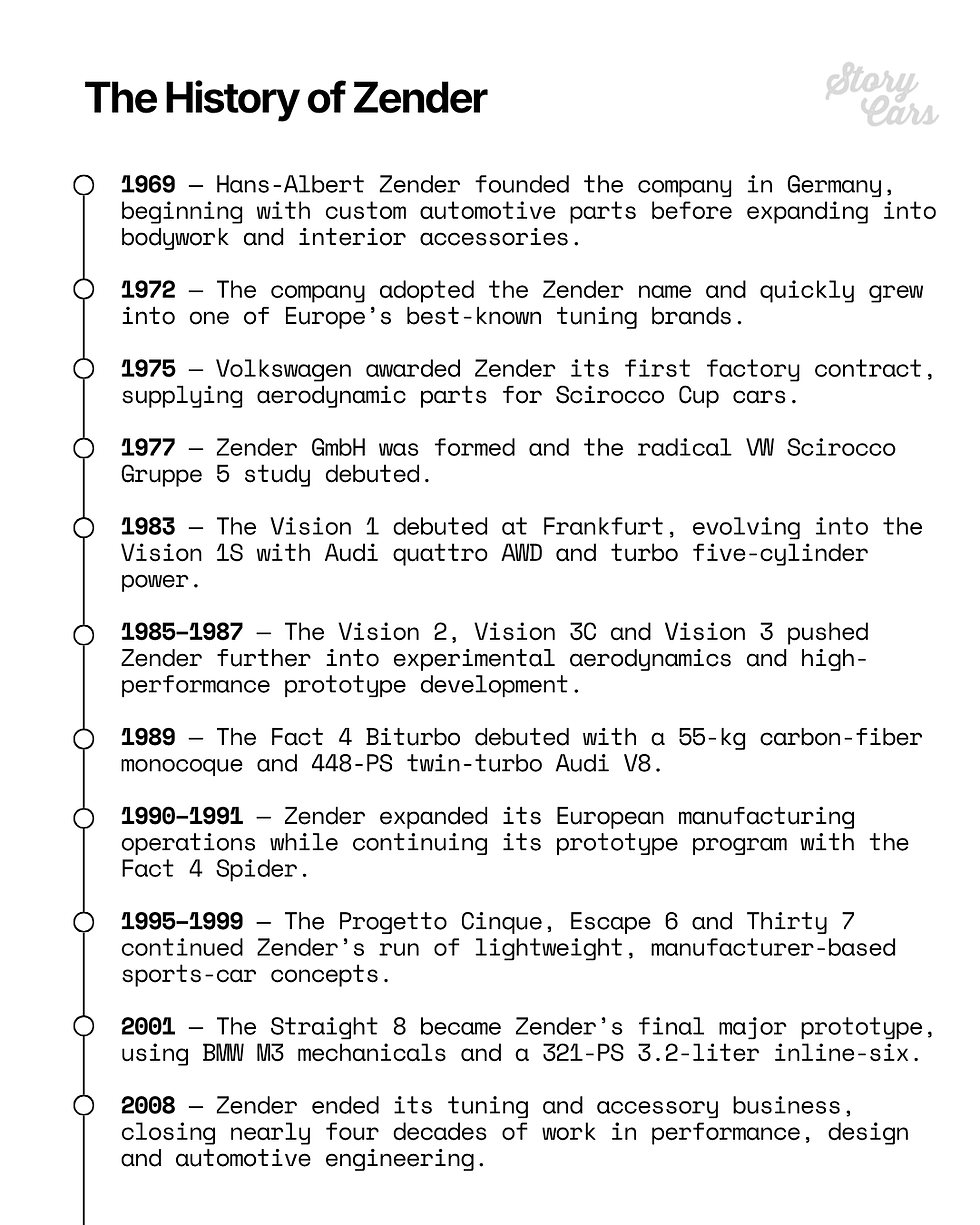
Founded in 1969 by Hans-Albert Zender, the German company began in a garage near Koblenz, producing custom bucket seats and fiberglass fender extensions for cars like the NSU TT. By 1975, Volkswagen had hired Zender to supply aerodynamic components for its Scirocco Cup racers. What followed was an increasingly ambitious series of concept cars that served as rolling demonstrations of the company's engineering, materials, and design capabilities. Some were fully functional sports cars; others were little more than beautifully sculpted shells. All made a convincing argument that Zender had outgrown the aftermarket catalog.

1977 Zender VW Scirocco Gruppe 5
Zender's first radical Scirocco study took Volkswagen's modest front-wheel-drive coupe and dressed it for an entirely different tax bracket. Inspired by Group 5 racing, the 1977 concept featured enormously widened fenders, a deep front air dam, aggressive side bodywork, and a towering rear wing. It built on Zender's experience supplying aerodynamic components for Volkswagen's Scirocco Cup cars, taking the familiar Giugiaro-designed shape well beyond anything available at a dealership. The Gruppe 5 was primarily a styling and aerodynamic showcase rather than a documented factory competition car. Practicality had clearly been left somewhere beneath the original body panels.

1981 Zender VW Scirocco Z 40 Turbo
Compared with the Gruppe 5, the 1981 Scirocco Z 40 Turbo looked almost restrained, at least until someone opened the door. Beneath its aerodynamic body kit sat a turbocharged 1,588cc Volkswagen four-cylinder producing a reported 143 PS, enough for a claimed 210 km/h (130 mph) top speed and 0–100 km/h in 7.6 seconds. The exterior received revised bumpers, side skirts, wider wheels, and an integrated rear spoiler, while the interior took a decidedly space-age approach to dashboard design. It was considerably more sophisticated than simply attaching fiberglass to a showroom Scirocco, although the resulting price was rather less modest than Volkswagen probably intended.

1983 Zender Vision 1S
Zender's first independently styled sports car began with the Vision 1, unveiled at Frankfurt in 1983 and subsequently developed into the Vision 1S. Under its dramatic fiberglass-and-carbon-reinforced body sat the platform and four-wheel-drive system of the Audi quattro, complete with a turbocharged 2.2-liter five-cylinder producing approximately 240 PS. The 2+2 coupe featured upward-opening doors, retractable headlights, adjustable Zender/Koni suspension, and enormous 285-section Pirelli P7 rear tires. Higher-output versions were advertised with up to 300 PS, while claimed top speeds ranged from 235 to 270 km/h. It retained Audi's mechanical foundations but apparently wanted nothing to do with Audi's design department.

1985 Zender Vision 2
By 1985, Zender had abandoned the idea of making its prototypes resemble conventional automobiles. The Vision 2 arrived at Frankfurt with an impossibly low wedge-shaped body, exaggerated rear haunches, and a specially designed underbody intended to function as an aerodynamic diffuser. At just 107 centimeters (42 inches) tall and nearly two meters wide, it had the proportions of an endurance racer and the visual subtlety of a flying doorstop. There was only one complication: the Vision 2 had no engine. It was strictly a body and aerodynamic study, making its impressive-looking performance potential entirely theoretical.

1986 Zender Vision 3C Roadster
The Vision 3C Roadster took the previous year's wedge-shaped experiment and removed most of what separated the occupants from the atmosphere. Presented at the 1986 Geneva Motor Show, it retained the Vision family's low nose, angular bodywork, broad shoulders, and deep side intakes, now arranged around an open two-seat cockpit. Measuring just 110 centimeters (43 inches) tall, the car looked ready to challenge Ferrari and Lamborghini despite initially being presented as a design study rather than a finished production-ready sports car. Its greatest achievement was establishing the shape that would soon receive considerably more serious mechanical attention.

1987 Zender Vision 3
The Vision 3 finally gave Zender's futuristic bodywork the powertrain it deserved. Developed from the preceding roadster study, the 1987 coupe used a mid-mounted 5.5-liter V8 sourced from the Mercedes-Benz 560 SEL, producing 300 PS and delivering a claimed top speed of 282 km/h (175 mph). Designer Günther Zillner refined the body in a wind tunnel, generating enough aerodynamic downforce to avoid the enormous rear wings favored by contemporary supercars. At approximately 1,350 kilograms (2,976 pounds), it remained a substantial machine, but the combination of Mercedes engineering and Zender styling produced something far removed from its donor luxury sedan.

1989 Zender Fact 4 Biturbo
The Fact 4 Biturbo marked Zender's most serious attempt at building a genuine supercar. Unveiled at Frankfurt in 1989, it featured a carbon-fiber monocoque and an exceptionally lightweight carbon body shell reportedly weighing just 55 kilograms (121 pounds). Behind the occupants sat a modified 3.6-liter Audi V8 equipped with two turbochargers, producing an extraordinary 448 PS (442 hp). Zender claimed 0–100 km/h in 4.3 seconds and a top speed of approximately 315 km/h (196 mph). The company described it as the world's first road-approved automobile with a carbon-fiber monocoque, years before the material became familiar supercar vocabulary. Development reportedly cost around two million Deutsche Marks, which helps explain why exactly one was built.

1991 Zender Swiftster
After building carbon-fiber supercars with enough power to embarrass a Ferrari, Zender turned its attention to a Suzuki Swift. The result was the Swiftster, an aggressively modified speedster based on the 1.3-liter Swift GTi, retaining its 101-PS four-cylinder engine. The roof and conventional windshield disappeared in favor of tiny wind deflectors, while individual roll hoops, exposed sports seats, vivid pink bodywork, and contrasting blue trim completed the transformation. Zender had previously experimented with a more conventional Swift-based Speedster, but the Swiftster pushed the idea into considerably less practical territory. It was a budget sports car for anyone who considered wind protection a sign of weakness.

1991 Zender Fact 4 Spider
The Fact 4 Spider was Zender's attempt to make its earlier supercar concept more financially realistic, although nobody would mistake it for an economy model. Revealed at Frankfurt in 1991, the open-top prototype replaced the Biturbo's expensive carbon-fiber monocoque with a purpose-built tubular-steel chassis while retaining lightweight composite bodywork. A naturally aspirated 3.6-liter Audi V8 produced 250 PS, moving approximately 1,230 kilograms (2,712 pounds) through a claimed 0–100 km/h sprint in 5.8 seconds. Its upward-opening doors reportedly weighed just three kilograms each, and a removable hardtop followed in 1992. Despite the more manageable engineering, the Spider never entered series production. Apparently, removing two turbochargers wasn't enough to make a hand-built supercar affordable.

1995 Zender Progetto Cinque
The 1995 Progetto Cinque abandoned the angular excess of Zender's earlier prototypes in favor of a flowing Italian-inspired roadster. Built around a purpose-designed tubular frame, it used the 2,959cc V6 from the Alfa Romeo Spider, producing 192 PS and offering a reported top speed of 225 km/h (140 mph). Its silver body featured rounded fenders, low-set headlights, a distinctive Alfa-inspired grille, and an unusually clean profile. Developed to demonstrate Zender's capabilities to Alfa Romeo, the project reportedly impressed the company's chief designer, Walter de Silva, who visited Zender to inspect it. The result helped establish a productive relationship between the two companies. Not every concept car needed 450 horsepower to justify its existence.

1997 Zender Escape 6
For the Escape 6, Zender combined the lightweight foundations of a Lotus Elise with an engine from a considerably less exotic corner of the Volkswagen Group. Introduced at the 1997 Frankfurt Motor Show, it featured an Elise-derived chassis, Zender-developed suspension, composite bodywork, and a 2.8-liter Volkswagen VR6 producing 174 PS. The finished prototype weighed approximately 850 kilograms (1,874 pounds), giving it a favorable power-to-weight ratio and a claimed 0–100 km/h time of 5.8 seconds. Its compact, rounded body looked more production-ready than many earlier Zender designs, although the company still stopped at a single prototype. Lotus handling philosophy, Volkswagen mechanicals, and not a single conventional body panel left untouched.

1999 Zender Thirty 7
Built to celebrate Zender's 30th anniversary, the Thirty 7 was originally named 307, representing 30 years and the company's seventh major prototype study. Like the Escape 6, it used a Lotus Elise chassis, but this time the engine was a turbocharged 1.8-liter Volkswagen four-cylinder producing a claimed 240 PS. Zender added its own suspension, a dramatically low body, and an open cockpit with individual roll hoops and virtually no weather protection. Standing just 97 centimeters (38 inches) tall, the car dispensed with both a conventional roof and usable luggage space. The anniversary present was apparently intended for someone who traveled light and checked the forecast religiously.

2001 Zender Straight 8
Zender's final major concept car arrived at Frankfurt in 2001 wearing the wonderfully misleading name Straight 8. Despite the badge, the roadster was powered by a 3.2-liter BMW M3 inline-six producing 321 PS, with the mechanical foundations supplied by an M3 Cabriolet. Zender developed the body and interior independently, wrapping the familiar BMW hardware in a low, angular roadster with distinctive front lighting and a specially developed color-shifting finish called Vert Soleil. Depending on the light, the paint appeared to change its underlying shade. The Straight 8 never became a production car, but it provided one final demonstration of Zender's ability to turn familiar mechanical components into something almost unrecognizable.
The End of an Unusually Ambitious Tuning Company
Zender's prototypes were never intended to become a full production lineup. They were engineering showcases, promotional tools, and occasional exercises in seeing how far a relatively small German company could push an idea. Along the way, Zender developed expertise in aerodynamic design, composite construction, lightweight structures, and specialized vehicle manufacturing, supporting its work with major manufacturers including Volkswagen, Ford, Fiat, and Opel.
On September 1, 2008, Zender discontinued its tuning and accessory business, closing the chapter on nearly four decades of aftermarket experimentation. Its prototype legacy remains far more interesting than the average collection of body kits: a company that started by widening the fenders of other people's cars and eventually decided it would be easier to design the whole thing itself.



Comments