
1941 Ford Soybean Car: Henry Ford's Forgotten Farm-to-Fender Experiment
.png/v1/fill/w_320,h_320/file.jpg)
In 1941, Henry Ford unveiled a car that looked like an ordinary prewar sedan but had a rather unusual ingredient list. Instead of conventional steel bodywork, it featured experimental plastic panels made with agricultural materials, mounted over a tubular-steel frame and powered by a familiar Ford flathead V8.
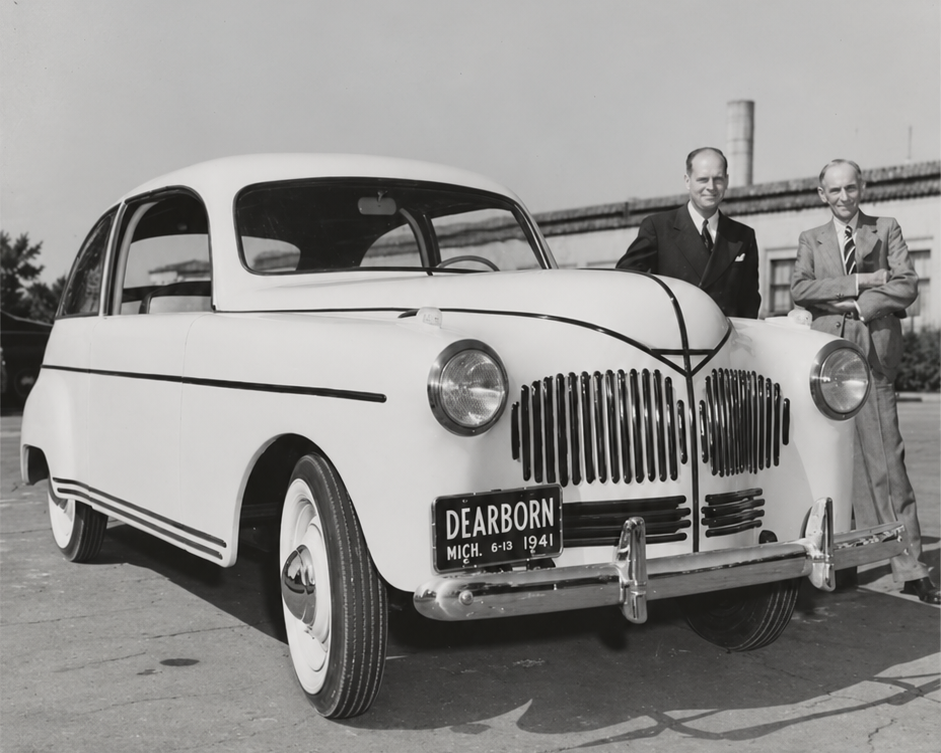
Known as the Ford Soybean Car, the prototype was part of Ford's attempt to connect American farming with automobile manufacturing. He wanted crops to supply factories, reduce dependence on steel, and create an entirely new market for farmers. It was an ambitious idea from a man who had already put soybeans into everything from automotive paint to gearshift knobs.
The resulting car was approximately one-third lighter than a conventional steel-bodied Ford, attracted national attention, and disappeared before ever reaching production. Its exact plastic formula disappeared with it.
Ford's Growing Obsession with Soybeans
Henry Ford began investing heavily in soybean research in 1931, establishing a laboratory at Greenfield Village in Dearborn, Michigan, to investigate industrial uses for agricultural products.
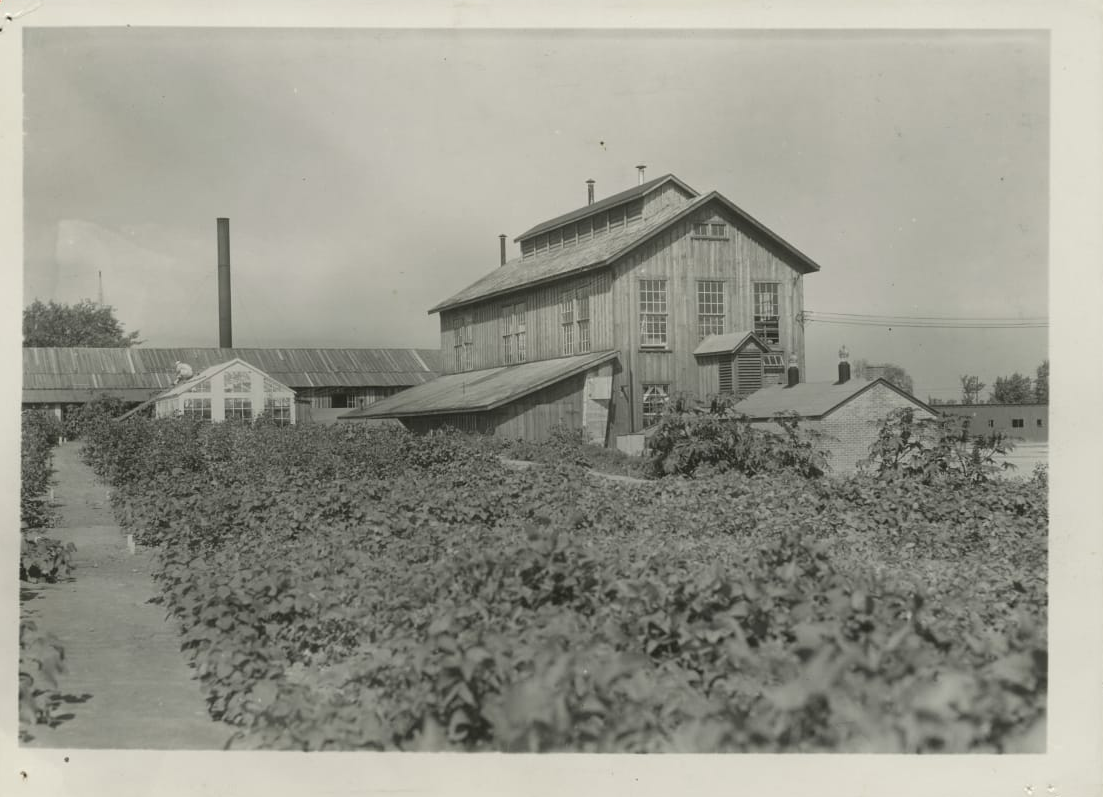
By the mid-1930s, Ford was already using soybean oil in automotive paint and soybean meal in molded plastic components, including gearshift knobs and horn buttons. The company even advertised its soybean-based paint, turning what would normally be a rather uninteresting manufacturing detail into a selling point.
Ford believed agriculture and industry could support one another. Farmers would gain new customers, manufacturers would gain alternative raw materials, and automobiles could become lighter and less dependent on conventional metals. The next logical step was to replace the metal body panels themselves. At least, that was Ford's version of logic.
George Washington Carver and Henry Ford

Ford's interest in agricultural materials brought him into contact with George Washington Carver, the prominent Black American agricultural scientist whose research at Tuskegee Institute explored new uses for crops, particularly peanuts, sweet potatoes, and soybeans.
The two met in 1937 at a conference in Dearborn focused on chemurgy, the industrial use of agricultural products. Their shared interests developed into a friendship, with visits, correspondence, and discussions about how plant-based materials might serve American industry.

The actual vehicle project was carried out by Ford's engineering and research staff, particularly Lowell E. Overly and chemist Robert A. Boyer. Designer E.T. "Bob" Gregorie had initially been placed in charge, but Ford eventually transferred responsibility to Overly and the Soybean Laboratory.

Lowell Overly in the 1941 Soybean Car
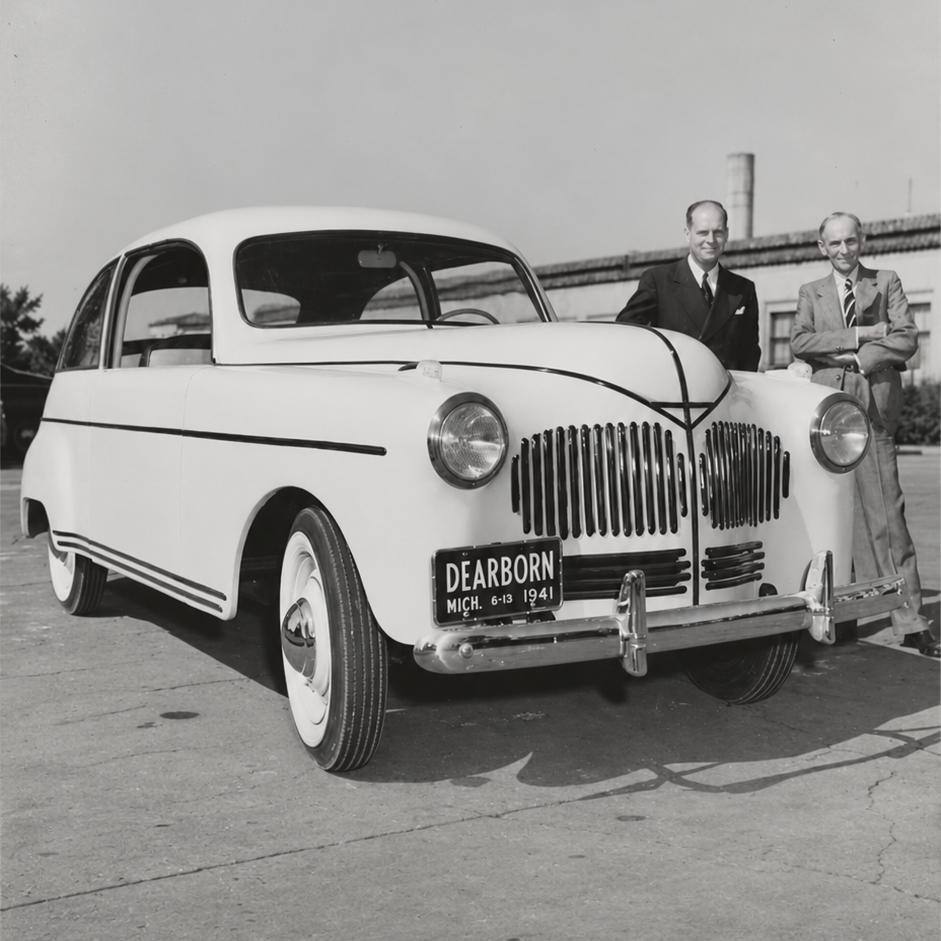
Henry Ford (right) and chemist Robert A. Boyer (left) standing next to the 1941 Soybean Car

Ford Motor Company Designer E.T. "Bob" Gregorie
Carver was a scientific colleague and an influence on Ford's wider agricultural ambitions, rather than a documented designer of the prototype. After the car's unveiling in August 1941, he even wrote to congratulate Ford on the achievement.
A Plastic Body with a Real V8
Unveiled on August 13, 1941, at Dearborn Days in Michigan, the Soybean Car was a functioning automobile rather than a static design exercise.
Its rounded, cream-colored body featured 14 molded plastic panels attached to a tubular-steel structure. The windows used lightweight acrylic, while the mechanical components remained considerably more conventional.

Power came from a 136-cubic-inch (2.2-liter) Ford V8-60 flathead engine, producing 60 horsepower. The engine, chassis components, and running gear were drawn from Ford's existing technology, allowing the engineers to concentrate on developing the unusual bodywork.

The weight savings were substantial. At approximately 2,000 pounds (907 kg), the prototype weighed roughly 1,000 pounds less than a comparable 3,000-pound steel-bodied Ford. That represented a reduction of about one-third, with potential benefits for performance, efficiency, and material consumption.
Ford also believed the plastic panels could resist dents and offer improved safety compared with steel. These were ambitious claims rather than benefits established through modern crash testing.
Despite the agricultural bodywork, the Soybean Car still ran on gasoline. Its V8 had no particular interest in becoming a vegetable.
The Secret Recipe Nobody Preserved
For a car named after soybeans, surprisingly little is known about the exact material used to manufacture its body.
Contemporary accounts described mixtures involving soybeans, wheat, hemp, flax, ramie, and other ingredients. Some accounts emphasized cellulose-based materials, while others discussed combinations of agricultural fibers and synthetic resins.
Lowell Overly, one of the people most closely involved in construction, later described the material as soybean fiber in a phenolic resin, with formaldehyde used during impregnation.
The distinction matters. The Soybean Car wasn't built entirely from compressed soybeans or a completely natural plastic. It used an experimental composite intended to combine agricultural fibers with the strength and moldability of chemical resins.
Unfortunately, no complete formula was preserved, and the original body panels no longer exist for examination. Exactly which ingredients were used, and in what proportions, remains uncertain.
Ford did secure patents related to experimental automobile body and chassis construction. One frequently associated with the Soybean Car, U.S. Patent 2,269,452, was granted in January 1942 and covered chassis construction rather than the missing plastic formula.
The engineering drawings survived, but the recipe didn't.
Henry Ford's Famous Axe Demonstration
One of the Soybean Car's most recognizable images shows Henry Ford swinging an axe at the rear of an automobile, apparently demonstrating the remarkable durability of his experimental plastic.
There was, however, a significant detail missing from the publicity.
The car being struck wasn't the Soybean Car. It was Ford's personal production automobile, fitted with an experimental plastic trunk lid made to demonstrate the material's properties.

The axe also had a protective rubber covering placed over its sharp end. Ford could strike the panel hard enough for the tool to rebound without demonstrating what an exposed steel blade would do to the material.
The test was intended to illustrate the plastic's resistance to impacts and dents, not establish its structural safety in an accident. Nevertheless, photographs of the demonstration became closely associated with the Soybean Car itself.
It was an effective piece of automotive publicity, even if the equipment deserved a more detailed caption.
World War II Ended the Experiment
Following its August 1941 debut, the Soybean Car appeared at the Michigan State Fairgrounds and generated considerable interest in the automotive press.
An August 1941 report in TIME described the prototype's unusual construction and noted that Robert Boyer hoped limited production might become possible by 1943. The project still required significant development, particularly in manufacturing processes and tooling for the molded body panels.
Then American automobile manufacturing had more immediate concerns.
The United States entered World War II in December 1941, and civilian automobile production soon gave way to military manufacturing. Steel, factory capacity, engineering resources, and production equipment were redirected toward the war effort.
A second Soybean Car prototype was reportedly under construction when the project was suspended. It was never completed.
After the war, Ford's priorities shifted toward restarting civilian automobile production. The experimental plastic car was not revived, and the proposed agricultural alternative to conventional steel bodywork never made it into dealerships.
What Happened to the Original Soybean Car?
Only one completed, functioning Soybean Car is known to have been built, and it no longer exists.
According to Lowell Overly, the original prototype was eventually destroyed by Ford designer E.T. Gregorie. Its precise fate is otherwise poorly documented, and the vehicle never became part of The Henry Ford Museum's collection.
What survives are archival photographs, engineering drawings, contemporary press reports, patent documents, and firsthand accounts from those involved in its development.
The photographs provide an unusually detailed record of the car's tubular structure, conventional running gear, distinctive bodywork, and the people responsible for assembling it. They also show just how much experimentation occurred behind a design that, from a distance, looked surprisingly ordinary.

The Soybean Car's Lasting Legacy
The Soybean Car never entered production, but its underlying idea didn't disappear entirely.
Decades later, Ford returned to agricultural materials in automotive manufacturing. Soy-based foam debuted in the 2008 Ford Mustang and eventually became widely used in seat cushions, seatbacks, and headrests across Ford's North American vehicle lineup.

The technologies were different, but the basic ambition was familiar: replace some petroleum-derived materials with renewable agricultural resources without sacrificing the practical requirements of a production automobile.
Henry Ford's original prototype was far from a finished commercial product. Its body material was experimental, its manufacturing process required further development, and the war ended any realistic chance of immediate production.
Still, the 1941 Soybean Car demonstrated that an automobile didn't necessarily need a conventional stamped-steel body. It combined agricultural research, composite materials, lightweight construction, and ordinary Ford mechanical components into a single working prototype.
One completed car, a missing plastic formula, and an agricultural experiment that took decades to find its way back into Ford vehicles.


Comments