
1956 Chrysler Norseman Concept: The Chrysler That Sank 70 Years Ago
.png/v1/fill/w_320,h_320/file.jpg)
Most concept cars eventually retire to museums, disappear into private collections, or meet an unceremonious end at the crusher. The 1956 Chrysler Norseman managed something considerably more unusual: it sank to the bottom of the Atlantic Ocean before making its public debut. Designed in Detroit and painstakingly constructed by Carrozzeria Ghia in Italy, the Norseman was one of Chrysler's most ambitious experiments of the 1950s, featuring an almost pillarless passenger compartment, aluminum bodywork, an electrically retractable glass roof section, and a proper Hemi V8.
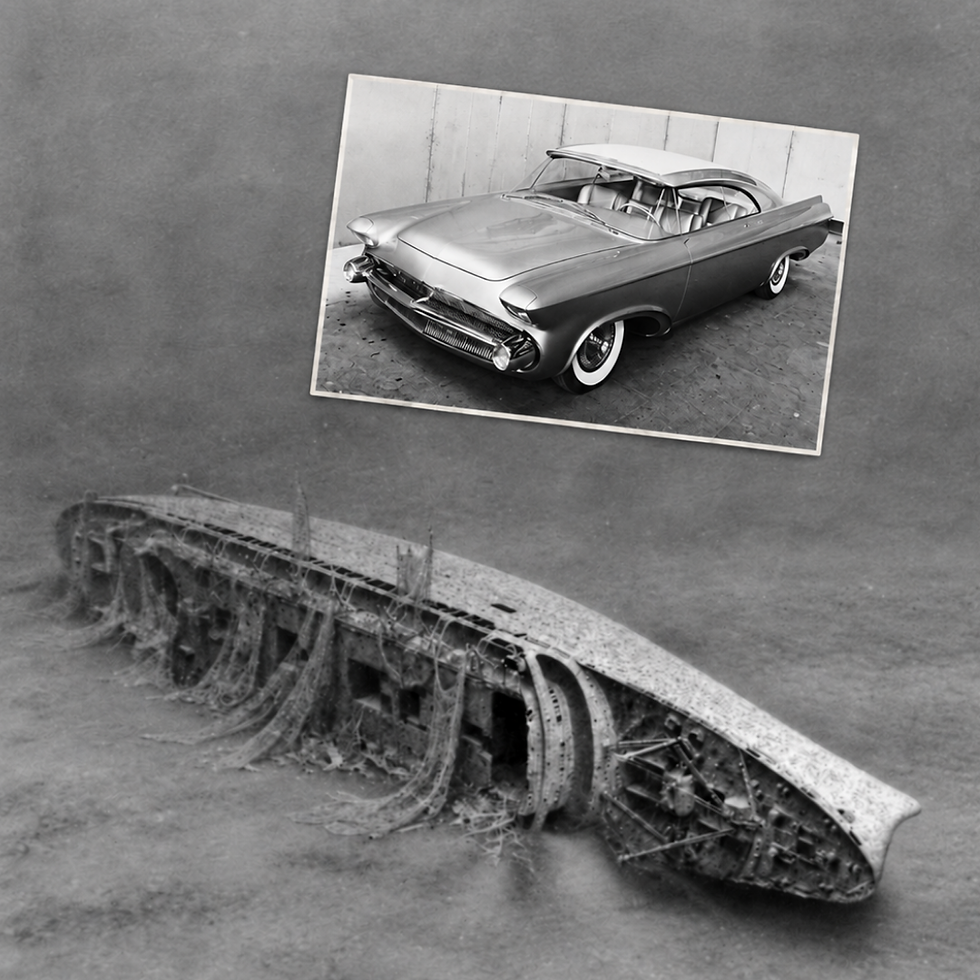
After roughly two years of development and a reported investment of $150,000, the finished prototype was packed for shipment to New York aboard the Italian ocean liner SS Andrea Doria. On July 25, 1956, the ship collided with another passenger liner off Nantucket, Massachusetts, and sank the following morning, taking 51 lives across the two vessels and Chrysler's one-of-a-kind automobile with it. Seventy years later, the Norseman remains one of Detroit's most fascinating missing concept cars, with only a handful of photographs documenting an automobile that almost nobody got to see.
A Detroit Dream with an Italian Passport
By the early 1950s, Chrysler styling chief Virgil Exner was busy dragging the company out of its conservative postwar design era. His emerging Forward Look philosophy emphasized lower rooflines, longer proportions, improved visibility, and increasingly dramatic tailfins. To demonstrate ideas too expensive or unconventional for immediate production, Exner developed a series of experimental vehicles Chrysler called Idea Cars. These weren't supposed to be ordinary production models wearing expensive paint. They were intended to explore genuinely new approaches to automotive styling, engineering, and passenger accommodation.
Exner had also established a productive relationship with Luigi Segre, who headed the Italian coachbuilder Carrozzeria Ghia in Turin. The partnership produced several remarkable Chrysler concepts, including the K-310, d'Elegance, and Falcon. Italy offered the craftsmanship needed for complicated one-off bodywork without tying up an American production facility, making Ghia an ideal partner for Detroit's more expensive daydreams.
The Norseman originated in Chrysler's own studios, where designer William "Billie" Brownlie proposed eliminating conventional windshield pillars altogether. Working under Exner alongside designers including Cliff Voss and Deo Lewton, Brownlie helped develop a sleek four-passenger fastback with a roof supported principally from the rear. Chrysler named it the Norseman, reportedly referencing Exner's Norwegian ancestry, and commissioned Ghia to turn the ambitious drawings into a functioning automobile.
Unlike some previous Chrysler-Ghia collaborations, the Norseman was constructed primarily from detailed engineering and surface drawings rather than a full-size clay model sent from Detroit. Ghia's prototype department, supervised by Sergio Coggiola, spent approximately 15 months manufacturing the car, hand-forming aluminum panels over a full-size wooden body buck. Chrysler's original announcement stated that the design had already spent a year on the drawing boards before construction began. Later accounts put the total effort at approximately 50,000 labor hours, with development costs commonly estimated between $150,000 and $200,000 in 1956 dollars. For that money, Chrysler could have purchased a respectable fleet of production cars. Instead, it ordered one without windshield pillars.
A Roof with Nothing to Lean On
The Norseman's defining engineering achievement was its cantilevered roof, a design intended to provide nearly uninterrupted outward visibility without the thick structural pillars found on conventional automobiles. Instead of relying on A-pillars at the windshield and B-pillars between the side windows, the roof was principally supported by substantial steel arches rising from the rear body structure. Two slender quarter-inch steel rods occupied the windshield corners, helping hold the roof assembly in tension while preserving the appearance of a nearly frameless glass enclosure.
Building such a structure was an enormous challenge for Ghia. The roof extended forward from its rear supports, placing unusual demands on the body structure and the specially developed wraparound windshield. Chrysler worked with glass manufacturer PPG Industries on a strengthened windshield intended to withstand the stresses imposed by the unconventional arrangement. Even so, the design raised obvious questions about rollover protection. According to later accounts from the design team, the slender rods were intended to break during a rollover, theoretically allowing the cantilevered roof to spring upward rather than crush the passenger compartment.
Chrysler reportedly claimed that the roof could support eight times the automobile's weight, but no surviving crash-test results substantiate that figure. The proposed safety benefits therefore remained theoretical. It was clever structural experimentation, although modern crash engineers might have appreciated a few more conventional pillars.
As if the roof wasn't complicated enough, the Norseman incorporated a 12-square-foot electrically operated glass panel that retracted forward to open the roof above the rear passengers. Some historical accounts describe this feature as a retractable rear window or backlight, reflecting the unusual shape and location of the moving glass. Either way, Ghia had to integrate a sizable powered mechanism into an exceptionally thin roof structure with little conventional support. The side windows also omitted the small triangular vent windows common to American automobiles of the period, further cleaning up the passenger compartment. The result was an extraordinary amount of glass wrapped around four occupants, with remarkably little visible metal holding everything together.
Hemi Power in an Italian Suit
Beneath its experimental bodywork, the Norseman retained familiar Chrysler mechanical components. The working prototype reportedly used a 331-cubic-inch (5.4-liter) FirePower Hemi V8 producing 235 horsepower, driving the rear wheels through a two-speed PowerFlite automatic transmission. Its pushbutton gear selector was thoroughly modern by mid-1950s standards, although the engine itself was considerably less exotic than the bodywork surrounding it. Chrysler's original July 1956 announcement confirmed the PowerFlite transmission and an advanced Chrysler engine but did not publish the engine's displacement or horsepower. The 331-cubic-inch specification comes from later technical histories and accounts associated with the design team.
The Norseman rode on a specially constructed, Chrysler-derived chassis with substantial frame rails, cross-bracing, and a full-length underbody panel designed to smooth airflow beneath the car. Some later histories describe a modified 1955 Chrysler chassis with torsion-bar front suspension and rear leaf springs, although the exact suspension arrangement is less securely documented than the vehicle's dimensions and powertrain. Unlike a static styling buck, the Norseman was built with functioning running gear, brakes, steering, and normal automotive mechanical systems.
At 227.5 inches (5,779 mm) long, 80 inches (2,032 mm) wide, and just 57 inches (1,448 mm) tall, the Norseman was nearly 19 feet of American luxury-car proportions stretched over a 129-inch (3,277 mm) wheelbase. Its aluminum bodywork was intended to reduce unnecessary mass, while the low hood, smooth undertray, and streamlined fastback helped address aerodynamic drag. Chrysler never published a verified curb weight, top speed, acceleration figure, or drag coefficient, so claims about its actual road performance remain speculative.
Stylistically, the Norseman was unusually restrained compared with many contemporary American dream cars. Its long hood dipped between sharply defined front fenders, while concealed headlights sat above an oval chrome grille filled with closely spaced vertical elements. Thin floating bumpers and prominent corner pods gave the nose a distinctly futuristic appearance without requiring the usual acreage of chrome. Along the sides, a crisp character line extended toward subtle tailfins, ending in an elaborate rear treatment with oval bumper openings and vertically arranged groups of three small round taillights. Even the exterior door handles and trunk release were concealed. The whole thing looked surprisingly close to a production automobile, provided Chrysler's accountants never inspected the roof.
First-Class Accommodations
Inside, the Norseman was intended to demonstrate that its unusual structural design could coexist with the convenience and comfort expected from a luxury automobile. Four individual bucket seats replaced the conventional front and rear benches, with wide center consoles separating the occupants. Historical photographs show a padded dashboard, satin-finished metal trim, and instruments mounted in unusual pods suspended beneath the dashboard's upper edge. Brownlie was closely associated with the instrument-panel design, while Deo Lewton contributed to the cabin's overall treatment.
Contemporary descriptions and later design-team accounts mention electrically adjustable seating, pivoting front seatbacks to improve rear access, retractable two-point lap belts, and metallic green-and-gray leather upholstery. The consoles incorporated storage compartments and belt hardware, while a small pull-out writing surface was reportedly fitted beneath the front passenger's side of the dashboard. Ghia's records also describe experimental luminescent paint applied to the backs of the front seats as a method of illuminating the passenger compartment.
These details gave the Norseman an unusually sophisticated interior for 1956. Retracting seatbelts were still uncommon, individually adjustable rear seats were far from typical, and the powered glass roof was something most American buyers wouldn't encounter for decades. Chrysler hoped to demonstrate a level of automation and passenger convenience well beyond its showroom offerings. The car even found room for a writing desk, presumably for anyone whose journey required correspondence more urgent than arriving safely.
A Mystery in Metallic Green
One of the stranger details surrounding the Norseman is that historians cannot establish its finished paint scheme with complete certainty. In Chrysler's original July 26, 1956 announcement, the company described the car as wearing two-tone metallic green with red accents inside the flared wheel openings. That remains the strongest contemporary manufacturer description, but it is not the only version of the story.
Brownlie later recalled that Exner had requested silver bodywork with contrasting dark roof treatment and red interior upholstery. Italian journalists who reportedly saw the finished automobile before shipment described two shades of blue. Accounts attributed to Exner's son, Virgil Exner Jr., further complicate matters by describing light metallic green with a silver roof.
Unfortunately, Ghia photographed the finished car only sparingly before shipment, expecting Chrysler to arrange extensive studio photography once it arrived in the United States. The surviving original photographs are black and white, and no verified contemporary color photograph of the completed Norseman is known to exist. Its exact combination of body, roof, and interior colors therefore remains disputed. Many modern photographs circulating online are colorized images, illustrations, or digital reconstructions rather than genuine period color photography.
For a car developed at considerable expense to show the world what Chrysler's future might look like, the decision to postpone the color photography proved particularly unfortunate.
A One-Way Ticket on the Andrea Doria
With construction finally completed, the Norseman was prepared for its transatlantic journey in July 1956. Historical accounts place its loading aboard the SS Andrea Doria at Genoa on July 17, with the finished prototype destined for New York and eventually Chrysler's American facilities. Unlike ordinary passenger automobiles stored in the ship's garage, the Norseman was reportedly packed inside a protective wooden crate and secured in the vessel's No. 2 cargo hold. The arrangement was intended to protect the hand-built vehicle during the crossing, ensuring it arrived in suitable condition for publicity photography and the 1957 auto-show season.
The Andrea Doria was among Italy's most prestigious ocean liners, a 697-foot luxury vessel that entered service in 1953. Its amenities included three outdoor swimming pools, lavishly decorated public rooms, and elaborate Italian artwork. On its final voyage, the ship carried approximately 1,706 passengers and crew, traveling from Italy toward New York. Among the passengers were families emigrating to America, vacationers, and business travelers. Somewhere beneath the passenger decks sat Chrysler's expensive automotive experiment, boxed up like particularly complicated furniture.
Late on July 25, the Andrea Doria approached the northeastern United States through increasingly heavy fog. At the same time, the Swedish passenger liner MS Stockholm was departing New York for Gothenburg, Sweden. Both vessels carried radar equipment, but their crews developed conflicting interpretations of the other ship's position and intended course. At approximately 11:10 p.m., some 40–50 miles south of Nantucket, the Stockholm's reinforced bow struck the Italian liner's starboard side, penetrating deep into passenger cabins and damaging critical watertight compartments.
The collision killed people aboard both ships and left the Andrea Doria rapidly taking on water. The Italian liner developed a severe starboard list, preventing the crew from launching half its lifeboats and making evacuation exceptionally difficult. Nearby vessels responded to the distress calls, including the damaged Stockholm itself and the French liner SS Île de France, which turned back to assist. The French ship launched 13 lifeboats and rescued 753 survivors, while other responding vessels helped evacuate the remaining passengers and crew.
The Andrea Doria remained afloat through the night, finally sinking at approximately 10:09 a.m. on July 26, 1956. Of the 51 people killed in the disaster, 46 were aboard the Italian liner and five were crew members of the Stockholm. More than 1,600 people were rescued from the Andrea Doria, making the response one of the most significant civilian maritime rescue operations of its era.
As the abandoned liner rolled farther onto its starboard side and disappeared beneath the Atlantic, it carried its remaining cargo down with it. That included the Norseman, still packed away and waiting for an American unveiling that would never take place.
Chrysler's Most Unfortunate Press Release
On July 26, the same day the Andrea Doria sank, Chrysler issued a formal statement confirming the loss of its experimental automobile. The company identified the car by name, outlined its unusual construction, and acknowledged that recovery was impractical. According to the company's New York shipping agent, the ship had sunk in approximately 200 feet of water and the vehicle was considered a complete loss. Chrysler also confirmed that the Norseman was insured, a detail that probably offered considerably more reassurance to the accounting department than to the designers awaiting its arrival.
The Norseman had been intended as a centerpiece of Chrysler's 1957 auto-show appearances, where the public would have been able to examine its pillarless construction, moving glass roof, lightweight aluminum bodywork, and experimental interior. Later accounts also suggest Chrysler intended to crash-test the vehicle after its exhibition tour to evaluate the strength of its unusual roof. That testing never happened, leaving one of the project's most important engineering questions unanswered.
Virgil Exner was reportedly recovering from a heart attack when the ship sank, and his family initially hesitated to tell him what had happened. According to recollections from his son, Exner ultimately appreciated the peculiar historical significance of losing a one-of-a-kind show car in a famous shipwreck, despite the disappointment of never seeing it reach the public.
Chrysler did not commission a replacement. Recreating the Norseman would have required another lengthy and expensive construction program, and the 1957 model year was rapidly approaching. The car had always been an experimental design study rather than a production model awaiting launch, so its sinking did not directly cancel a planned showroom automobile. It did, however, eliminate the opportunity to evaluate and promote an unusually ambitious piece of Chrysler engineering.
The Norseman Was Found, But Never Recovered
For nearly four decades, the Norseman's precise condition remained unknown. The wreck of the Andrea Doria settled on its starboard side at a depth of roughly 240 feet (73 meters), becoming one of the world's most challenging technical diving sites. Strong currents, poor visibility, extreme depth, and the gradual collapse of the vessel's interior made its cargo areas particularly hazardous to explore.
During dives in the early 1990s, underwater researcher David A. Bright reported locating the Norseman's remains in the ship's No. 2 cargo area. Bright, an experienced wreck diver who had extensively explored the Andrea Doria, encountered the vehicle while searching the interior for a missing diver. According to his account, the protective wooden crate had disintegrated, and decades of saltwater exposure had reduced much of the automobile to corroded, largely unrecognizable debris.
Bright reported that its surviving tires helped identify the wreckage, but the remaining bodywork and mechanical components were in extraordinarily poor condition. He subsequently visited the location on other dives, with his last reported visit to the Norseman's resting place occurring in 1994. In a retrospective account published in February 2006, Bright explained that deterioration of the cargo hold made it doubtful that anyone would safely reach the vehicle again.
His warning carried particular weight. On July 8, 2006, Bright died after another expedition to the Andrea Doria, where he had been documenting the wreck in preparation for the 50th anniversary of the sinking. He was 49 years old and had completed more than 100 dives to the site during his career.
Attempts to recover the Norseman have occasionally been discussed by collectors and enthusiasts, including concept-car collector Joe Bortz, but no authenticated recovery of the complete vehicle, its Hemi engine, or substantial identifiable bodywork has been documented. Even before the wreck's continuing structural collapse, experts questioned whether anything recognizable could survive salvage, let alone restoration. After seventy years underwater, the remaining structure is likely buried within a severely deteriorated and increasingly inaccessible section of the liner.
The Future Chrysler Never Got to Test
Although the Norseman never appeared at an auto show, several elements of its styling were remarkably forward-looking. Its long fastback roof, pronounced rear sail panels, restrained tailfins, and clean side surfaces anticipated visual themes that became familiar during the 1960s. Automotive historians have drawn comparisons with the 1965 Rambler Marlin and later Dodge Charger designs, although similarities alone do not establish that those cars were directly influenced by the lost prototype.
The Norseman's most distinctive engineering feature, its cantilevered pillarless roof, never entered Chrysler production. Whether its structural challenges could have been solved economically remains unknown, and the absence of completed crash testing makes any claims about its safety impossible to verify. Its Hemi engine, automatic transmission, and general chassis engineering were relatively conventional, but its body construction, visibility, powered glass, and interior conveniences represented the kind of ambitious experimentation that made postwar American concept cars so interesting.
Seventy years after the Andrea Doria sank, the Norseman remains a remarkable example of an automobile whose legend has grown almost entirely from the things nobody got to see. The original car has never been publicly displayed, no verified period color photographs have surfaced, and the only people known to have examined its remains found little more than wreckage.
Chrysler designed the Norseman to give drivers an almost unobstructed view of the world. Instead, the world got a handful of photographs, some engineering drawings, and a one-of-a-kind Hemi-powered coupe resting somewhere inside a collapsing ocean liner. For a company determined to show America the future, it was a particularly unfortunate way to miss the unveiling.


Comments