
2026 Smart Concept #2
- Story Cars
.png/v1/fill/w_320,h_320/file.jpg)
- Apr 24
- 3 min read
Smart has spent the last few years trying to grow beyond the tiny city cars that made the brand famous, but the Concept #2 suggests the company understands where its identity really came from. Unveiled as a small two-seat electric concept, the Smart #2 previews a production model that will serve as a direct successor to the third-generation Smart Fortwo, which went out of production two years ago. For a brand now jointly run by Mercedes-Benz and Geely, this is more than just another electric model. It is a return to the basic idea that made Smart stand out in the first place: a compact, clever, urban car built for cities rather than highways, suburbs, or status.

The Concept #2 is slightly larger than the old Fortwo, measuring 2,792 mm long compared with 2,695 mm for the third-generation car, but it remains extremely small by modern standards. Its turning radius of 6.95 meters keeps it close to the original Smart formula, where maneuverability mattered as much as styling or performance. That compact footprint is important because Smart’s recent move into larger compact and mid-size electric models has not completely reshaped how people see the brand. To many car enthusiasts, Smart still means a short, two-seat city car, and the #2 appears to lean directly into that memory.
Visually, however, the Concept #2 is far more polished and fashion-led than the original Fortwo. Instead of a purely functional urban runabout, it looks almost like a designer object on wheels. The soft porcelain-colored body, gold-toned hardware, strap-like door handles, decorative leather-style details on the front bumper, translucent matte wheel covers, mirror caps, and white tires all push the car into a more lifestyle-driven space. It does not just look small and practical. It looks styled, curated, and intentionally upscale.
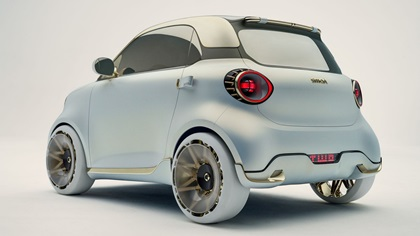
That fashion influence appears to come strongly from Mercedes-Benz design culture, especially the work of retired chief designer Gorden Wagener. The lighting elements use cross-like graphics that echo the star motifs found on newer Mercedes-Benz models, while the small decorative slashes around the headlights and taillights feel like exterior versions of the trim details Mercedes has used inside its cabins. The result is a Smart that feels more elegant than the Fortwo, but also more closely tied to Mercedes’ current design language.
The interior has not yet been shown, which leaves one of the biggest questions unanswered. Smart’s recent models have leaned heavily into large screens, glossy surfaces, and a premium-tech aesthetic, but that approach does not always feel natural in a tiny city car. The best small cars usually succeed because they make clever use of limited space, not because they try to feel like shrunken luxury vehicles. If the production Smart #2 can balance modern technology with simple, functional packaging, it could feel much more convincing than if it simply borrows the same interior formula used in larger electric crossovers.
Under the body, the Smart #2 is based on a new Electric Compact Architecture platform developed specifically for this model. It will be fully electric, with a single motor mounted at the rear axle, keeping a connection to the Fortwo’s rear-driven layout. Smart has only released one major technical figure so far: a WLTP range of 300 km, or about 186 miles. That is roughly twice the range of the electric third-generation Fortwo and could make the #2 far more usable as a daily car. The old electric Fortwo made sense for short urban trips, but its limited range kept it from feeling flexible. A 186-mile rating gives the new car a much stronger argument.
The production version is expected to debut in October at the Paris Motor Show, which makes sense given the car’s likely market. Smart does not appear to be aiming this model at China in a major way, partly because a small premium EV has little chance of making a major splash there against cheaper domestic competition. Europe is the more natural home for a car like this, especially in dense cities where parking is tight, emissions rules are strict, and a compact electric two-seater can still feel genuinely useful.
The challenge will be price. The Smart #2 will likely not be cheap, and that could limit its appeal. The original Smart worked because it was unusual, efficient, and unmistakably urban, but a premium electric city car has to justify itself in a market filled with larger, more practical EVs. Still, Smart may have a better chance by returning to its roots than by trying to compete with every other electric crossover brand.
In that sense, the Concept #2 feels like a correction. Smart’s larger models may help broaden the lineup, but they do not fully explain why the brand exists. A tiny two-seat EV does. The Concept #2 brings Smart back to the kind of car people still associate with its name: small, distinctive, city-focused, and just strange enough to be memorable.


Comments