
2006 Lamborghini Miura Concept
.png/v1/fill/w_320,h_320/file.jpg)
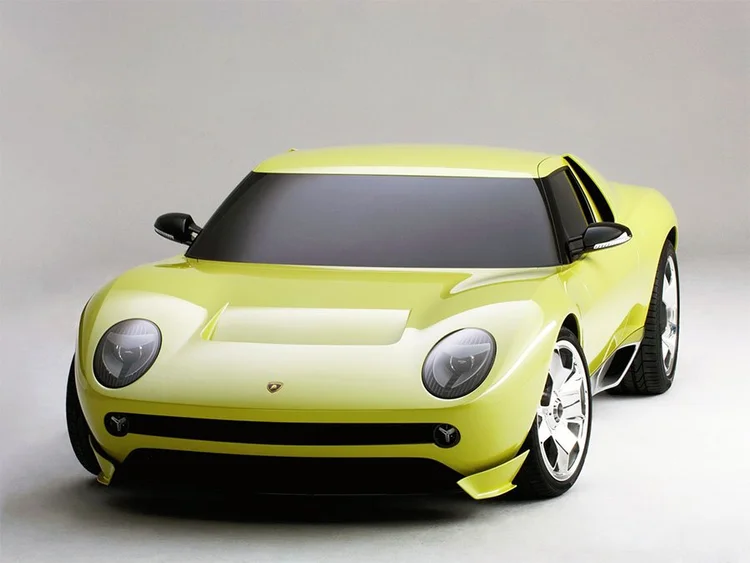


The 2006 Lamborghini Miura Concept was a modern reinterpretation of one of Lamborghini’s most important cars, created to celebrate the 40th anniversary of the original Miura. Designed by Walter de Silva, it kept the impossibly low roof, wide rear shoulders, short overhangs and basic proportions of Marcello Gandini’s 1966 original, then cleaned everything up for the 21st century. Lamborghini showed it at the 2006 North American International Auto Show in Detroit, and for a few minutes the world wondered if the Miura was actually coming back.
The Lamborghini Miura Concept was the first Lamborghini credited to Walter de Silva after he became head of Lamborghini Design while also leading design for the Audi Group. De Silva had reportedly wanted to reinterpret the Miura for about two years, and the project finally gave him the opportunity. Rather than redesign the car from scratch, his team treated the original shape almost like protected architecture: keep what made it recognizable, modernize what age had made impractical and resist the urge to cover it in vents.
The car it celebrated needed little introduction. The original Lamborghini Miura P400 was designed by Marcello Gandini at Bertone and publicly unveiled at the 1966 Geneva Motor Show. Its transversely mounted 3.9-liter V12 sat behind the cabin, helping establish the basic mid-engine layout that would come to define the modern supercar. Forty years later, de Silva’s concept deliberately kept the same visual relationship between a tiny nose, cabin pushed forward and a huge amount of body wrapped around the rear wheels.
Lamborghini’s current historical material describes the 2006 Miura Concept as being based on the Gallardo platform, adapted for the design study. The company never released an official engine output, torque figure, acceleration time or top speed for the concept, and the original 2006 announcement focused almost entirely on design rather than performance. Claims that it used a specific Murciélago V12 configuration have circulated for years, but Lamborghini did not include those specifications in its original release, so there is no reason to bolt production-car numbers onto a concept that was never sold.
Visually, the concept was unmistakably a Miura. The nose retained the original car’s wide oval headlights and black surrounds, but the famous eyelashes were simplified into modern detailing. The hood kept the original’s low, almost flat shape, while large lower intakes gave the front enough cooling and aerodynamic drama to remind everyone this was still a Lamborghini from 2006.
The side profile was even more faithful. A single clean curve ran from the nose over the cabin and down toward the rear, while the doors carried large black air intakes modeled after the original Miura’s openings. The concept also used modern center-lock wheels designed to echo the Miura’s classic magnesium wheels. De Silva modernized nearly every surface without changing the part everyone actually cared about: the silhouette.
The rear received a similar treatment. Horizontal black vents covered much of the engine area, recalling the louvers of later Miuras, while thin modern taillights replaced the more delicate lamps of the 1960s car. Large exhaust outlets and a more developed lower diffuser brought the aerodynamics into the modern era without turning the back of the car into an air-conditioning unit.
Inside, Lamborghini kept the same philosophy. The cabin was modernized but deliberately restrained, using a simple driver-focused layout rather than trying to predict a future full of screens. The shapes, trim and controls were contemporary, but the interior still felt connected to the original Miura rather than looking like a Gallardo dashboard wearing vintage clothing.
Despite the reaction it received, the 2006 Lamborghini Miura Concept never entered production. Lamborghini ultimately made it clear that the car was a celebration of its history, not the start of a retro model line. CEO Stephan Winkelmann argued that Lamborghini needed to look forward rather than revive old designs, effectively ending hopes of a second-generation Miura. It was an unusually disciplined decision from a company that had just built a yellow supercar specifically to remind everyone how good its yellow supercar from 1966 looked.
The 2006 Lamborghini Miura Concept remains significant because it showed how carefully a historic design could be modernized without turning it into a caricature. It never needed fake performance numbers or a production run to make its point. Forty years after Gandini’s original changed the shape of the supercar, Walter de Silva proved that very little about that shape actually needed fixing.

Comments