
2006 Hyundai HED-3 Arnejs Concept
.png/v1/fill/w_320,h_320/file.jpg)
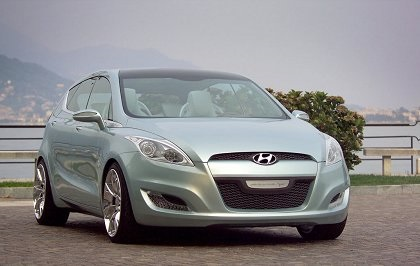
The 2006 Hyundai HED-3 Arnejs Concept was a five-door C-segment hatchback created as a near-production preview of Hyundai’s next European compact car. Pronounced “Ar-nez,” it combined a 170-hp 2.0-liter VGT diesel, five-speed automatic transmission and 19-inch wheels with styling that was considerably more dramatic than the Hyundais sharing parking lots in 2006. It debuted at the Paris Motor Show on September 28, 2006, and unlike many concept cars, there was already a production car hiding underneath it.
The Hyundai HED-3 Arnejs Concept was designed at Hyundai’s European Research and Design Centre in Rüsselsheim, Germany, under European chief designer Thomas Bürkle. Internally, the production program was known as FD, and Hyundai developed it specifically to compete in Europe’s crowded C-segment against cars such as the Volkswagen Golf, Ford Focus and Opel Astra. The Arnejs followed the HED-2 Genus and continued the European studio’s emerging design language, which Hyundai called “Dynamic Sculpture.”
The concept measured 4,335 mm (170.7 in) long, 1,840 mm (72.4 in) wide and 1,488 mm (58.6 in) tall, with a 2,649 mm (104.3 in) wheelbase. Under the hood was a 2.0-liter VGT turbo-diesel producing 170 hp, paired with a five-speed automatic transmission. It rode on polished 19-inch aluminum wheels wrapped in 245/35 R19 low-profile tires. Hyundai did not publish the concept’s torque, weight or performance figures, so there is little reason to invent a 0–60 time for a show car that was really there to explain what the next Hyundai hatchback would look like.
Styling was built around flowing, wave-like surfaces first explored on the HED-2 Genus. The front used a large hexagonal grille, swept-back headlights filled with jewel-like lighting elements and heavily sculpted bumper openings. Convex and concave surfaces ran into pronounced wheel arches, while an aluminum trim piece on each front fender carried the Arnejs name.
The roof was one of the concept’s best details. The windshield appeared to continue almost uninterrupted into a wave-shaped panoramic glass roof, which narrowed as it stretched toward the rear spoiler and third brake light. Along the sides, a rising shoulder line and deeply sculpted doors made the five-door hatchback look lower and more coupe-like than its practical layout suggested.
Hyundai went even further inside. The cabin used four individual seats, flowing dashboard surfaces and a center console shaped around the same natural-wave theme as the exterior. The concept eliminated conventional visible pillars between the side windows, while the glass could retract completely to create a much more open cabin. The steering wheel, air vents, door handles and instruments were treated almost like individual pieces of industrial design rather than parts pulled from a production dashboard.
The important part is that the 2006 Hyundai HED-3 Arnejs Concept actually led somewhere. Hyundai unveiled the production i30 at the 2007 Geneva Motor Show, and its basic proportions, long wheelbase, character lines and overall shape clearly carried over from the Arnejs. The wild roof, pillarless glass and 19-inch wheels stayed on the show stand, but the underlying design became Hyundai’s first C-segment model developed specifically around European buyers.
That makes the HED-3 more than another forgotten mid-2000s concept. The Hyundai HED-3 Arnejs Concept was essentially the first-generation i30 wearing its show-car clothes, and it arrived at an important point in Hyundai’s transformation from a value-focused Korean manufacturer into a company willing to develop cars specifically for European tastes. For once, the concept-car promise of “this previews our future” was basically true.
Comments