
2006 Kia Soul Concept
.png/v1/fill/w_320,h_320/file.jpg)
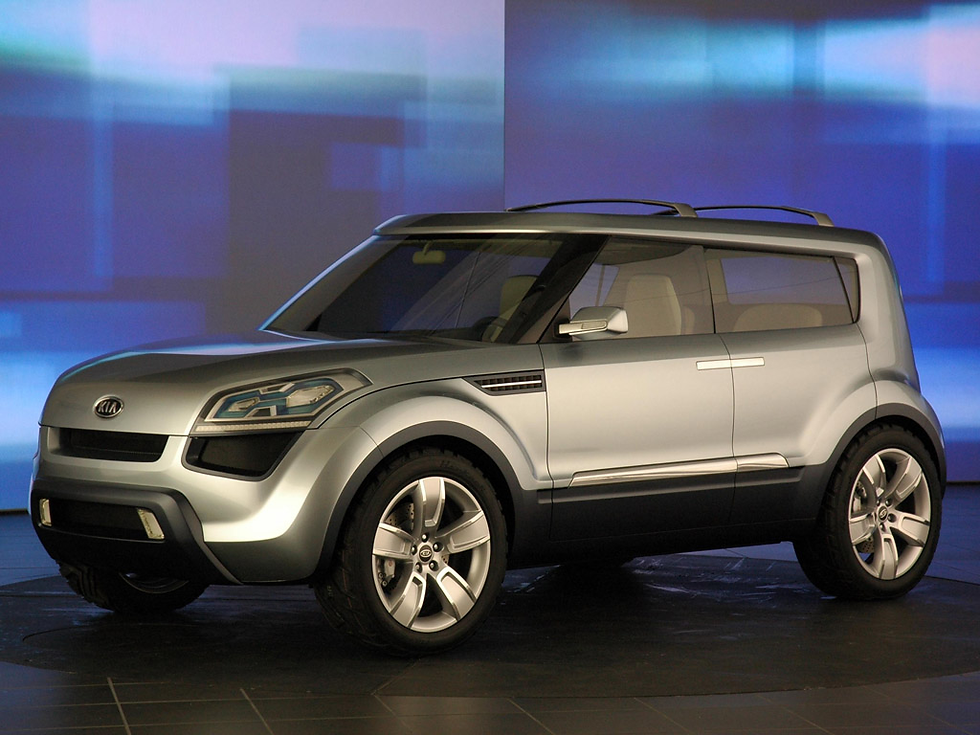
The 2006 Kia Soul Concept was the boxy crossover that eventually gave Kia one of its most recognizable production cars. Unveiled at the 2006 North American International Auto Show in Detroit, it combined a 2.0-liter four-cylinder engine, five-speed automatic transmission and front-wheel drive with rear-hinged doors, no B-pillars, a panoramic roof and an interior designed around its stereo system. For a company still best known for inexpensive transportation, the Soul looked like someone in the design department had finally been allowed to have fun.
The Kia Soul Concept was a joint project between Kia’s design studios in California and South Korea, led on the American side by Kia Motors America chief designer Tom Kearns. Kia even sent a California designer to Korea for roughly six weeks during development. The shape also built on ideas from the 2005 Kia Mesa Concept, but pushed them into a smaller, more urban crossover. The name was deliberate: “Soul” referred both to giving the car some personality and to Seoul, the South Korean home of Kia.
The concept measured about 159 inches (4,039 mm) long, 72.8 inches (1,849 mm) wide and 64 inches (1,626 mm) tall, with a 100-inch (2,540 mm) wheelbase. Power came from a 2.0-liter inline-four gasoline engine connected to a five-speed automatic transmission with a manual-shift mode, driving the front wheels. Kia also fitted adaptive cruise control. The point was not outright performance; it was creating a small vehicle with the stance and usefulness of a crossover without turning it into another conventional compact SUV.
Its proportions did most of the work. A wraparound windshield, oversized wheel arches, short overhangs and a slightly sloping roof gave the Soul a sturdy, almost toy-like shape. Front and rear brush guards added some fake-trail toughness, while side vents helped cool the engine compartment. The headlights incorporated the grille into a single graphic, and the taillights were mounted high on the rear corners, a feature that would survive remarkably well into the production Soul.
The doors were much less conventional. The front doors opened normally while the rear doors were rear-hinged, and there was no fixed B-pillar between them. Opening both sides created a large uninterrupted entrance to the cabin. Kia called them “freestyle” doors, which sounds more cheerful than “suicide doors” and was probably easier to put in a press release.
Above the cabin was a panoramic glass roof with a front section that could slide backward over the rear portion, opening both rows to the sky. Integrated roof rails could move equipment forward and backward, reinforcing the Soul’s active-lifestyle theme. At the rear, the powered liftgate included one of the concept’s strangest ideas: a separate drawer-like storage compartment that folded outward for muddy shoes, wetsuits, hiking gear or even a skateboard. Dirty cargo basically got its own mailbox.
The interior was built around high-end audio equipment rather than treating the stereo as something added afterward. Kia specifically designed the dashboard around the front speakers, positioning them for better sound quality. The cabin also included a notebook computer mounted on a swing-out tray in the glovebox area, Bluetooth, MP3 support, USB ports, Wi-Fi and telematics, plus fold-up rear entertainment displays in the full-length center console. For 2006, it was carrying enough connectivity hardware to qualify as a small office.
Two semi-bucket seats filled the front, while the rear seats could fold flat to expand the cargo area. Ambient lighting surrounded the panoramic roof and appeared in the door panels, giving the otherwise practical cabin a slightly nightclub-like atmosphere. The whole interior was designed to be reconfigurable, social and technology-focused rather than simply maximizing the number of cupholders.
The 2006 Kia Soul Concept proved unusually important because Kia actually followed through. The company approved the Soul for production, and the showroom model made its debut at the 2008 Paris Motor Show before reaching buyers as a 2010 model in the United States. Kia’s later design chief Peter Schreyer oversaw its evolution toward production, while teams in Korea, Europe and the United States worked to preserve the original concept’s character. The rear-hinged doors and some of the wilder interior features disappeared, but the upright body, high-mounted taillights, unusual roofline and basic personality remained surprisingly intact.
The original Kia Soul Concept helped mark the point where Kia began using design as something more than decoration. It previewed a production model that became a long-running part of the brand, won design recognition and looked almost nothing like the conventional compact cars surrounding it. Plenty of concepts claim to show the future; the Soul basically showed up two years early and waited for the factory to catch up.

Comments