
2006 GM EcoJet: Jay Leno’s 650-HP Biodiesel-Powered Turbine Supercar
.png/v1/fill/w_320,h_320/file.jpg)

The 2006 GM EcoJet is one of the most unusual concept cars General Motors has ever built. Developed with Jay Leno and unveiled at the 2006 SEMA Show in Las Vegas, the EcoJet combined the proportions of an exotic mid-engine supercar with technology more closely associated with aircraft.
Instead of a conventional gasoline V8, the GM EcoJet used a Honeywell LT101 gas turbine engine. The turbine produced approximately 650 horsepower and 600 Nm (about 443 lb-ft) of torque, while the car weighed only around 2,400 pounds (1,090 kg).
The concept was also designed to operate on biodiesel, giving the EcoJet an environmental angle that contrasted sharply with its aviation-inspired engineering and dramatic supercar appearance.
The result was not intended to preview a production Chevrolet or Cadillac. The EcoJet was an engineering and design experiment: a demonstration of what could happen when automotive design, lightweight materials, alternative fuel and turbine technology were combined in a single vehicle.

GM EcoJet Technical Specifications
Specification | 2006 GM EcoJet |
Manufacturer | General Motors |
Model | EcoJet |
Model year | 2006 |
Vehicle type | Concept supercar |
Debut | 2006 SEMA Show, Las Vegas |
Layout | Mid-engine |
Donor architecture | Chevrolet Corvette Z06-based |
Engine | Honeywell LT101 gas turbine |
Maximum power | Approx. 650 hp |
Maximum torque | Approx. 600 Nm / 443 lb-ft |
Maximum turbine speed | Approx. 20,000 rpm |
Fuel | Biodiesel / renewable plant-derived diesel fuel |
Vehicle weight | Approx. 2,400 lb / 1,090 kg |
Exterior materials | Carbon fiber and Kevlar |
Lightweight structural materials | Aluminum and magnesium |
Power-to-weight ratio | Approx. 596 hp per metric ton |
Key collaborator | Jay Leno |
Production status | One-off concept / show car |
Why GM Built the EcoJet
The EcoJet began with an unconventional question: what would happen if an aircraft-style turbine engine were installed in a lightweight supercar?
Jay Leno played an important role in turning the idea into a real vehicle. Leno is well known for his extensive car and motorcycle collection and his interest in unusual mechanical technology. The project brought that enthusiasm together with the engineering and design resources of General Motors.
An alternative-fuel concept was part of the thinking from the beginning. A hydrogen-powered vehicle was reportedly considered during the early development process, but the idea was abandoned because of the project's schedule. The team instead pursued a gas turbine capable of operating on biodiesel.
That decision ultimately defined the EcoJet.
A Honeywell Turbine Instead of a V8
The most important technical feature of the GM EcoJet concept is its Honeywell LT101 gas turbine.
A conventional piston engine generates power through combustion inside individual cylinders. Pistons move up and down, connecting rods transfer that movement to a crankshaft, and the rotating crankshaft sends power through the drivetrain.
A gas turbine works differently.
Air enters the turbine and is compressed before fuel is introduced and burned. The resulting high-temperature, high-pressure gas flows through turbine stages at tremendous speed. That energy spins the turbine assembly, producing usable rotational power.
Gas turbines offer several attractive characteristics, including a high power output relative to their physical size and weight. This explains their widespread use in aviation and certain specialized military and industrial applications.
Their use in passenger cars, however, has always been rare.
That made fitting a turbine to the EcoJet much more complicated than simply replacing one conventional engine with another.

Approximately 650 Horsepower
The Honeywell turbine installed in the EcoJet was rated at approximately 650 horsepower and 600 Nm of torque, equivalent to roughly 443 lb-ft.
The turbine could operate at speeds approaching 20,000 rpm.
Those figures become even more impressive when considered alongside the EcoJet's low weight. At approximately 1,090 kg, the concept had a calculated power-to-weight ratio of about 596 horsepower per metric ton.
For a concept vehicle developed in 2006, that was an exceptional figure.
The EcoJet therefore was not simply a design exercise with an unusual engine. On paper, its combination of turbine power and lightweight construction placed it firmly within supercar territory.
Mid-Engine Layout
Although the Chevrolet Corvette Z06 provided the starting point for the project, the finished EcoJet was fundamentally different from a normal Corvette.
One of the biggest changes involved engine placement.
A Corvette Z06 traditionally uses a front-engine configuration. The EcoJet's turbine was positioned behind the passenger compartment, transforming the vehicle into a mid-engine concept.
This was a major engineering change.
The turbine had different packaging, airflow, heat-management and exhaust requirements from the Corvette's conventional V8. GM therefore had to develop the vehicle around the unusual powertrain rather than simply fitting the turbine beneath an existing Corvette hood.
Moving the engine behind the occupants also helped give the EcoJet the proportions expected of an exotic supercar.

Lightweight Carbon Fiber and Kevlar Body
Keeping weight under control was another important part of the project.
The EcoJet weighed approximately 2,400 pounds, or 1,090 kilograms, despite carrying an unconventional turbine powertrain.
GM achieved the low weight through extensive use of lightweight materials.
The exterior panels were constructed using carbon fiber and Kevlar, while aluminum and magnesium were incorporated into the vehicle's structure.
These material choices were particularly appropriate because the EcoJet intentionally blurred the line between automotive and aviation engineering. Aluminum and magnesium have long histories in aircraft construction because engineers can use them to reduce mass while meeting demanding structural requirements.
Carbon-fiber composites offered another opportunity to create complex body shapes without the weight associated with conventional steel bodywork.

Aviation-Inspired Exterior Design
The EcoJet's aircraft influence extended far beyond its engine.
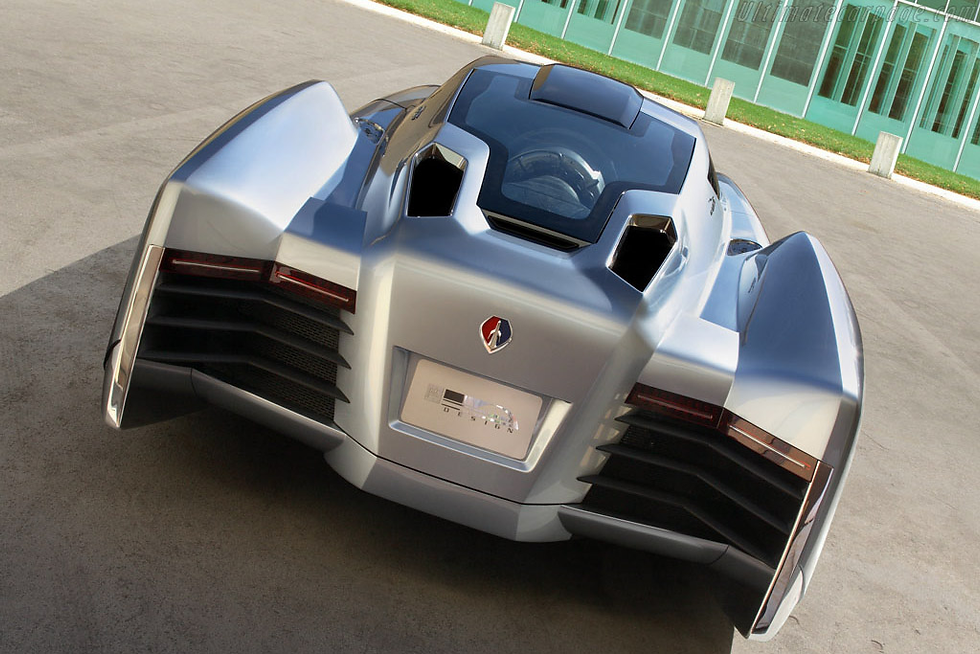
Its exterior was designed to visually communicate speed and turbine power. The car featured a very low profile, a long and dramatic windshield, pronounced wheel arches, large air openings and a wide rear section.
The body wrapped tightly around the mechanical components, creating the appearance of an aircraft fuselage adapted for road use.
Large side openings were functional as well as visual. A turbine-powered car requires substantial airflow, and the EcoJet's body had to accommodate the cooling and breathing requirements of its unusual engine.
At the rear, the design became particularly dramatic, reinforcing the impression that the vehicle was closer to a road-going jet than a conventional sports car.
GM's then-design chief Ed Welburn was closely associated with the project and described the engineering challenge in terms of combining the character of an aircraft with that of a Formula 1 car.
That description captures the EcoJet well. Its appearance was not retro, despite Jay Leno's association with historic automobiles. Instead, it was deliberately futuristic and technical.
Biodiesel Fuel Gave the EcoJet Its Name
The "Eco" portion of EcoJet was not simply marketing language.
The turbine was designed to run on biodiesel, a renewable diesel-type fuel derived from biological sources rather than relying exclusively on conventional petroleum diesel.
This created an unusual combination.
The EcoJet was a 650-horsepower supercar concept powered by technology associated with aircraft, yet GM and Leno also used the project to investigate how an alternative fuel could work in a high-performance application.
It demonstrated that environmental experimentation did not necessarily have to take the form of a small economy car.
That philosophy has become much more familiar in the years since the EcoJet appeared. Modern manufacturers routinely use electrification and alternative powertrain technology to increase performance as well as efficiency. In 2006, however, combining an alternative fuel with an extreme supercar concept was considerably less common.
Why Turbine Cars Are So Rare
If gas turbines can generate substantial power from a compact package, why aren't more road cars turbine-powered?
The answer comes down to practical compromises.
Gas turbines are extremely effective in applications where they can operate under conditions suited to their design, which is one reason they are so successful in aviation. Normal road driving presents a very different operating environment.
Passenger cars must repeatedly start, stop, idle and accelerate across a huge range of engine speeds and loads. They must also be affordable to manufacture, easy to maintain, relatively quiet and efficient during everyday operation.
A turbine introduces challenges involving fuel consumption, heat, exhaust management, throttle response, cost and packaging.
For a concept car, engineers have considerably more freedom. For a mass-production road vehicle expected to operate reliably for years in traffic, those compromises become much more significant.
The EcoJet was therefore better suited to demonstrating possibilities than establishing a realistic production formula.

The EcoJet Was Not GM's First Experience With Turbine Cars
The idea of a gas-turbine-powered automobile was not completely new when the EcoJet debuted.
Automotive companies had experimented with turbine power decades earlier. General Motors itself developed the famous Firebird turbine concepts during the 1950s and 1960s, using dramatic aircraft-inspired designs to explore the future of transportation.
Other manufacturers experimented with similar ideas. Chrysler, for example, famously developed and tested turbine-powered passenger cars during the 1960s.
The EcoJet can therefore be viewed as a modern interpretation of a much older automotive idea.
The difference was that GM could combine turbine technology with 21st-century composite materials, modern supercar design and renewable fuel.
A Corvette Connection Without Looking Like a Corvette
Calling the EcoJet a turbine-powered Corvette can be misleading.
The Corvette Z06 platform contributed to the project's foundation, but the resulting vehicle was radically reengineered. Moving the powertrain behind the occupants alone fundamentally changed the architecture.
Its carbon-fiber and Kevlar exterior also had virtually nothing in common visually with the production Corvette.
Instead of attempting to preserve Corvette styling, the designers created an entirely new shape around the turbine powertrain.
The Corvette connection is therefore best understood as an engineering starting point rather than an indication that GM intended the EcoJet to become a future Corvette model.
Built as a Show Car, Not a Production Supercar
Despite its dramatic specifications, there was never a realistic expectation that buyers would soon be able to order an EcoJet from a Chevrolet or Cadillac dealer.
The project was conceived primarily as a technology demonstrator and show car.
Producing a turbine-powered road car commercially would have required GM to solve a long list of engineering, regulatory, manufacturing, durability and cost challenges.
Fuel consumption was another major consideration. A turbine's characteristics can make sense in aircraft, but they are much more difficult to optimize for normal stop-and-go road use.
The cost of the turbine itself would also have made a production version difficult to justify.
GM did not publish the type of complete acceleration, top-speed and fuel-economy figures normally associated with a production performance car. That is important because spectacular horsepower figures alone do not establish how quickly a vehicle accelerates or how efficiently it operates.
Claims about the EcoJet's 0–60 mph time or maximum speed should therefore be treated carefully unless supported by documented testing.
Jay Leno and the EcoJet
Jay Leno's involvement is one of the reasons the EcoJet remains well known among concept-car enthusiasts.
Rather than simply lending his name to a finished vehicle, Leno participated in the development of the idea alongside General Motors.
That relationship made sense. His collection contains everything from early steam cars to modern supercars, motorcycles and turbine-powered machinery. The EcoJet's combination of unusual engineering and extreme performance fit naturally with that interest.
After completing its show-car duties, the EcoJet became closely associated with Jay Leno's collection, helping preserve the car rather than leaving it as a forgotten auto-show prototype.
EcoJet vs. Conventional Supercars
The EcoJet's most impressive statistic may be its power-to-mass ratio.
With approximately 650 hp moving only 1,090 kg, the concept works out to roughly:
596 hp per metric ton.
That figure explains why the EcoJet generated so much attention even during an era when supercar horsepower was rising rapidly.
However, power-to-weight ratios do not tell the entire performance story.
A road car's acceleration depends on transmission behavior, traction, gearing, tire performance, aerodynamic drag, torque delivery, and numerous other variables. Because the EcoJet was a one-off experimental concept rather than a fully instrumented production model, direct performance comparisons with production supercars should be approached with caution.
What the number does demonstrate is how aggressively GM pursued lightweight construction.
Why the 2006 GM EcoJet Still Matters
The 2006 GM EcoJet remains significant because it approached alternative automotive technology from an unusual direction.
It was not an electric car.
It was not a hybrid.
It was not a conventional biodiesel passenger car.
Instead, GM and Jay Leno combined a 650-horsepower gas turbine, renewable fuel, carbon fiber, Kevlar, magnesium, aluminum and mid-engine supercar architecture.
The project also arrived before high-performance alternative-powertrain vehicles became common. Today, electric motors, hybrid systems, synthetic fuels and advanced composites are routinely discussed in connection with the world's fastest cars.
The EcoJet explored a similar principle in 2006: new powertrain technology could be exciting rather than merely economical.
Its solution was ultimately too specialized for mass production, but that was not necessarily the point.
Concept cars exist partly to investigate ideas without requiring every idea to become commercially viable.
Frequently Asked Questions About the GM EcoJet
What is the GM EcoJet?
The GM EcoJet is a one-off turbine-powered concept supercar developed by General Motors with Jay Leno and revealed at the 2006 SEMA Show.
What engine does the GM EcoJet have?
The EcoJet uses a Honeywell LT101 gas turbine engine, a type of powerplant derived from aviation applications rather than a conventional automotive piston engine.
How much horsepower does the GM EcoJet produce?
The turbine produces approximately 650 horsepower.
How much torque does the EcoJet have?
Its quoted maximum torque is approximately 600 Nm, or about 443 lb-ft.
What fuel does the GM EcoJet use?
The EcoJet's turbine was configured to operate on biodiesel derived from renewable biological sources.
How much does the GM EcoJet weigh?
The concept weighs approximately 2,400 pounds (1,090 kg).
Is the GM EcoJet based on a Corvette?
The project used the Chevrolet Corvette Z06 as an engineering foundation, but the vehicle was extensively redesigned. Most importantly, its turbine was mounted behind the passenger compartment in a mid-engine configuration.
Is the EcoJet a jet-powered car?
It is more accurate to call the EcoJet a gas-turbine-powered car. Its turbine technology is related to aircraft propulsion, but the vehicle uses the turbine to provide mechanical power for the drivetrain rather than functioning like a conventional jet aircraft propelled primarily by exhaust thrust.
How fast is the GM EcoJet?
GM did not release a comprehensive set of verified production-style performance specifications for the one-off concept. Its 650-horsepower output and low weight suggest considerable performance potential, but unsupported top-speed or acceleration figures should not be presented as established specifications.
Was the GM EcoJet ever sold?
No. The EcoJet remained a one-off concept and technology demonstrator rather than becoming a production automobile.
Who designed the GM EcoJet?
The EcoJet was created by General Motors designers and engineers in collaboration with Jay Leno, with GM design chief Ed Welburn closely associated with the project.
Where was the GM EcoJet unveiled?
The car made its public debut at the 2006 SEMA Show in Las Vegas, Nevada.
Final Thoughts
Nearly two decades after its debut, the GM EcoJet remains one of the strangest and most fascinating American concept supercars of the 2000s.


Comments