
1971 AMC/Jeep Cowboy Pickup Prototype
.png/v1/fill/w_320,h_320/file.jpg)

Long before the Jeep Comanche—and decades before compact, car-based pickups came back into fashion—American Motors Corporation experimented with an unusual little truck that blended an AMC Hornet with Jeep.
It was called the Cowboy, and unlike many forgotten concepts, this one got surprisingly close to becoming a real production vehicle.
Developed around 1971, the Cowboy was AMC’s answer to two very different trends happening in the American truck market. Chevrolet’s El Camino and Ford’s Ranchero had proven there was a market for passenger-car-based pickups, while smaller Japanese trucks from brands such as Datsun and Toyota were rapidly finding American buyers. AMC wanted something compact enough to compete with the imports, attractive enough to challenge the El Camino, and—most importantly—cheap enough for AMC to actually build.
That last requirement would shape almost everything about the Cowboy.
A Pickup Born From the AMC Hornet
AMC had introduced the compact Hornet for 1970, after spending heavily to develop the new car and its tooling. At nearly the same time, AMC acquired Kaiser Jeep in 1970 for roughly $75 million, giving the company an established truck and four-wheel-drive division. AMC naturally began looking for ways to get more products—and more revenue—from both investments.
AMC product planner and former designer Jim Alexander became one of the key figures behind the Cowboy. According to Jeep historian Patrick Foster, Alexander proposed a compact pickup based on a shortened two-door Hornet body, with a rear structure added to carry a roughly six-foot pickup bed.
The project was handled through Jeep's design operation, with contemporary accounts identifying Jeep chief stylist Jim Angers and his team as part of the effort.
At first glance, building an El Camino-style Hornet seemed obvious. The problem was money.
AMC Couldn't Afford to Build It Like an El Camino
An integrated coupe-utility body would require large, unique body stampings extending from the passenger compartment into the pickup box. For General Motors, that sort of tooling investment was possible. For AMC, one of Detroit's smaller manufacturers, it was much harder to justify.
Alexander came up with a clever workaround.
Instead of stamping the cab and bed as one continuous body, the Cowboy would use a separate cab and pickup box. The Hornet's unitized body would effectively end behind the passenger compartment, while a rear stub-frame structure supported the cargo bed.
It was an unusually practical solution: build a car-based pickup without paying for an entirely new car-based pickup body.
An AMC Ambassador fuel tank was installed beneath the front portion of the bed, while the spare tire fit beneath the rear portion.
The result looked remarkably production-ready. Instead of appearing like a Hornet crudely cut behind the doors, the Cowboy had the proportions of a proper compact pickup.
There Wasn't Just One Cowboy
This is where the Cowboy's history gets muddled online.
Period histories and later research indicate that three versions were constructed, but they were not three identical running trucks.
Jeep historian Patrick Foster describes the program as consisting of a nonrunning fiberglass mock-up, a six-cylinder test vehicle, and a running test vehicle based on the Hornet SC/360 V8.
Other historical accounts describe the three visually as a red Jeep-branded Cowboy, a yellow six-cylinder version, and the best-known green-and-white V8 Cowboy.
That distinction matters, because photographs of different Cowboy iterations are often labeled online as if they show the same vehicle.




The Red Jeep Cowboy
The earliest version is generally identified as the red Cowboy carrying Jeep branding, including a Jeep script on the tailgate.
That created a branding problem.
The Cowboy was based on a rear-wheel-drive passenger car, and it did not have four-wheel drive. At the time, Jeep's identity was overwhelmingly tied to four-wheel-drive vehicles. AMC reportedly became uncomfortable selling a two-wheel-drive Hornet pickup as a Jeep, and subsequent Cowboy proposals were treated more as AMC products.
AMC would eventually develop the sophisticated full-time four-wheel-drive system that appeared in the AMC Eagle for 1980, but adapting an appropriate 4WD system for the Cowboy in the early 1970s would have added cost the project could not support.


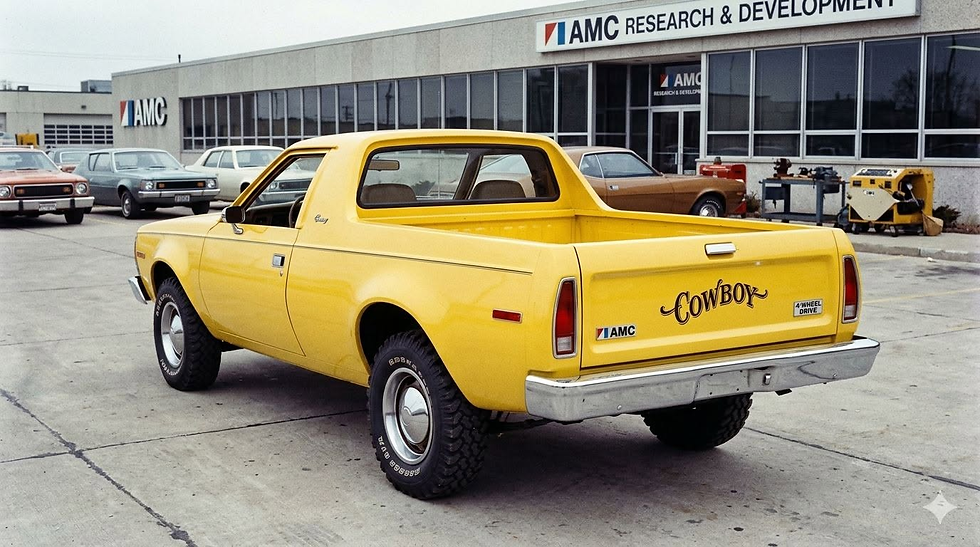
The Six-Cylinder Cowboy
Another development vehicle used an AMC inline-six and is commonly described as yellow, with styling incorporating a Gremlin-influenced front end. Later summaries identify its engine as AMC's 258-cu-in inline-six, although the strongest period-derived documentation simply describes it as the six-cylinder test vehicle.
The SC/360 Cowboy
The most significant Cowboy was built from one of AMC's rarest muscle cars: the 1971 Hornet SC/360.
Its 360-cu-in V8, equivalent to roughly 5.9 liters, gave AMC's little truck substantially more muscle than the four-cylinder compact pickups arriving from Japan. The surviving Cowboy also had a floor-mounted manual transmission, bucket-style seating, radio and air conditioning.
The donor SC/360 itself was a serious piece of machinery. A production 1971 SC/360 came standard with a 245-gross-horsepower two-barrel 360, while the optional four-barrel Go Package increased output to 285 gross horsepower.
However, those figures should not automatically be quoted as the Cowboy's horsepower. Sources establish that the surviving prototype used the SC/360's 360 V8, but available historical material does not definitively document the prototype's original carburetion and factory output configuration. Aftermarket Edelbrock cylinder heads found on the surviving truck appear to have been installed later rather than during AMC's development program.
The Design Was More Sophisticated Than It Looked
Early Cowboy design studies apparently experimented with the shorter front doors from a four-door Hornet. That configuration left the cab looking cramped.
The design evolved to incorporate the longer doors from the two-door Hornet, along with redesigned upper window framing and what historical descriptions call a “K-pillar” effect behind the side glass. That gave the cab better proportions and improved outward visibility.
What made the Cowboy interesting was that AMC wasn't merely cutting up a Hornet for publicity. Engineers were solving genuine production problems: how to reinforce a bed behind a unitized passenger-car structure, where to package the fuel tank and spare tire, and how to make the truck look intentional without investing in expensive new body dies.
In concept, it was closer to a real production engineering exercise than a typical auto-show fantasy.

So Why Didn't AMC Build It?
The Cowboy's downfall wasn't that the idea didn't work.
AMC had another Hornet derivative waiting for investment: the Hornet hatchback.
The company's manufacturing capacity and development resources were limited, and management concluded that a hatchback version of the Hornet offered greater sales potential than a compact pickup. AMC consequently shelved the Cowboy program and added a hatchback to the Hornet range for the 1973 model year.
Cost also remained an issue. Even with Alexander's clever separate-bed construction, contemporary accounts indicate AMC struggled to position the Cowboy sufficiently below vehicles such as the El Camino while meeting the project's original business case.
There was also the unresolved identity question. A two-wheel-drive pickup didn't sit comfortably under the Jeep badge, while engineering a four-wheel-drive version would have pushed development costs higher.
The Cowboy was effectively caught between three identities: AMC economy car, Jeep pickup and El Camino-style utility vehicle.
AMC chose the hatchback instead.
One Cowboy Survived
Fortunately, the Cowboy story didn't end with every prototype being crushed.
The green-and-white SC/360-based truck survives.
Historical accounts state that AMC retained it for testing at its proving grounds before eventually selling it to Jim Alexander. Alexander and his son later updated the truck with newer Hornet front-end sheetmetal and grille components. Ownership subsequently passed through collectors, and the truck has appeared at AMC enthusiast events, including the 2011 AMC World Meet.
The surviving truck therefore doesn't appear exactly as it did during the earliest Cowboy development period, which explains why historical photographs sometimes seem to show different front ends on what is described as the same prototype.
Of the Cowboy program's three known development vehicles, historical accounts generally identify the V8 SC/360 example as the sole surviving original prototype.
A Preview of the Jeep Comanche?
Calling the Cowboy a direct prototype of the later Jeep Comanche would be overstating the connection, but there is an interesting engineering parallel.
When AMC eventually launched the Jeep Comanche for 1986, it was based on the unit-body XJ Cherokee and combined that unitized passenger compartment with a substantial rear structure supporting a conventional pickup bed. The basic idea—unit-body vehicle up front, reinforced truck structure behind it—echoed the engineering problem AMC had already explored with the Cowboy more than a decade earlier.
The two trucks belonged to entirely different development programs, so the Cowboy shouldn't simply be called “the first Comanche.” But it demonstrated that AMC engineers were thinking about hybrid unit-body/pickup construction remarkably early.
The Compact Truck AMC Was Too Early to Build
Looking back, the Cowboy seems almost painfully well timed.
Compact imported pickups exploded in popularity during the 1970s. Chevrolet began selling the Isuzu-built LUV, Ford answered with the Mazda-built Courier, and Datsun and Toyota continued expanding their presence in the American truck market.
AMC already owned Jeep, already had the Hornet architecture, and had already built a surprisingly handsome domestic compact pickup capable of accepting anything from an economical inline-six to a 360 V8.
Yet the Cowboy disappeared while the compact-pickup segment around it grew.
Its cancellation wasn't necessarily irrational. AMC operated with fewer factories, less money and far less margin for failure than GM, Ford or Chrysler. The Hornet hatchback was a relatively straightforward extension of an existing successful passenger-car line. The Cowboy required AMC to establish an entirely new niche while solving cost, manufacturing and branding problems at the same time.
But more than 50 years later, the decision still makes the Cowboy one of AMC's greatest what-ifs.
This wasn't merely an auto-show truck that existed as a styling exercise. AMC built multiple development versions, engineered a practical way to hang a six-foot pickup box behind a unit-body Hornet, tested six-cylinder and V8 configurations and produced at least one running prototype that survives today.
In 1971, AMC had essentially figured out how to build an American compact pickup from one of its cheapest passenger cars.
It just never gave the Cowboy the chance to find out whether America wanted one.


Comments