

2015 Porsche Mission E: the electric future Porsche imagined before the Taycan
When Porsche unveiled the Mission E at the 2015 Frankfurt International Motor Show, it was immediately clear that the company was presenting far more than a conventional concept car. The striking four-door prototype represented the most significant technological shift undertaken by the Stuttgart manufacturer since the introduction of the Cayenne: Porsche’s definitive entry into the world of high-performance electric mobility.
At the time, much of the automotive industry was still cautiously exploring electrification. Tesla had already demonstrated that electric vehicles could offer serious performance, yet many traditional European manufacturers remained hesitant, particularly within the luxury sports segment. Porsche, however, adopted a very different approach. Rather than merely adapting an existing model, the Mission E was conceived from the outset as a dedicated high-performance EV that preserves the brand’s sporting identity.
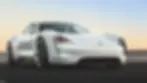
Visually, the car immediately attracted attention. Its low-slung proportions, muscular rear haunches, and flowing roofline combined classic Porsche design language with a distinctly futuristic aesthetic. The front end subtly recalled the 918 Spyder, while the rear introduced a continuous LED light signature that would later become one of the defining features of the production Taycan.
Even today, the Mission E still appears remarkably modern.
Yet the true significance of the concept lay beneath its dramatic bodywork. Technically, the Mission E showcased one of the most advanced electric architectures seen anywhere in the industry at the time. Porsche engineers developed an innovative 800-volt electrical system — while most competitors still relied on 400-volt technology — allowing substantially faster charging speeds, improved thermal efficiency and more consistent high-performance operation.
The concept used two permanently excited synchronous motors derived from Porsche’s Le Mans-winning 919 Hybrid program, producing a combined output of more than 600 horsepower. Porsche claimed acceleration from 0 to 100 km/h in under 3.5 seconds, 0 to 200 km/h in under 12 seconds, and a theoretical driving range approaching 500 kilometers under the old NEDC (New European Driving Cycle) testing standard.

Perhaps even more impressive was the charging capability. Porsche announced that the Mission E could recover approximately 80 percent of its battery capacity in only fifteen minutes using the company’s proposed 800-volt charging infrastructure. In 2015, when charging speed remained one of the major limitations of electric vehicles, such figures appeared almost futuristic.
Crucially, the Mission E was never intended to remain a purely experimental show car. Unlike many concepts that are dramatically diluted before reaching production, Porsche managed to retain much of the original design and engineering philosophy when the Taycan entered production in 2019.
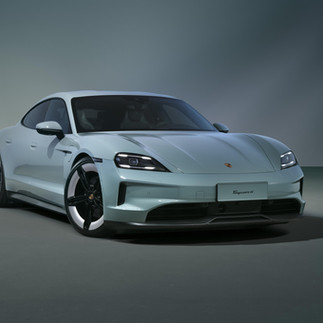
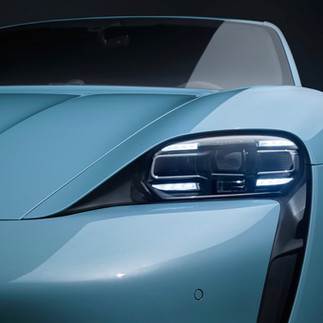
The production Taycan remained remarkably faithful to the original concept, although several changes were inevitable. The dramatic rear-hinged doors disappeared, more conventional proportions were introduced, and the highly minimalist interior evolved into a more realistic luxury environment suitable for everyday use. Nevertheless, compared with most concept-to-production transitions, the Taycan preserved an unusually high degree of visual continuity with the Mission E.


Mechanically, Porsche also retained the project’s most ambitious innovations. The Taycan continued to use the advanced 800-volt architecture introduced by the Mission E, allowing charging capacities of up to 270 kW on later versions. Under ideal conditions, this enabled the battery to charge from 5 to 80 percent in a little more than twenty minutes — still highly competitive today.
Battery capacity and performance evolved considerably across the range. Entry-level rear-wheel-drive versions produced approximately 400 horsepower, while the flagship Taycan Turbo S delivered up to 761 horsepower with launch control engaged. The latter could accelerate from 0 to 100 km/h in as little as 2.8 seconds, placing it firmly amongst the fastest production saloons ever built.
One of the Taycan’s most technically interesting features was its two-speed transmission mounted on the rear axle. Unlike most electric vehicles, which typically rely on a single-speed gearbox, Porsche introduced a second gear to improve high-speed efficiency and sustained autobahn performance — an engineering solution that reflected the company’s traditional approach to grand touring capability.
From a dynamic perspective, the Taycan rapidly established itself as one of the finest driver-oriented EVs on the market. The low center of gravity provided by the battery pack, sophisticated suspension systems, and precise steering characteristics gave the car a degree of agility and balance rarely associated with large electric saloons. In many respects, Porsche succeeded where numerous rivals struggled: translating the brand’s sporting DNA into an electrified era without completely sacrificing driving engagement.


Commercially, however, the situation has proved more complex. Although the Taycan initially attracted strong demand and considerable media attention, the global market for large luxury EVs has shown signs of slowing in recent years. Porsche has reportedly adjusted production levels in response to softer demand and changing market conditions, particularly as customers in the premium segment remain divided over the long-term appeal of fully electric performance cars.
Part of this hesitation stems from the emotional dimension traditionally associated with brands such as Porsche. While the Taycan is unquestionably fast, refined and technologically sophisticated, some enthusiasts continue to miss the visceral qualities of combustion-powered sports cars: the sound, vibration and mechanical interaction that have long defined the Porsche experience.
At the same time, competition has intensified dramatically. Chinese manufacturers have rapidly emerged as serious contenders in the EV sector, offering increasingly advanced electric vehicles with sophisticated software integration, impressive battery technology, and highly competitive pricing. In several areas, particularly charging efficiency and digital ecosystems, some Asian manufacturers now rival — or even surpass — established European brands.


This broader transformation also forms the backdrop to Ferrari’s recent unveiling of the Luce, the first fully electric model from the Maranello marque. Although the vehicle has generated enormous media attention, reactions amongst enthusiasts and industry observers have been notably divided, particularly regarding its styling and overall design philosophy. Some critics argue that the car appears more influenced by consumer electronics aesthetics than by Ferrari’s traditional visual identity.
The involvement of former Apple executive Jony Ive has only reinforced this perception. For many observers, the Luce symbolizes the growing convergence between the automotive and technology industries — a shift that not all traditional sports car enthusiasts necessarily welcome.


Nevertheless, it would be entirely wrong to consider the Mission E or the Taycan unsuccessful projects. On the contrary, the Mission E remains one of the most influential automotive concept cars of the past decade. More importantly, it demonstrated that Porsche could approach electrification not as a compromise, but as an opportunity to reinterpret performance for a new technological age.





The question that remains unresolved is whether the future of luxury motoring will truly become fully electric — or whether passionate drivers will continue searching for the emotional and mechanical character that helped transform brands such as Porsche and Ferrari into enduring automotive legends.


