
15 of the Craziest Headlight Designs in Automotive History

Headlights are usually treated as simple, practical parts of a car. They help you see. They help other drivers see you. That is supposed to be the whole job.
But throughout automotive history, designers have used headlights for much more than visibility.
Some were hidden inside fenders. Some turned with the steering wheel. Some popped up, rotated sideways, sat under glass, opened like eyelids, or looked more like sci-fi movie props than actual car parts.
This list looks at 15 of the strangest, boldest, and most memorable headlight designs ever put on production cars, prototypes, and concepts. Some were brilliant. Some were ridiculous. A few were both.











1. 1936–37 Cord 810/812
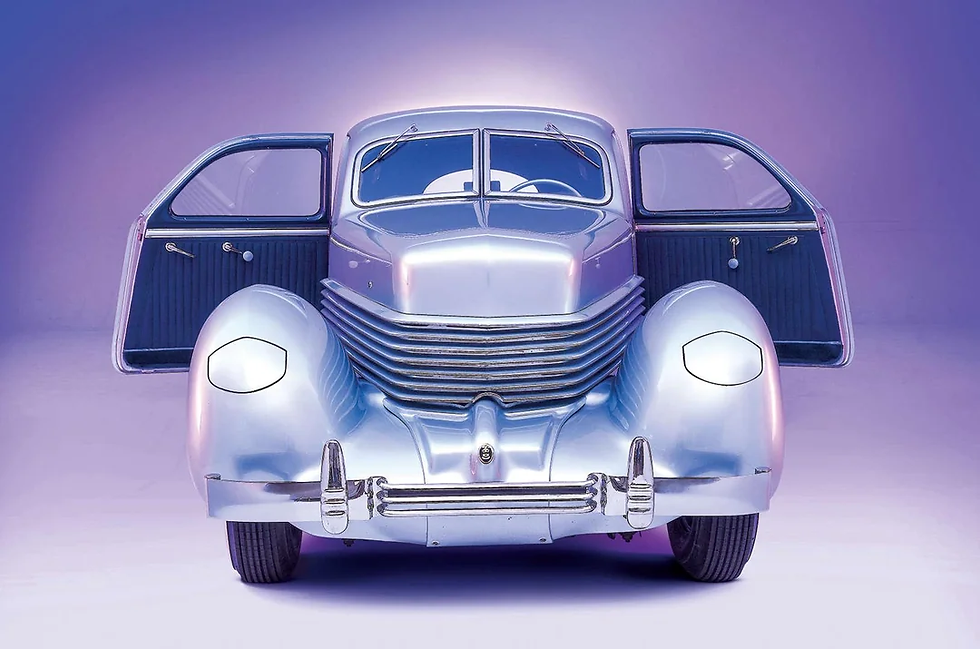
The Cord 810 and 812 were among the earliest cars to make hidden headlights famous.
Instead of placing the lamps out in the open, Cord tucked them into the front fenders. When the driver wanted to use them, they had to be opened manually with dashboard hand cranks.
That sounds almost absurd today, but in the 1930s it was wildly futuristic. The smooth front end gave the Cord a cleaner, more aerodynamic look than most cars of the era. At the same time, the whole setup was mechanical in a way that feels almost theatrical now.
Hidden headlights would later become a major design trend, especially in sports cars and wedge-shaped concepts. Cord helped prove the idea could work decades earlier.
2. 1938 Buick Y-Job Concept
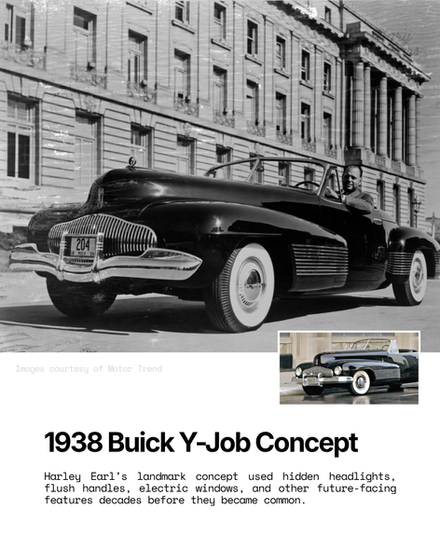
The 1938 Buick Y-Job is one of the most important concept cars ever built, and its headlights were part of the reason why.
Designed under Harley Earl, the Y-Job introduced a long list of future-facing ideas, including hidden headlights, flush door handles, and electric windows. These features were decades ahead of what most production cars offered at the time.
The headlights helped give the car a clean, low, almost custom-built appearance. They disappeared into the bodywork instead of interrupting the front end with bulky lamps.
Today, hidden headlights are usually associated with 1970s, 1980s, and 1990s sports cars. The Y-Job showed that designers were already thinking about that idea before World War II.
3. 1947–48 Tucker 48
The Tucker 48 had one of the most famous headlights in automotive history: the center “Cyclops Eye.”
Mounted in the middle of the front end, this third headlight turned with the steering wheel to help illuminate corners. It was a clever idea, especially at a time when night driving was far more challenging than it is today.
But it also made the Tucker look strange in the best way. Most cars had two headlights. The Tucker had three, with the center lamp giving the whole front end a face-like expression.
The design was so unusual that some states reportedly had laws against cars with more than two headlights. That only adds to the Tucker’s legend. It was not just different for style. It was different because the car was trying to solve a real problem in an unconventional way.
4. 1956–1962 Tatra 603
The Tatra 603 looked unusual from almost every angle, but its early headlight setup made the front end especially strange.
Early versions used three headlights under one glass cover. The center lamp rotated with the front axle, creating a nose that looked more like something from a space-age film than a normal sedan.
Tatra was never a typical car company, and the 603 proves it. The car had rear-engine engineering, aerodynamic styling, and a headlight layout that felt unlike almost anything else on the road.
The result was part luxury car, part engineering experiment, and part Cold War spaceship.
5. 1967–1975 Citroën DS / ID
Citroën has always had a reputation for doing things differently, and the DS is one of the best examples.
Later versions of the DS and ID used four lamps under glass. The inner high beams could swivel with the steering, helping the driver see through corners. Unlike some weird headlight ideas that were mostly for show, this one had a clear purpose.
The design also fit the car perfectly. The DS already looked smooth, futuristic, and almost alien compared with other sedans of its era. The glass-covered lighting made the front end feel even more advanced.
It was strange, but it was not silly. It was one of those rare designs that looked wild and actually made sense.
6. 1968–1973 Opel GT
The Opel GT had one of the most entertaining headlight mechanisms ever put into production.
Its headlights did not pop straight up like most hidden-lamp cars. Instead, they rotated sideways along a longitudinal axis. Both lights turned in the same direction, and the driver operated them with a large lever inside the cabin.
It was dramatic, mechanical, and completely unnecessary in the best possible way.
The Opel GT was already a small, sporty coupe with miniature Corvette energy. The rotating headlights gave it even more personality. They turned a simple function into an event.
A normal car turns its headlights on. The Opel GT performs.
7. 1968 Alfa Romeo Carabo
The Alfa Romeo Carabo was one of the most important wedge concepts of the late 1960s, and its lighting treatment helped define that look.
The Carabo used slatted covers over lift-up headlights. The whole front end was extremely low and sharp, with the headlights integrated into the car’s futuristic wedge shape rather than treated as separate parts.
It looked radical then, and it still does now.
The Carabo helped influence the design language that would later appear on exotic cars throughout the 1970s and 1980s. Its headlight setup was part of that message: low, hidden, aggressive, and futuristic.
This was not just a car with unusual lights. It was a preview of an entire design era.
8. 1970 Lancia Stratos HF Zero
The Lancia Stratos HF Zero barely looked like a car at all.
It was basically a wedge with a windshield, and the front lighting was reduced to a razor-thin slit. There were no traditional headlight shapes, no friendly round lamps, and no conventional front-end expression.
That was the point.
The Stratos HF Zero looked like a concept car from another planet. Its lighting made the front end feel less mechanical and more cinematic. It was closer to a prop from a dystopian sci-fi movie than a road car.
Many concept cars claim to be futuristic. The Stratos HF Zero actually looked like it had arrived from the future by mistake.
9. 1972 Maserati Boomerang
The Maserati Boomerang took the wedge idea and made it even sharper.
Designed by Giorgetto Giugiaro, the Boomerang had an ultra-flat body, a low blade-like nose, and hidden lighting that almost disappeared into the front end. The entire car looked like it had been drawn with a ruler.
Its headlights were not the main visual feature because the whole nose was the feature. That is what made the design so striking. The lighting did not interrupt the shape. It supported it.
The Boomerang helped show how far 1970s concept design could go. The headlights were part of a larger idea: make the car look like one clean, sharp object slicing through the air.
10. 1980 Aston Martin Bulldog
The Aston Martin Bulldog had one of the strangest hidden headlight setups ever seen on a supercar concept.
Instead of normal pop-up headlights, it hid a bank of five headlights behind a panel below the windshield and in the nose area. When activated, the panel opened to reveal the full light array.
That is the kind of idea that sounds fake until you see it.
The Bulldog was already extreme. It had a low, angular wedge shape and looked more like a secret engineering project than a traditional Aston Martin. The hidden five-light setup made it even more bizarre.
It was excessive, but that was part of the appeal. The Bulldog did not try to look elegant in a normal way. It tried to look advanced, rare, and slightly dangerous.
11. 1988 Italdesign Aztec
The Italdesign Aztec was strange even by concept car standards.
It had dual cockpits, a brutally angular body, and tiny slit-like lights integrated into the front end. The headlights barely looked like headlights at all. They looked more like a cyberpunk facial expression.
That makes sense for a car like this. The Aztec did not have a soft or friendly design. Everything about it felt technical, sharp, and experimental.
The lighting helped complete the look. It did not just illuminate the road. It made the car look like a machine from a future that never happened.
12. 2001 Toyota Pod Concept
The Toyota Pod was created with Sony, and its lighting was not just about visibility. It was about expression.
The car used exterior LEDs to show “emotions.” Its front lights acted like a face, with color-changing panels and eyebrow-like lighting behavior.
That makes the Pod one of the strangest entries on this list because its headlights were not only a design feature. They were part of the car’s personality.
It was a very early look at the idea of cars communicating through light. Today, many EVs and concepts use animated lighting signatures, welcome sequences, and expressive front-end graphics. The Pod took that idea to an almost cartoon-like extreme more than two decades ago.
13. 2008 BMW GINA Light Visionary Model
The BMW GINA Light Visionary Model may have the most unusual headlight opening on this list.
The car had a flexible fabric skin stretched over its body structure. The headlights were hidden underneath that material. When switched on, the fabric opened like eyelids to reveal the lamps.
It was unsettling, clever, and completely different from the usual hidden-headlight approach.
Most hidden headlights use panels, doors, motors, or rotating mechanisms. The GINA made the body itself move. That gave the front end an organic quality, almost like the car was waking up.
It was not practical for mass production, but as a design experiment, it was unforgettable.
14. 2008 Mazda Furai Concept
The Mazda Furai Concept looked alive.
Its blue LED “fangs” followed Mazda’s Nagare design language, which focused on flowing, natural forms. Instead of looking like normal lamps, the headlights and light trim became part of the car’s sculpted body.
The result was aggressive, organic, and almost aquatic. The front end looked less like a traditional race car and more like a predator.
Mazda’s own material described the Furai’s aggressive headlamps and headlamp trim pieces as part of the airflow management around the car. That made the lighting feel integrated into both the design and the function.
The Furai was already one of the most dramatic concepts of the 2000s. Its lighting helped make it unforgettable.
15. 2017 Lamborghini Terzo Millennio Concept
Lamborghini has never been subtle, but the Terzo Millennio pushed the brand’s design language into full science-fiction territory.
Its giant Y-shaped lighting elements were carved into the body, making the headlights feel like part of the structure rather than separate components. The front end looked sharp, violent, and futuristic even by Lamborghini standards.
The lights were not just decoration. They helped define the entire face of the car.
Modern supercars often use lighting signatures as brand identifiers, but the Terzo Millennio turned that idea up to maximum volume. It looked less like a production preview and more like a rolling design manifesto.
Honorable Mention: Fiat Multipla
The Fiat Multipla deserves an honorable mention because it is impossible to talk about strange automotive lighting without thinking about it.
Its stacked, awkward, bug-eyed front end made it one of the most recognizable car designs of its era. The Multipla was practical, roomy, and clever, but the front lighting layout made sure nobody would ever call it ordinary.
It may not be beautiful in the traditional sense, but it is memorable. In design history, that still counts for something.
Final Thoughts
The best headlight designs do more than light the road. They change the way a car feels.
The Cord 810/812 made hidden headlights feel futuristic before the idea became mainstream. The Tucker 48 used a third lamp to help drivers see around corners. The Citroën DS made steering headlights feel elegant and advanced. The Opel GT turned a simple mechanism into a piece of theater.
Then came the wedges: the Carabo, Stratos HF Zero, Boomerang, and Bulldog. These cars showed how headlights could disappear into the shape of the car entirely.
Later, concepts like the Toyota Pod, BMW GINA, Mazda Furai, and Lamborghini Terzo Millennio pushed lighting into new territory, using it for expression, movement, identity, and drama.
Some of these ideas were practical. Some were overcomplicated. Some were flat-out ridiculous.
That is what makes them worth remembering.
Because in automotive design, weird does not always mean wrong. Sometimes weird is what makes a car impossible to forget.