
The $50 Bet That Created the American Road Trip
.png/v1/fill/w_320,h_320/file.jpg)

Today, a cross-country road trip can be planned in minutes. In 1903, there were no Interstate highways, no gas stations, virtually no useful road maps for the West, and only about 150 miles of paved road in the entire United States—all of it inside cities. Most roads were dirt tracks built for horses and wagons. Many Americans still considered the automobile an expensive novelty that might never become practical transportation.
Then Horatio Nelson Jackson put $50 on the table.
On May 19, 1903, Jackson, a 31-year-old Vermont physician who had given up his medical practice after a bout of tuberculosis, was visiting San Francisco with his wife, Bertha. At the University Club, he overheard a debate about the future of the automobile. The prevailing opinion was that cars were unreliable toys and that nobody would drive one across the continent. Jackson disagreed and accepted a $50 wager that he could reach New York by automobile in less than 90 days.
There was an obvious problem.
Jackson didn't own a car.
He also had little experience driving one, had no route prepared, and had never crossed the country by automobile—because nobody had.
Four days later, he left anyway.
A Car, a Mechanic and No Real Plan
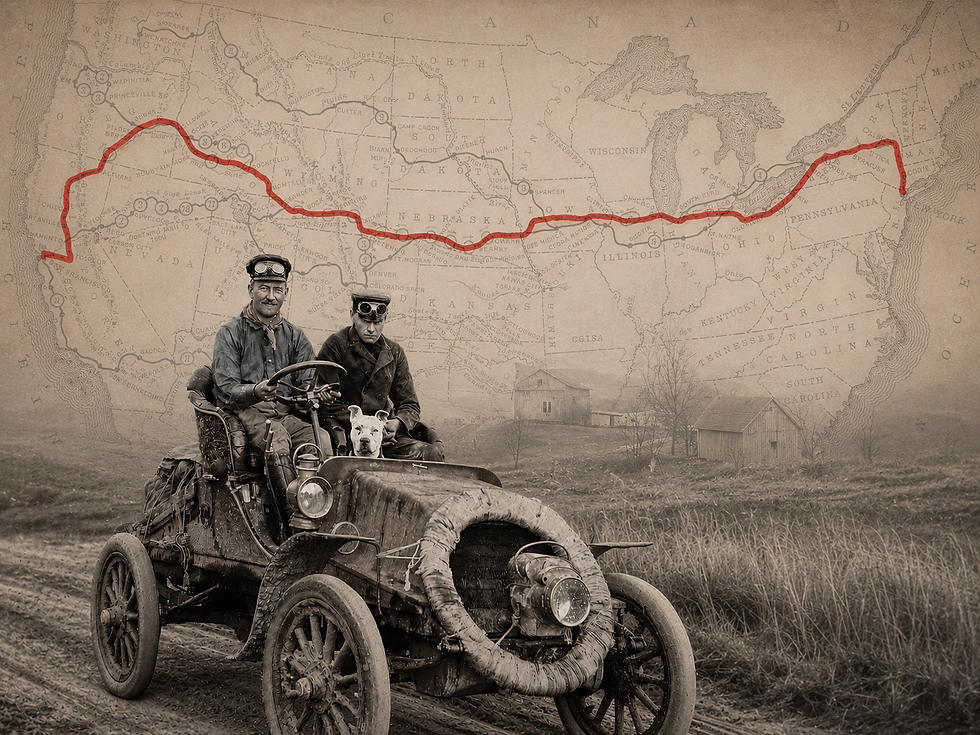
Jackson bought a used 1903 Winton touring car and named it Vermont after his home state. The open touring car produced about 20 horsepower and offered little protection from the weather. Jackson hired Sewall K. Crocker, a 22-year-old mechanic and former professional bicycle racer who had recommended the Winton for the trip.

They loaded the car with tools, spare parts, sleeping bags, blankets, rubber clothing, weapons, a Kodak camera and whatever fuel and oil they could carry. Bertha sensibly returned east by train.
On the afternoon of May 23, 1903, Jackson and Crocker drove down Market Street, crossed San Francisco Bay by ferry and pointed Vermont toward New York.
They made it about 15 miles beyond Oakland before blowing a tire.
Their only spare was now gone.
America's first road trip was underway.
Meet the Crew

Horatio Nelson Jackson
The Driver
A 31-year-old Vermont doctor and automobile enthusiast who accepted the $50 bet despite owning no car and having little driving experience. Jackson financed the entire expedition and supplied the determination—and money—that kept it moving.

Bud
The Navigator(ish)
A bulldog Jackson bought for $15 in Caldwell, Idaho, roughly three weeks into the trip. Fitted with goggles to protect his eyes from dust, Bud became the crew’s mascot and eventually one of the most recognizable faces of America’s first road trip.

Sewall K. Crocker
The Mechanic
A 22-year-old mechanic and former bicycle racer who recommended the Winton and became the expedition’s mechanical lifeline. Crocker repaired everything from broken engine parts to failed wheel bearings, often improvising fixes far from a proper shop.
There Wasn't Really a Road to Follow
The problem wasn't simply that America's roads were bad. In huge sections of the West, the kind of connected road system a modern driver would recognize effectively didn't exist.
Jackson and Crocker followed wagon trails, asked locals for directions and used railroad lines as navigational guides. When necessary, they drove directly along railroad rights-of-way and over railroad trestles. Beyond the Mississippi, useful road maps were especially scarce.

Jackson also deliberately headed north instead of taking a direct route through Nevada and Utah. Previous attempts had demonstrated how dangerous deep desert sand could be for an early automobile, so Vermont traveled through Northern California, Oregon and Idaho before turning east through Wyoming.
The detour did not make the trip easy.
It merely changed the problems.
The Mountains Tried to End the Trip Early
By May 27, Jackson and Crocker were climbing rough mountain trails in Northern California that had never seen an automobile. They removed boulders by hand, repeatedly repaired the clutch, patched punctured inner tubes and pumped the tires back up manually. Streams often had no bridges, forcing them to simply drive into the water and hope the Winton reached the other side.

One crossing was too deep.
The car became stuck, so Jackson and Crocker stripped off their clothes, waded across with their block and tackle, attached it to a tree and pulled the Winton out with rope.
Their equipment was disappearing almost as quickly as the miles passed. Jackson lost spectacles and a fountain pen. Crocker once crawled under the car to clear a clogged oil line and had roughly two gallons of oil pour over him. He finished the day wearing Jackson's clothes.
Yet when they reached Alturas, California, Jackson was increasingly convinced the car could make it.
The locals weren't so sure what they were looking at. Many had never seen an automobile. Crowds gathered around Vermont wherever it stopped.
That reaction would follow them across the country.

63 Days Across America
May 19 — San Francisco, California
Jackson accepts the $50 wager that he can reach New York by automobile in less than 90 days
May 23 — San Francisco
Jackson and Crocker leave in Vermont, their 20-hp Winton touring car. Fifteen miles beyond Oakland, their first tire blows.
May 24 — Sacramento
After 118 miles, they repair the ignition, buy secondhand tire tubes because new ones aren't available, add an acetylene headlamp and study the limited maps they can find.
May 27–31 — Northern California
They climb narrow mountain trails, remove boulders, ford streams, repair repeated punctures and use block-and-tackle to pull Vermont from a creek. By Alturas, the car has become a local attraction.
Early June — Lakeview, Oregon
Tire trouble strands them while replacements arrive by rail. Jackson notes that some locals have never seen a railroad or traveled more than 50 miles from home; one schoolboy reportedly asks for a holiday just to see the automobile.
June 6 — Oregon Desert
They immediately take a wrong road, then defective batteries leave Vermont stranded. Jackson fires his gun to attract a passing cowboy, who uses his horse and lariats to tow the 20-hp automobile.
June 6–7 — S.L. Ranch
Offered a questionable attic bed, Jackson and Crocker wait until their hosts fall asleep, climb out the window and sleep in horse stalls instead.
June 7–10 — Southeastern Oregon
Their cyclometer is ripped from the car by sagebrush and their reserve gasoline leaks away. Crocker bicycles toward Burns for fuel, gets a puncture and walks much of the journey before returning with gasoline and benzine.
June 10 — Ontario, Oregon
After 19 days, they finally reach a railroad again. New tires and a front spring are waiting at the station.
June 11 — Caldwell, Idaho
After crossing the Snake River, heavy rain turns the roads to mud. They get stuck in a stream, arrive soaked at midnight—and discover they smell terrible because they have run over a skunk.
June 12 — Caldwell
Jackson pays $15 for a bulldog named Bud. Dust bothers Bud's eyes, so he gets his own pair of driving goggles and joins the expedition. The actual goggles survive in the Smithsonian collection.

June 12–15 — Idaho
Bad directions send the travelers another 38 miles out of their way. An air-intake pipe also disappears somewhere along the road, prompting Jackson to contact Winton for replacement parts.
June 15–16 — Idaho
The trio crosses the volcanic landscape now known as Craters of the Moon. In rural communities, locals exchange home-cooked meals for rides in the automobile, which some nickname the "Go-Like-Hell Machine."
June 16 — Soda Springs
The first automobile many residents have ever seen rolls into town. Gambling reportedly stops while people inspect it. Jackson then discovers his coat—with most of his remaining cash—has fallen from the car.
June 17 — Montpelier, Idaho
A front-wheel hub and bearings fail. Crocker borrows bearings from a farmer's mowing machine, and a blacksmith adapts them to the Winton.
June 20–21 — Wyoming
A cloudburst washes out the road. Trying to navigate open country, they zigzag 69 miles out of their way and become completely lost near the Green River.
June 21 — Wyoming
After nearly 36 hours without food, Jackson jokes that he and Crocker are beginning to look suspiciously at Bud. A lone sheepherder eventually feeds them roast lamb and boiled corn; Jackson is so grateful he gives the man a rifle.
June 22 — Wyoming
Vermont sinks deeply into a mud hole. Three Italian laborers help free it after Jackson offers to carry their luggage. Later that day, Jackson and Crocker drive across two rivers using railroad bridges.
June 23–28 — Rawlins, Wyoming
A connecting-rod failure punches through the crankcase cover. They are stranded for five days waiting for Winton parts to arrive by train—and Jackson learns that a Packard team is now chasing him across America.
Late June — Elk Mountain
The repaired Winton encounters some of the trip's steepest terrain. Jackson and Crocker resort to their block-and-tackle 17 times to keep moving.
Early July — Cheyenne and Archer, Wyoming
Another connecting-rod failure stops the car less than an hour outside Cheyenne. A railroad crew tows them to Archer, where Jackson waits for more parts and spends his fourth wedding anniversary away from Bertha.
July 7 — Archer
Replacement parts finally arrive. By now, Packard's team is closing quickly and a factory-backed Oldsmobile has also left San Francisco.
July — The Great Plains
Conditions finally begin improving. Better roads and flatter terrain allow Jackson to put serious mileage behind him, while his two rivals encounter problems of their own.
July 20–21 — Cleveland, Ohio
Vermont reaches the city where it was built. Winton gives the battered car an overnight service and offers Jackson factory support for the remaining journey; he declines.
July 21–23 — Cleveland to Buffalo
Rather than tackle the Alleghenies, Jackson turns northeast toward Buffalo, adding hundreds of miles but avoiding more mountains. Torrential rain prompts him to joke that he may need paddles for the wheels and a rudder for the car.
Late July — New York State
East of Buffalo, Vermont hits a hidden obstruction at roughly 20 mph and throws Jackson, Crocker and Bud into the air. Nobody is seriously hurt, and the car keeps going.
July 25 — Hudson Valley
Cheering crowds greet the travelers as they head south. At Peekskill, reporters, Winton officials and Bertha Jackson join them for the final miles.
July 26 — New York City
At 4:30 a.m., Jackson, Crocker and Bud enter Manhattan.
63 days, 12 hours and 30 minutes after leaving San Francisco, they have done it.
The Road Trip Got Weird
The mechanical failures tell only half the story. In 1903, simply seeing an automobile could be an event.
A woman reportedly deliberately misdirected Jackson and Crocker so relatives farther down the road would get a chance to see a car. Cowboys used horses and lariats to rescue Vermont. Ranch families traded food for rides. In one Idaho town, gambling stopped when the automobile arrived. One Oregon traveler apparently mistook the approaching Winton for a train that had somehow left the tracks and hid beneath his wagon.
Then there were the smaller indignities: Jackson repeatedly lost his glasses as the car bounced along; Crocker was covered in engine oil; they slept in horse stalls rather than questionable bedding; their gasoline leaked away; they ran over a skunk immediately before checking into a hotel; Jackson lost his coat and cash; and a piece of farm machinery eventually became part of America's first transcontinental automobile.
Bud became a celebrity in his own right. He rode at the front of the Winton wearing goggles to protect his eyes from dust and eventually appeared with Jackson and Crocker in some of the trip's most famous photographs. Jackson joked that Bud was the only member of the trio who completed the journey without swearing.
By the time the travelers reached the East, crowds and newspapers were waiting for them.
The automobile itself had become the attraction.
Then It Became a Race
Jackson's trip began as a private bet.
It didn't stay that way.
On June 20, while Jackson was lost in Wyoming, Tom Fetch and Marius Krarup left San Francisco in a 12-hp 1903 Packard Model F. Unlike Jackson's improvised adventure, Packard's expedition had been planned for months. Fetch was a company test driver; Krarup was a journalist for Automobile Magazine. Their itinerary had been mapped in advance, supplies were positioned along the route, luggage traveled ahead by train, and a Packard machinist provided additional support.

Packard wasn't merely trying to cross America.
It was staging a publicity campaign.
And it worked—almost too well.
Fetch and Krarup moved roughly twice as many miles per day as Jackson during part of the chase. By early July, despite leaving nearly a month later, they had closed the gap considerably.
But Packard's carefully planned route became its own problem.
The company's advertising director had routed the car through spectacular sections of Utah and Colorado because the scenery would produce better publicity photographs. The result was brutal terrain through canyons and the Rockies. The man responsible later admitted that he had prioritized publicity over practicality.
The supposedly organized corporate expedition had made the same basic mistake Jackson repeatedly made:
It chose the wrong road.

And Then Oldsmobile Joined In
On July 6, a third car left San Francisco.
Experienced motorists and mechanics Lester Whitman and Eugene Hammond set off in a much smaller 1902 Oldsmobile Curved Dash Runabout, another manufacturer-backed attempt to claim the transcontinental prize.

Now there were three cars racing east.
The Oldsmobile initially moved quickly across the Sierra Nevada and into Nevada, but breakdowns soon destroyed its momentum. At one point, a failed component left the little Oldsmobile capable of moving in reverse but not forward.
Jackson suddenly had a lead worth protecting.

The First One to New York
At 4:30 on the morning of July 26, Vermont crossed into Manhattan.
The final tally was extraordinary: approximately 5,600 miles, 63 days, 12 hours and 30 minutes, and $8,000 of Jackson's own money. PBS's account puts the fuel consumption at about 800 gallons of gasoline; Atlas Obscura's later retelling gives 600 gallons, so the surviving secondary accounts conflict on that figure. The $8,000 total included the car, Crocker's salary, fuel, food, lodging, tires, replacement parts and even the $15 paid for Bud.
Jackson had also lost about 20 pounds.
The New York Herald described the Winton as mud-covered and battered after its 5,600-mile journey. The car had a broken mudguard and sprung front axle, but it had made it.
And the $50?
Jackson never collected it.

What Happened to Packard and Oldsmobile?
Packard did eventually reach New York.
Fetch and Krarup arrived roughly two weeks after Jackson. Ironically, their total elapsed crossing time was about a day and a half shorter than Jackson's—but because they had left San Francisco nearly a month later, they were still second across the country. A fleet of Packards escorted them into New York.
Oldsmobile came third.
Whitman and Hammond reached New York on September 17, after 73 days on the road. They then continued north to Boston and dipped the Oldsmobile's front wheels into the Atlantic, allowing the company to claim the publicity-friendly distinction of the first "sea-to-sea" automobile crossing.
By the end of 1903, three automobiles had crossed the United States.
The question was no longer whether it could be done.
It was how quickly it could be done.
The Trip Wasn't Even Over
After conquering the continent, Jackson still had to get home.
On July 30, he and Bertha—with Bud aboard—left New York in Vermont for Burlington. Naturally, the car continued breaking.
The low-speed clutch failed in Hudson. The high-speed clutch failed in Albany. A breaker box failed in Middlebury. Near Burlington, Jackson's brothers came out in another automobile to escort him home—and their car broke down instead.
Jackson hooked their disabled car to Vermont and towed them the final miles.
Then came the perfect ending.
On August 7, Jackson finally pulled into his stable in Burlington. As Vermont crossed the threshold, its drive chain—one of the few major components that had survived the entire transcontinental trip without failing—snapped in two.
Two months later, Jackson was back behind the wheel.
On October 3, 1903, the man who had just driven across an entire continent was arrested in Burlington and fined $5 plus court costs for exceeding the local six-mile-per-hour speed limit.
What Happened to Vermont?
Jackson kept the Winton for decades and eventually donated it to the Smithsonian in 1944.
The original 1903 Winton Vermont survives in the collection of the Smithsonian's National Museum of American History, along with Bud's tiny driving goggles.

Its importance goes well beyond being an old car that survived.
Jackson, Crocker and Bud had demonstrated that an automobile could provide something the railroad could not: individual freedom over enormous distances. The Smithsonian credits the pioneering journey with helping change Americans' perception of long-distance automobile travel; within a decade, serious plans for coast-to-coast highways were underway.
In 1903, driving across America sounded ridiculous.
By the end of that same year, three cars had done it.
Within a generation, Americans would be packing their own cars, choosing their own destinations and heading across the country simply because they could.
Jackson spent $8,000 to win a $50 bet he never collected.
What he actually proved was worth considerably more: America could be driven.


Comments