
10 Dead Car Brands: Their First Cars, Last Cars, and Why They Disappeared
.png/v1/fill/w_320,h_320/file.jpg)
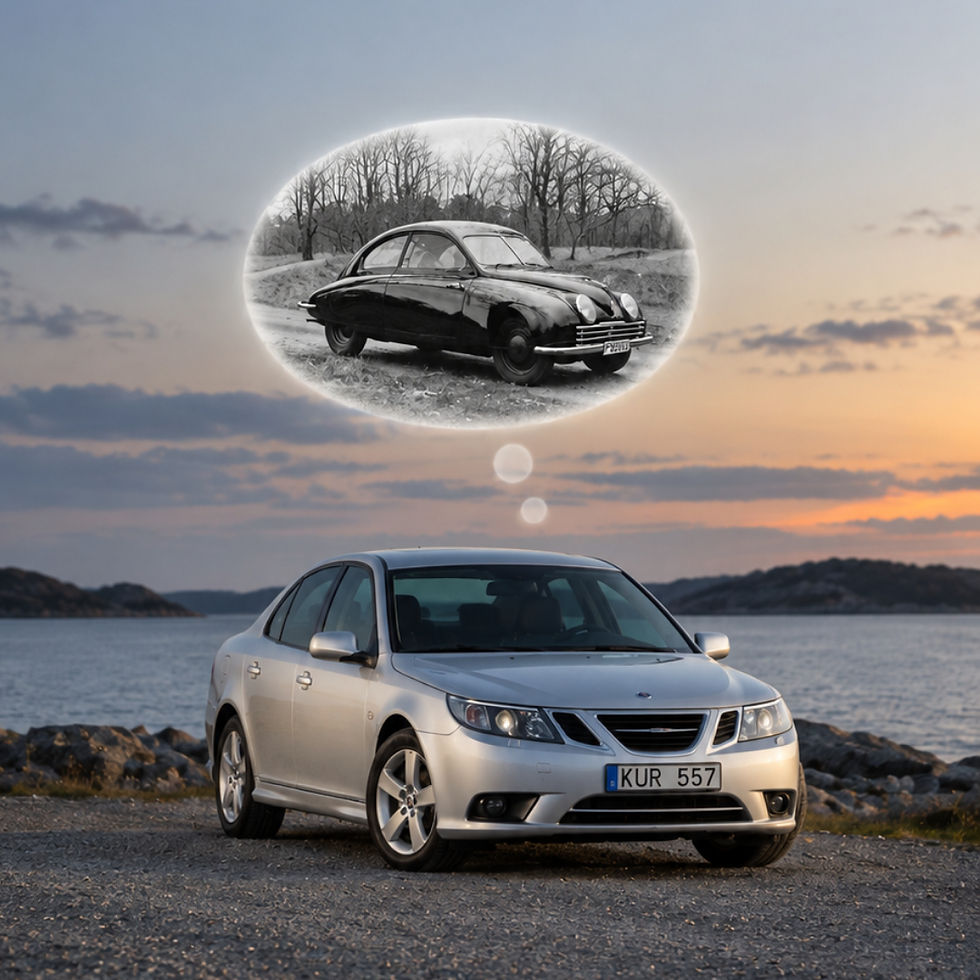
Some of the biggest names in automotive history are no longer around. Pontiac, Saab, Plymouth, Packard, and Oldsmobile were once fixtures of the industry, each with its own identity, loyal following, and place in the market. Today, they exist primarily in museums, private collections, and the memories of enthusiasts.
Not every brand disappeared because it built bad cars. Some were casualties of corporate restructuring, others struggled to compete with larger manufacturers, and several simply became too similar to the brands sitting beside them in the showroom.
What's particularly fascinating is how dramatically some of these manufacturers changed between their first and final vehicles. A company that began building luxury automobiles might end its existence selling rebadged economy cars. Another might spend a century developing engineering innovations, only to disappear amid financial trouble.
Here are ten defunct car brands, the vehicles that started their stories, the cars that brought them to a close, and what ultimately went wrong.
1
Pontiac (1926–2010)
FIRST CAR: 1926 PONTIAC SERIES 6-27 | LAST CAR: 2010 PONTIAC G6
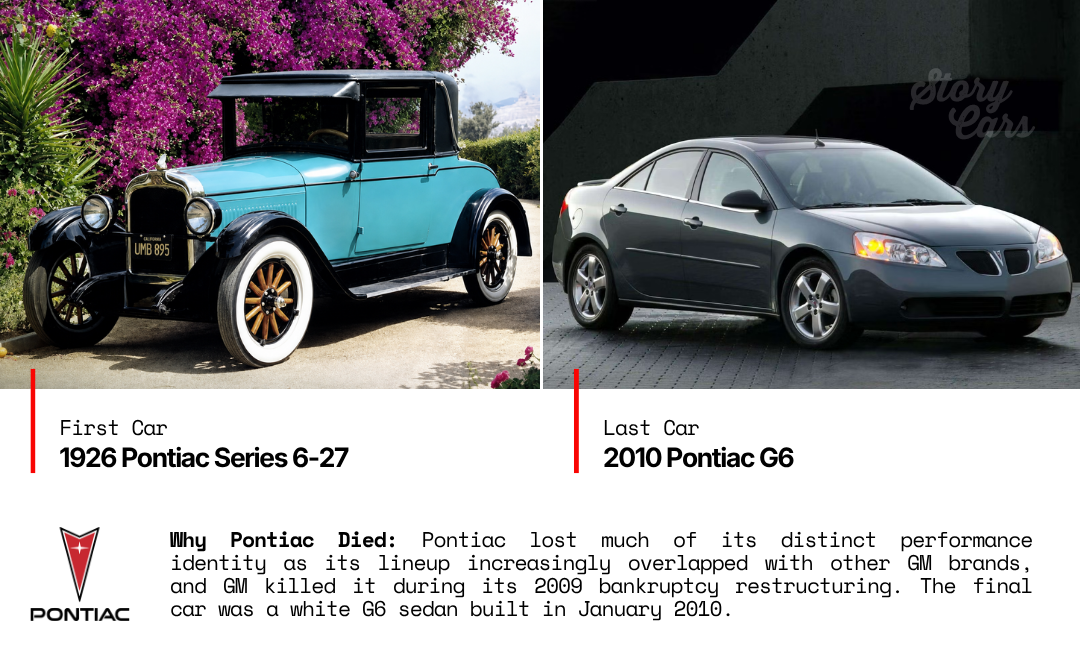
Pontiac arrived in 1926 as a companion brand to General Motors' Oakland division. Its first offering, the Series 6-27, provided six-cylinder performance at a relatively affordable price, immediately establishing Pontiac as an appealing alternative to more expensive cars.
The brand grew so successful that it eventually replaced Oakland entirely. By the 1960s, Pontiac had become one of America's defining performance marques, producing legends like the GTO, Firebird, and Trans Am.
That identity became harder to maintain in later decades. As General Motors increasingly shared platforms, engines, and components across its divisions, Pontiac's products began to overlap with those of Chevrolet, Buick, and other GM brands.
When GM entered bankruptcy restructuring in 2009, Pontiac was among the brands selected for elimination. The final Pontiac, a white G6 sedan, rolled off the assembly line in January 2010.
Why it disappeared: GM's financial crisis ultimately ended Pontiac, but years of declining differentiation had already weakened its position within the company.
2
Saab (1947–2011)
FIRST CAR: 1947 SAAB 92001 “URSAAB” | LAST CAR: 2011 SAAB 9-3
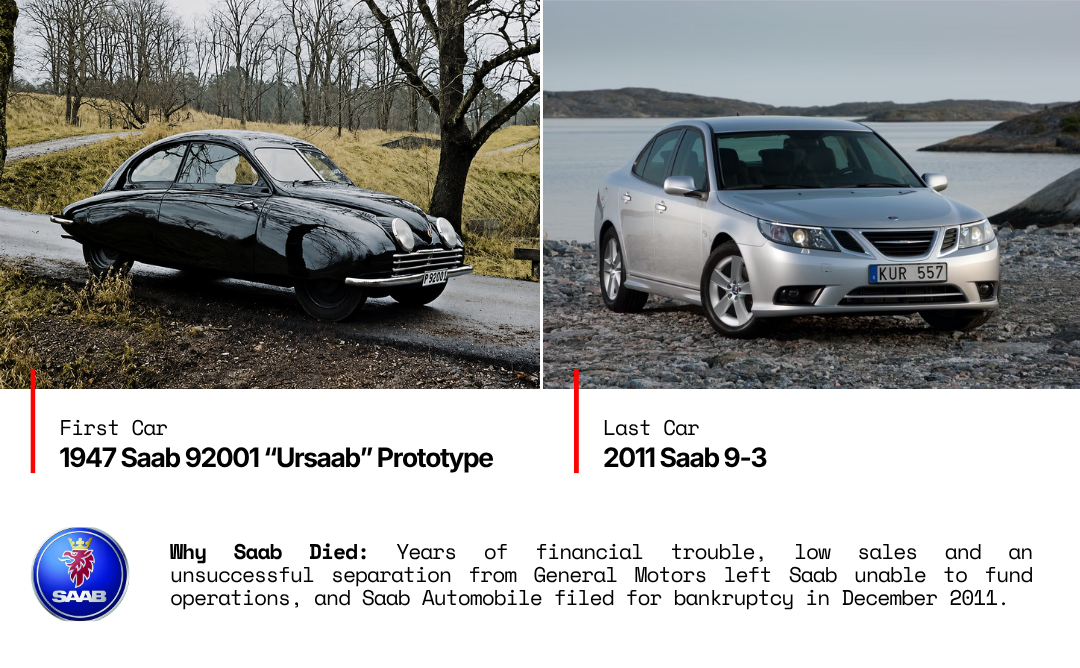
Saab's automotive story began in an unlikely place: the aviation industry.
Originally an aircraft manufacturer, the Swedish company developed its first automobile prototype, the Saab 92001, nicknamed Ursaab, in 1947. Its streamlined body reflected the company's aeronautical background and introduced the unconventional thinking that would become a Saab trademark.
Over the following decades, Saab developed a reputation for distinctive engineering, turbocharged engines, advanced safety features, and designs that rarely followed conventional automotive trends.
But engineering originality wasn't enough to guarantee commercial success.
General Motors acquired full ownership of Saab Automobile in 2000, and the brand struggled with limited sales volumes, aging products, and financial pressure. GM eventually sold Saab to Spyker Cars in 2010, but the new ownership couldn't secure the funding needed to sustain production.
Saab Automobile filed for bankruptcy in December 2011, bringing an end to the original manufacturer's production of cars such as the 9-3.
Why it disappeared: Low sales, persistent financial difficulties, and an unsuccessful transition away from GM ownership left Saab without the resources to continue building cars.
3
Plymouth (1928–2001)
FIRST CAR: 1928 PLYMOUTH MODEL Q | LAST CAR: 2001 PLYMOUTH NEON
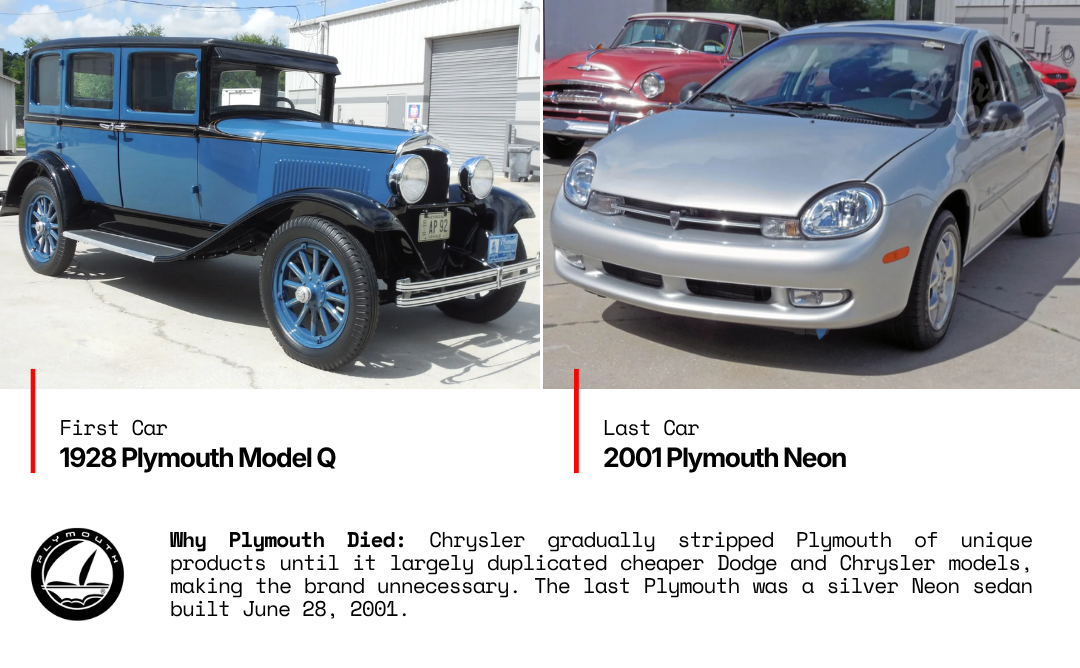
Chrysler introduced Plymouth in 1928 to compete in the affordable automobile market dominated by Ford and Chevrolet.
Its first model, the Plymouth Model Q, helped establish Chrysler in a segment where price and practicality mattered more than prestige. Plymouth became an important part of the company's business and later produced recognizable models including the Barracuda, Road Runner, and Fury.
During the muscle-car era, Plymouth managed to combine affordable transportation with genuine performance credentials.
Unfortunately, its position within Chrysler's lineup gradually became less distinct. As Plymouth models increasingly shared their platforms and identities with Dodge and Chrysler vehicles, the company struggled to justify maintaining another brand.
Chrysler announced Plymouth's discontinuation in 1999, and the final Plymouth, a silver Neon sedan, was built on June 28, 2001.
Why it disappeared: Plymouth lost its distinct role as Chrysler consolidated its brands and reduced the number of overlapping vehicles in its portfolio.
4
Austin (1905–1980s)
EARLY CAR: 1906 AUSTIN 25/30 HP | FINAL AUSTIN-BADGED LINEUP INCLUDED THE MONTEGO
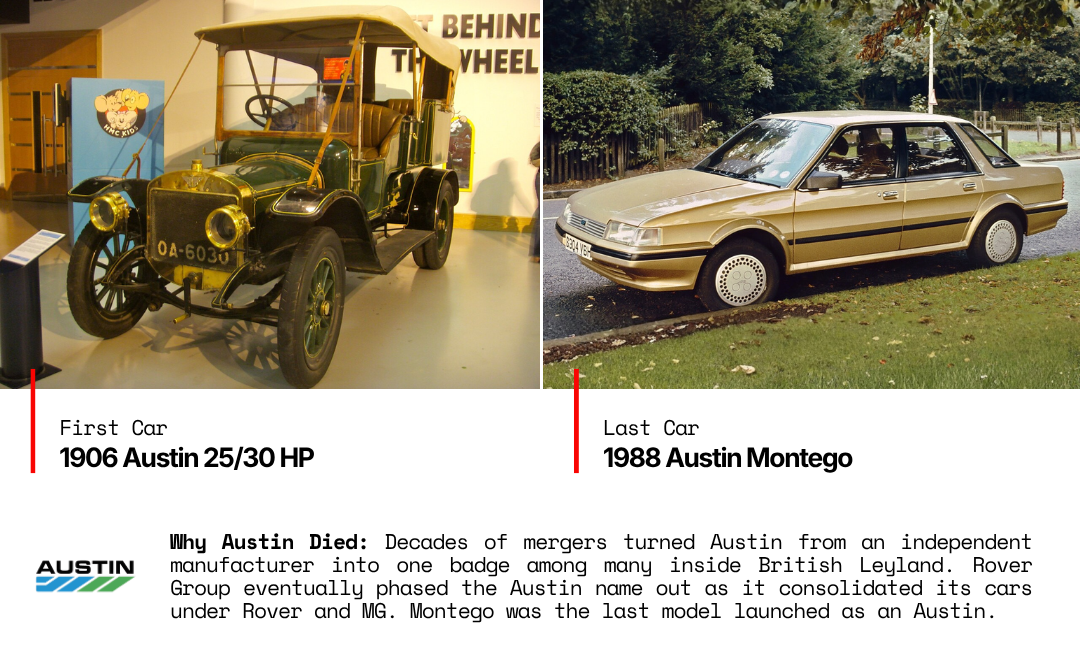
The Austin Motor Company was founded by Herbert Austin in 1905 and quickly became one of Britain's important automotive manufacturers.
Early models such as the 1906 Austin 25/30 HP reflected the industry's transition from experimental motor vehicles into practical, commercially produced automobiles.
Austin's influence expanded enormously during the twentieth century, particularly with the Austin Seven, which helped bring affordable motoring to Britain and inspired licensed or related vehicle production abroad.
The company later became part of the British Motor Corporation and eventually the sprawling British Leyland organization, where numerous historic British marques were brought under common ownership.
By the 1980s, Austin was no longer the independent force it had once been. The Austin Montego, introduced in 1984, was among the final new models to carry the name, although production of some Austin-badged cars continued afterward.
The Rover Group progressively abandoned Austin branding as it reorganized its passenger-car business around Rover and MG.
Why it disappeared: Corporate mergers, overlapping brands, and a changing product strategy gradually eliminated Austin's independent identity.
5
American Motors Corporation (1954–1988)
EARLY AMC-ERA CAR: 1958 RAMBLER AMERICAN | FINAL MODEL: 1988 AMC EAGLE WAGON
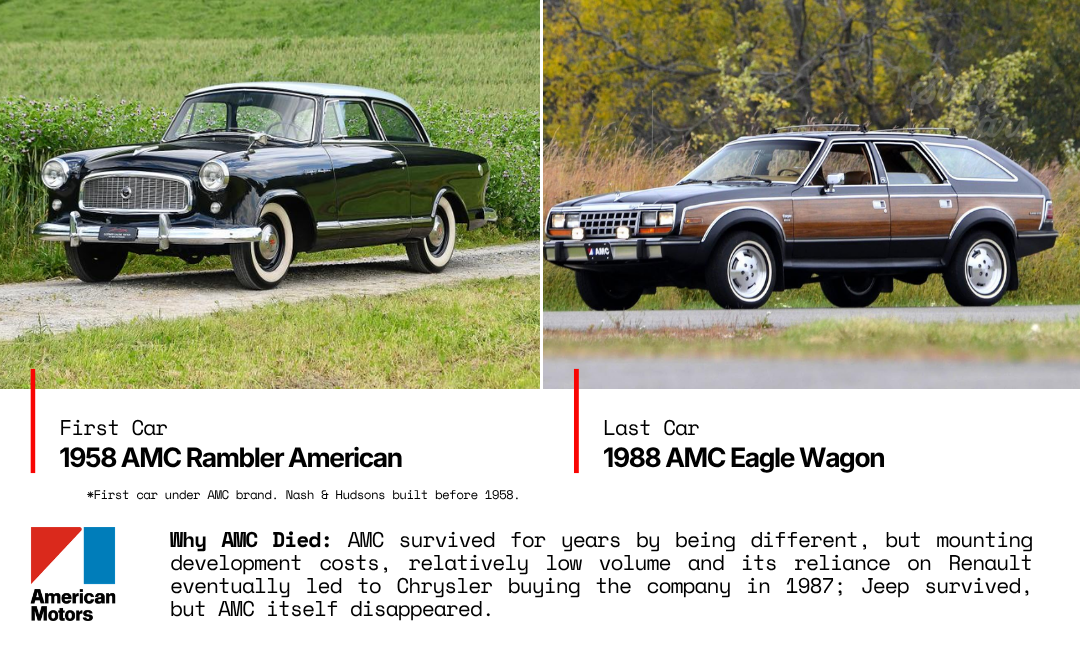
American Motors Corporation, better known as AMC, was formed in 1954 through the merger of Nash-Kelvinator and Hudson Motor Car Company.
Rather than competing directly with Detroit's Big Three on size and production volume, AMC frequently pursued unconventional products and underserved market segments.
The Rambler American, introduced in 1958, represented the company's emphasis on smaller, affordable vehicles at a time when many American manufacturers were concentrating on increasingly large cars.
AMC later produced memorable vehicles including the AMX, Javelin, Gremlin, and Pacer. Its Eagle, introduced for 1980, combined passenger-car comfort with four-wheel-drive capability years before modern crossover SUVs became commonplace.
Despite its innovative products, AMC struggled to finance the development of competitive new vehicles. Its relationship with Renault provided additional resources but couldn't resolve its long-term challenges.
Chrysler acquired AMC in 1987, primarily gaining its valuable Jeep operations. The AMC name was retired, while production of the Eagle wagon continued into 1988.
Why it disappeared: Limited production volume, rising development costs, and sustained financial pressure left AMC unable to remain independent. Jeep survived the acquisition, but the AMC brand did not.
6
Packard (1899–1958)
FIRST CAR: 1899 PACKARD MODEL A | LAST DETROIT-BUILT PACKARDS: 1956, INCLUDING THE PATRICIAN
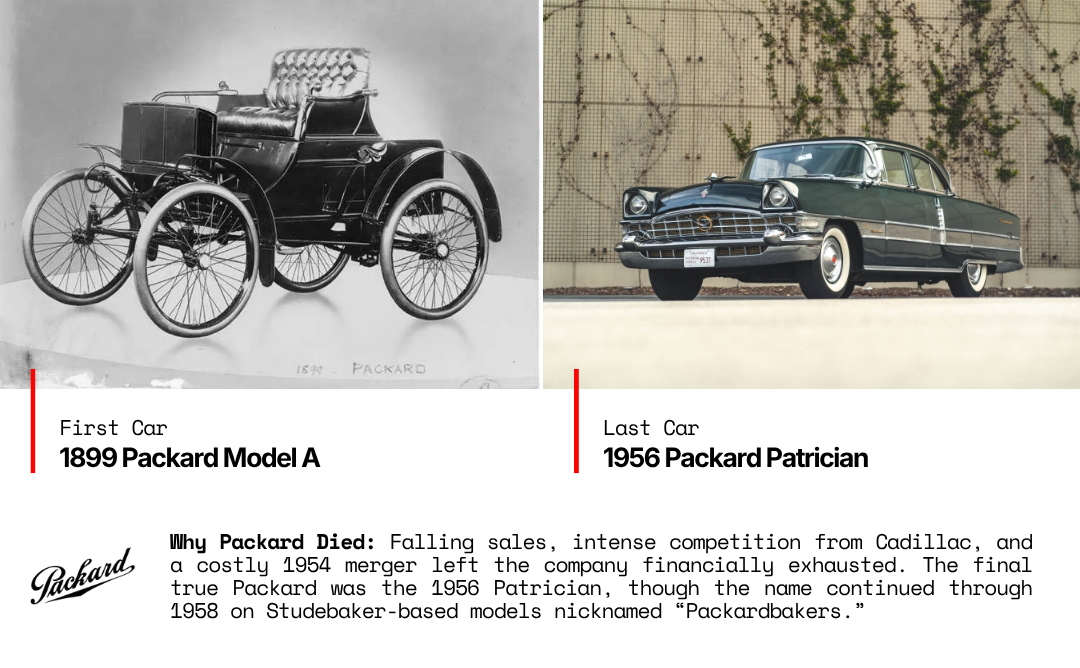
Packard was once among the most respected names in American luxury automobiles.
Founded in 1899, the company began with the Packard Model A, a remarkably early automobile that helped establish the brand's reputation for engineering quality and refinement.
During the first half of the twentieth century, Packard competed in the upper reaches of the luxury market, producing prestigious vehicles favored by wealthy customers, celebrities, and government officials.
Its slogan, “Ask the Man Who Owns One,” became one of the best-known advertising lines in automotive history.
However, the luxury market changed dramatically after World War II. Cadillac benefited from General Motors' enormous production scale, extensive dealer network, and resources for developing new technology.
Packard struggled to maintain its competitive position. Its 1954 merger with Studebaker was intended to improve both companies' prospects but ultimately failed to provide lasting financial stability.
The final Detroit-built Packards appeared in 1956, including the Patrician. The Packard name continued through 1958 on vehicles largely derived from Studebaker designs, earning the nickname “Packardbakers” among enthusiasts.
Why it disappeared: Declining sales, increasing competition from Cadillac, and an unsuccessful merger brought an end to one of America's most prestigious luxury marques.
7
Oldsmobile (1897–2004)
FIRST VEHICLE: 1897 OLDSMOBILE | LAST CAR: 2004 OLDSMOBILE ALERO
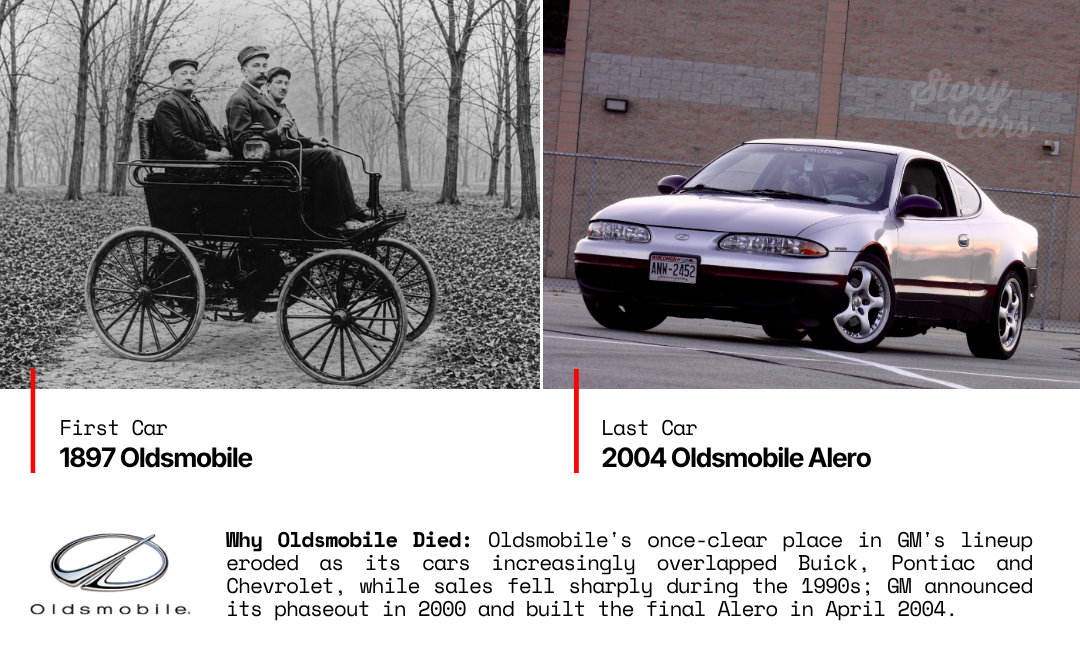
Few automotive brands could claim a history as long as Oldsmobile.
Founded by Ransom E. Olds in 1897, the company was among America's earliest automobile manufacturers. Its first experimental automobiles preceded the famous Curved Dash Oldsmobile, introduced in 1901, which became an important early mass-produced vehicle.
Oldsmobile joined General Motors in 1908 and subsequently played a significant role in developing technologies that shaped the American automotive industry.
The marque introduced the Hydra-Matic automatic transmission in 1940 and the influential Rocket V8 engine in 1949. Later models, including the 442, Cutlass, and Toronado, helped build a reputation for combining performance, comfort, and innovation.
But by the 1990s, Oldsmobile faced a familiar problem within GM: customers increasingly struggled to understand what distinguished it from Buick, Pontiac, and Chevrolet.
Sales declined, and attempts to modernize the brand were unable to reverse its fortunes.
GM announced Oldsmobile's phaseout in December 2000. The final vehicle, an Alero sedan, was completed in April 2004.
Why it disappeared: Declining sales and increasing overlap with other GM divisions made Oldsmobile difficult to sustain, despite more than a century of automotive history.
8
Studebaker (1902–1966)
FIRST CAR: 1902 STUDEBAKER ELECTRIC | LAST CAR: 1966 STUDEBAKER CRUISER
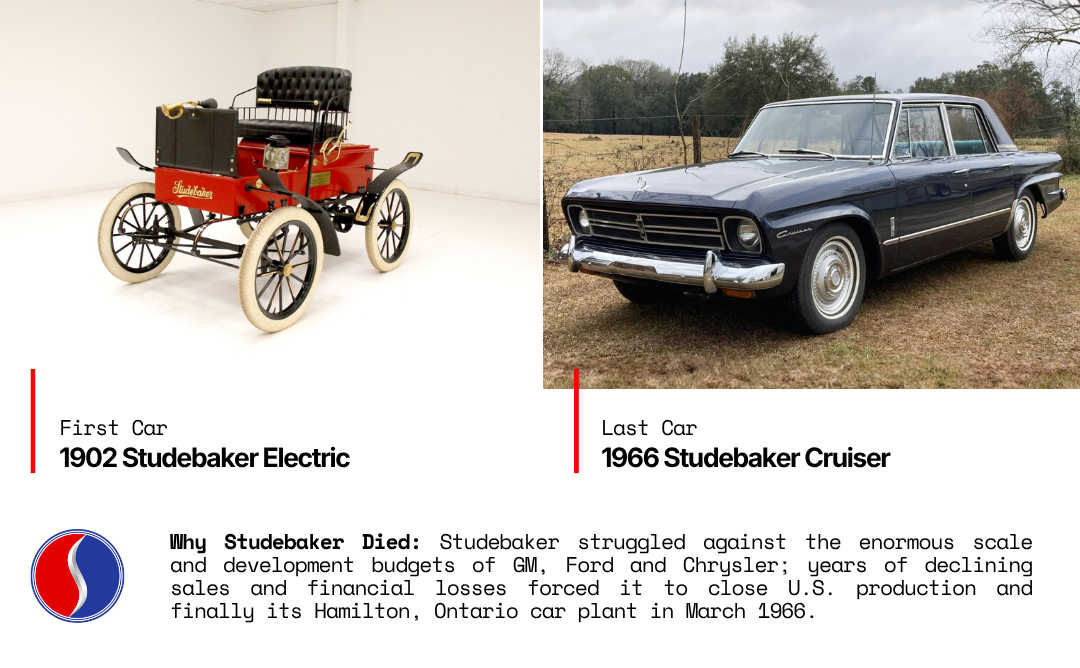
Studebaker's history stretches back even further than the automobile itself.
Founded in 1852, the company originally manufactured wagons and horse-drawn vehicles before entering the automotive industry in 1902 with an electric automobile.
Yes, one of America's oldest automotive manufacturers began building electric cars more than a century before the modern EV revolution.
Studebaker later transitioned to gasoline-powered vehicles and became a significant American manufacturer, producing everything from affordable family cars to distinctive designs such as the Commander, Champion, and Avanti.
Its styling was frequently ahead of its time, but the company faced mounting financial disadvantages as GM, Ford, and Chrysler expanded their operations.
Studebaker merged with Packard in 1954, yet the combined business continued struggling.
American production ended in South Bend, Indiana, in December 1963. Manufacturing continued in Hamilton, Ontario, until March 1966, when the last Studebaker, a Cruiser sedan, rolled off the assembly line.
Why it disappeared: Studebaker couldn't consistently match the production efficiency, development spending, and pricing power of America's three largest automakers.
9
Triumph (1923–1984)
FIRST CAR: 1923 TRIUMPH 10/20 | LAST CAR: 1984 TRIUMPH ACCLAIM
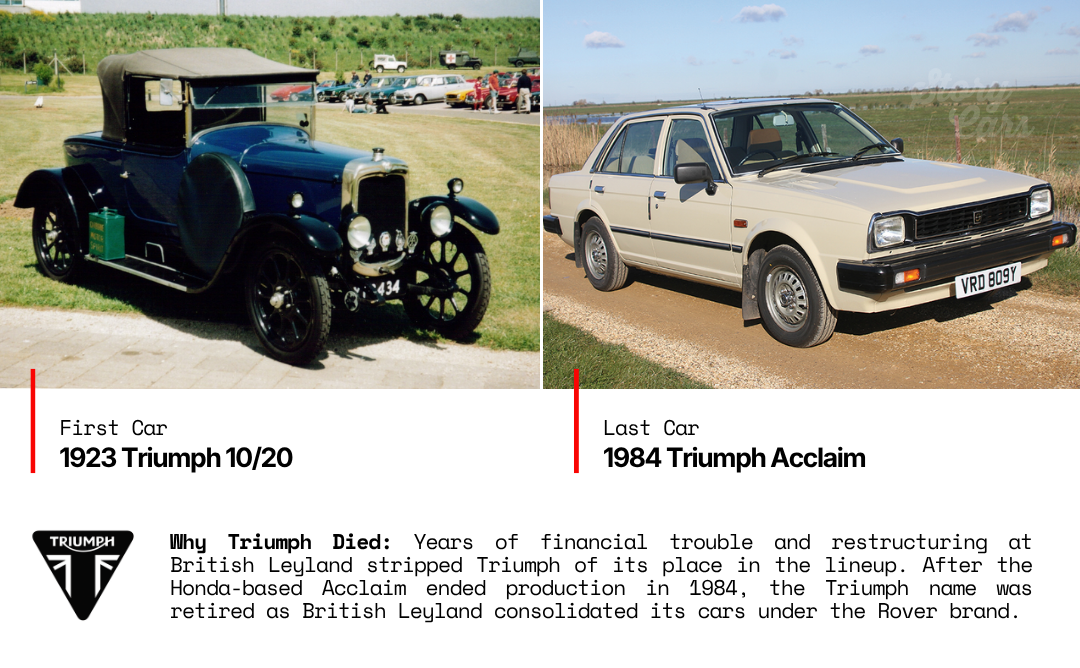
For generations of sports-car enthusiasts, Triumph represented an accessible introduction to British open-top motoring.
The company's automotive origins date to 1923 with the Triumph 10/20, although the Triumph business itself had begun decades earlier as a bicycle manufacturer.
Triumph eventually became closely associated with lightweight sports cars, producing celebrated models including the TR2, TR3, TR4, TR6, Spitfire, and Stag.
These vehicles helped establish the international appeal of British sports cars, particularly in the United States, where Triumph developed an enthusiastic customer base.
However, financial troubles and corporate restructuring progressively changed the brand's direction.
After becoming part of British Leyland, Triumph increasingly lost its individual identity within an organization already managing numerous competing brands.
Its final production model, the Triumph Acclaim, was introduced in 1981. Developed through a partnership with Honda, the Acclaim was based on the Honda Ballade and represented a considerable departure from the sports cars that had defined Triumph's reputation.
Production ended in 1984, and the Triumph name disappeared from new passenger cars.
Why it disappeared: Financial pressure, British Leyland's restructuring, and a shift toward the Rover brand ended Triumph's long history as an automobile manufacturer.
10
Mercury (1938–2011)
FIRST CAR: 1939 MERCURY EIGHT | LAST CAR: 2011 MERCURY GRAND MARQUIS
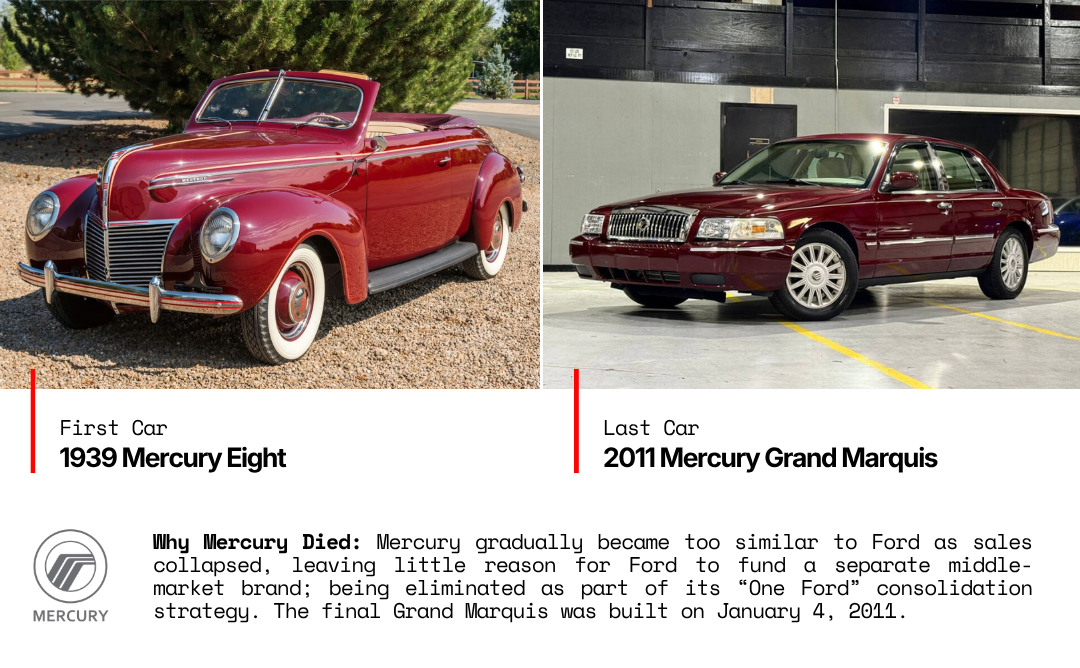
Ford established Mercury in 1938 to fill the gap between its mainstream Ford models and its more prestigious Lincoln automobiles.
The first Mercury Eight arrived for the 1939 model year, offering a larger, more refined alternative to a typical Ford without approaching Lincoln's luxury pricing.
Over the following decades, Mercury developed its own recognizable identity, producing vehicles like the Cougar, Marauder, Monterey, and Grand Marquis.
The Cougar in particular became an enduring part of the pony-car era, while the Grand Marquis built a loyal following among customers seeking traditional American sedans.
By the 2000s, however, Mercury had become increasingly difficult to distinguish from Ford.
Many Mercury vehicles shared their underlying engineering with Ford models, often featuring relatively modest differences in styling, equipment, and pricing.
As sales declined, Ford decided to discontinue Mercury and concentrate its investment on the Ford and Lincoln brands.
The final Mercury, a Grand Marquis sedan, was manufactured on January 4, 2011.
Why it disappeared: Declining demand and insufficient differentiation from Ford made Mercury an unnecessary middle-market division within Ford's streamlined brand strategy.
Why Do So Many Historic Car Brands Disappear?
Despite their vastly different histories, these ten manufacturers illustrate several recurring patterns in the automotive industry.
Brand identity matters. Pontiac, Plymouth, Oldsmobile, and Mercury all struggled when their vehicles became too similar to those offered by their parent companies. Without a clear reason for customers to choose one badge over another, the business case for maintaining separate brands became harder to justify.
Innovation doesn't guarantee survival. Saab and AMC developed distinctive products and pursued ideas that sometimes anticipated broader industry trends. But original engineering alone couldn't compensate for insufficient sales and financial resources.
Scale can determine survival. Companies like Studebaker and Packard faced competitors with vastly greater manufacturing capacity, research budgets, and distribution networks. Even respected products couldn't always overcome those disadvantages.
Corporate decisions can end a brand before its products become irrelevant. Austin and Triumph gradually disappeared through mergers and restructuring, while Jeep demonstrated that a successful product family could survive even after its parent manufacturer ceased to exist.
And then there's the difference between a company and its name. Some manufacturers ceased producing vehicles years before their corporate operations ended. Others continued using historic badges on products substantially different from those that originally established their reputations.
These distinctions make automotive history considerably more complicated than simply identifying the first and last cars to wear a particular emblem.
The Cars Are Gone. The Legacies Aren't.
It's easy to look at these manufacturers as failures, but that overlooks the enormous influence many had on the automotive industry.
Packard helped define American luxury. Oldsmobile helped popularize automatic transmissions. Studebaker explored electric mobility at the dawn of the automobile. AMC experimented with concepts that foreshadowed modern crossovers, and Saab demonstrated how an unconventional engineering philosophy could build a remarkably devoted following.
Even brands that disappeared through corporate consolidation left behind designs, technologies, and enthusiast communities that remain relevant decades later.
Their final vehicles weren't necessarily their greatest achievements. In some cases, they barely resembled the cars that originally made their manufacturers famous.
But that's what makes comparing their beginnings and endings so interesting: every badge has a story, and not every story gets a happy ending.
Which of these ten car brands deserved another chance? And if you could bring one back today, which would you choose?


Comments